

Evolution Of Manufacturing From Industry 1 0 To Industry 4 0 AI In Manufacturing




Try Before you Buy Download Free Sample Product
 Impress Your
 Audience
 100%
100% Editable
 Save Hours
 of Time


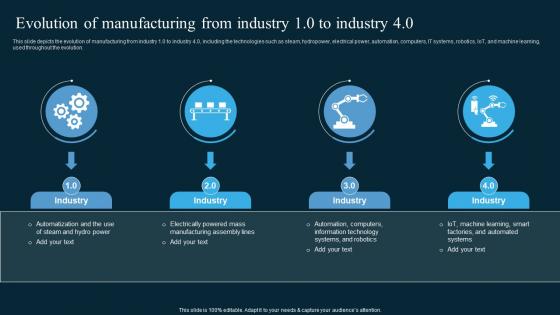
This slide depicts the evolution of manufacturing from industry 1.0 to industry 4.0, including the technologies such as steam, hydropower, electrical power, automation, computers, IT systems, robotics, IoT, and machine learning, used throughout the evolution.
People who downloaded this PowerPoint presentation also viewed the following :
Evolution Of Manufacturing From Industry 1 0 To Industry 4 0 AI In Manufacturing with all 9 slides:
Use our Evolution Of Manufacturing From Industry 1 0 To Industry 4 0 AI In Manufacturing to effectively help you save your valuable time. They are readymade to fit into any presentation structure.








FAQs for Evolution Of Manufacturing From Industry 1 0 To Industry 4 0
Key milestones include the assembly line revolution, automation integration, computer-aided manufacturing, lean production methodologies, and Industry 4.0 digitalization. These transformative phases have streamlined production processes, enhanced quality control, and minimized waste across automotive, electronics, and pharmaceutical sectors, with many manufacturers finding that strategic adoption ultimately delivers competitive advantage and operational efficiency in increasingly complex markets.
Automation has transformed manufacturing by streamlining production lines, reducing manual labor requirements, and enhancing precision through robotics, AI-driven quality control, and predictive maintenance systems. These technologies enable manufacturers to achieve faster production cycles, minimize defects, and optimize resource allocation, with automotive and electronics industries finding significantly improved operational efficiency and competitive advantage.
Emerging technologies like AI and IoT revolutionize modern manufacturing through predictive maintenance, real-time monitoring, automated quality control, supply chain optimization, and intelligent resource allocation. These systems streamline production by reducing downtime, enhancing precision, and enabling data-driven decisions, with automotive and electronics manufacturers finding significantly improved efficiency and competitive advantage.
The shift towards sustainable practices has revolutionized manufacturing strategies by driving circular economy adoption, renewable energy integration, waste reduction initiatives, and supply chain transparency requirements. These changes enable manufacturers to reduce operational costs, meet regulatory compliance, attract environmentally conscious consumers, and gain competitive advantage, with many organizations finding that sustainable practices ultimately enhance profitability while minimizing environmental impact.
Globalization has transformed manufacturing through supply chain diversification, offshore production strategies, technology transfer acceleration, and market access expansion across multiple continents. This evolution enables companies to optimize costs while accessing specialized expertise, with automotive and electronics industries leveraging global networks to enhance competitiveness and deliver innovative products efficiently.
Manufacturers face integration complexities with legacy systems, substantial upfront investment costs, cybersecurity vulnerabilities, and workforce skill gaps requiring extensive retraining. While these challenges present initial hurdles, many companies find that strategic phased implementation across production lines, quality control, and supply chain management ultimately delivers enhanced operational efficiency and competitive advantage in increasingly automated markets.
SMEs can adapt to manufacturing evolution by embracing automation technologies, implementing lean production methods, investing in digital tools like IoT sensors, and forming strategic partnerships with larger manufacturers. These approaches enable smaller manufacturers to streamline operations, reduce costs, and enhance quality control, with many finding that targeted technology investments deliver competitive advantages previously available only to large-scale operations.
Just-in-time production minimizes inventory costs, reduces waste, enhances operational efficiency, and accelerates response times to market demands. This strategic approach enables manufacturers across automotive, electronics, and consumer goods sectors to streamline supply chains, optimize resource allocation, and deliver faster customer fulfillment, ultimately providing significant competitive advantage in increasingly dynamic markets.
Advancements in materials science drive manufacturing innovation by enabling lighter, stronger, and more durable products, reducing production costs, and opening new design possibilities previously impossible with traditional materials. Through smart composites, nanomaterials, and bio-based alternatives, manufacturers in aerospace, automotive, and electronics sectors deliver enhanced performance, sustainability, and competitive advantages while streamlining production processes.
3D printing presents both challenges and opportunities for conventional manufacturing, enabling rapid prototyping, customized production, and reduced inventory costs while requiring new skills and equipment investments. Many manufacturers find that integrating additive manufacturing with traditional methods streamlines operations, accelerates product development cycles, and delivers competitive advantages in increasingly demanding markets.
Workforce training must evolve through digital simulation platforms, continuous upskilling programs, cross-functional collaboration modules, and adaptive learning technologies that mirror real manufacturing environments. Industries like automotive and electronics are increasingly implementing VR-based training and micro-learning systems, enabling workers to master advanced robotics and AI integration while reducing downtime and enhancing operational efficiency.
**INPUT**: What are the trends in supply chain management that are shaping modern manufacturing? **OUTPUT**: Supply chain management trends include AI-driven demand forecasting, blockchain transparency, IoT-enabled tracking, sustainable sourcing practices, and supplier diversification strategies. These technologies streamline operations by reducing inventory costs, enhancing visibility, and minimizing disruptions, with many manufacturers finding that integrated digital platforms ultimately deliver faster production cycles and improved customer responsiveness. **Word count: 53 words**
Manufacturers are enhancing supply chain resilience through diversification strategies, nearshoring initiatives, digital supply chain visibility platforms, strategic inventory management, and supplier relationship strengthening. These approaches enable companies to reduce single-source dependencies, improve response times to disruptions, and maintain operational continuity, with many automotive and electronics manufacturers finding that regionalized supply networks deliver greater flexibility and risk mitigation.
Governmental regulations significantly shape manufacturing evolution by driving environmental compliance, safety standards, and quality requirements, while simultaneously spurring innovation in cleaner technologies and automated processes. These regulatory frameworks enable manufacturers to streamline operations, enhance worker protection, and accelerate sustainable practices, with many industries finding that compliance ultimately delivers competitive advantages and improved operational efficiency.
The future of remote work in manufacturing combines on-site production with remote monitoring, quality control, predictive maintenance, and administrative functions through IoT sensors, digital twins, and cloud-based systems. While physical production requires on-site presence, manufacturers increasingly enable remote oversight of operations, troubleshooting, and management, ultimately delivering enhanced efficiency and reduced operational costs.
-
Professionally designed slides with color coordinated themes and icons. Perfect for enhancing the style of the presentations.
-
The visual appeal of the templates is just unparalleled! I was so worried about the design of my presentation but SlideTeam made it all so easy.