


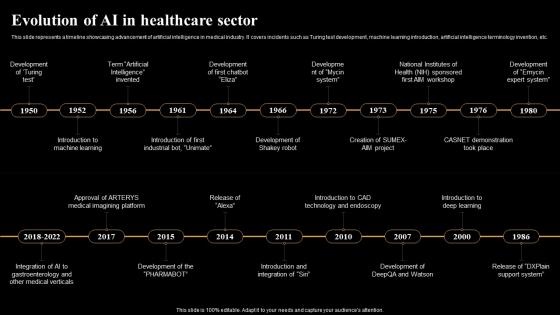
Evolution Of AI In Healthcare Sector Introduction And Use Of AI Tools AI SS




Try Before you Buy Download Free Sample Product
 Impress Your
 Audience
 100%
100% Editable
 Save Hours
 of Time


This slide represents a timeline showcasing advancement of artificial intelligence in medical industry. It covers incidents such as Turing test development, machine learning introduction, artificial intelligence terminology invention, etc.
People who downloaded this PowerPoint presentation also viewed the following :
Evolution Of AI In Healthcare Sector Introduction And Use Of AI Tools AI SS with all 6 slides:
Use our Evolution Of AI In Healthcare Sector Introduction And Use Of AI Tools AI SS to effectively help you save your valuable time. They are readymade to fit into any presentation structure.





FAQs for Evolution Of AI In Healthcare Sector Introduction And Use Of AI
Key milestones include early expert systems in the 1970s, medical imaging breakthroughs in the 1990s, IBM Watson's diagnostic capabilities in 2011, FDA approvals for AI diagnostic tools, and recent deep learning advances in radiology and pathology. These developments have progressively enhanced diagnostic accuracy, streamlined clinical workflows, and accelerated treatment decisions, with hospitals and healthcare systems increasingly finding that AI integration delivers faster patient care and improved outcomes.
Machine learning has revolutionized medical imaging diagnostics by enabling faster, more accurate detection of conditions like cancer, fractures, and neurological disorders through pattern recognition algorithms. Radiology departments in hospitals and imaging centers now achieve significantly improved diagnostic precision, reduced interpretation times, and enhanced early disease detection, ultimately delivering better patient outcomes while streamlining clinical workflows for healthcare professionals.
AI enhances personalized medicine through genomic analysis, predictive modeling, treatment optimization, drug discovery acceleration, and real-time patient monitoring. These technologies enable healthcare providers to tailor therapies based on individual genetic profiles, predict treatment responses more accurately, and adjust medications dynamically, with many hospitals and research institutions finding that personalized approaches significantly improve patient outcomes while reducing adverse reactions.
Natural language processing transforms electronic health records management by automatically extracting clinical insights from unstructured text, standardizing medical terminology, identifying patient risk factors, and streamlining documentation workflows. Through NLP technologies, hospitals and healthcare systems enhance diagnostic accuracy, reduce administrative burden on physicians, and improve patient care coordination, with many medical institutions finding that automated data analysis significantly accelerates treatment decisions and operational efficiency.
AI revolutionizes drug discovery through molecular modeling, predictive analytics, clinical trial optimization, and compound screening acceleration. These technologies streamline research by identifying promising candidates faster, reducing development costs significantly, and enhancing success rates, with pharmaceutical companies like Pfizer and Roche finding that AI-driven approaches cut discovery timelines while delivering more targeted, effective treatments.
AI in patient treatment plans raises ethical considerations including data privacy protection, algorithmic bias prevention, informed consent protocols, treatment transparency requirements, and physician oversight maintenance. These concerns present both challenges and opportunities, with many healthcare institutions finding that strategic AI implementation, combined with robust ethical frameworks and continuous monitoring, ultimately delivers improved patient outcomes while preserving trust and accountability.
AI enhances patient engagement through personalized communication platforms, automated appointment scheduling, medication reminders, virtual health assistants, and predictive analytics for intervention timing. These technologies streamline patient interactions by delivering tailored health content, monitoring compliance patterns, and providing real-time support, with many healthcare systems finding significantly improved adherence rates and patient satisfaction.
Integrating AI tools into healthcare systems presents challenges including data interoperability issues, regulatory compliance requirements, staff training needs, infrastructure limitations, and patient privacy concerns. These obstacles, while significant, increasingly drive innovation in healthcare technology, with many hospitals and medical institutions finding that strategic implementation approaches, phased rollouts, and comprehensive training programs ultimately deliver enhanced patient outcomes and operational efficiency.
Telemedicine is evolving through AI-powered diagnostic tools, predictive analytics, natural language processing for patient interactions, automated scheduling systems, and real-time health monitoring capabilities. These technologies streamline remote consultations by enhancing diagnostic accuracy, personalizing treatment recommendations, and reducing administrative burdens, with many healthcare providers finding that AI-driven telemedicine ultimately delivers faster patient care and improved operational efficiency.
AI significantly streamlines healthcare staff workflows by automating administrative tasks, accelerating diagnostic processes, and enhancing patient care coordination through predictive analytics and smart scheduling systems. These technologies enable nurses and physicians to reduce documentation time, prioritize critical cases more effectively, and focus on direct patient interaction, with many hospitals finding that AI-powered solutions ultimately deliver faster treatment responses and improved operational efficiency.
AI healthcare applications implement robust encryption protocols, HIPAA compliance frameworks, federated learning systems, blockchain verification, and multi-factor authentication controls. These security measures enable hospitals and medical institutions to protect patient records while leveraging AI insights, with many healthcare organizations finding that advanced privacy-preserving technologies ultimately deliver enhanced diagnostic capabilities and regulatory compliance.
AI assists in predicting disease outbreaks and managing public health by analyzing vast datasets from hospitals, social media, and environmental sensors to identify early warning patterns. Through machine learning algorithms, health agencies can forecast epidemic trajectories, optimize resource allocation, and coordinate rapid response strategies, with systems like those used during COVID-19 enabling faster containment and ultimately delivering more effective population health management.
AI adoption in healthcare presents both significant upfront investments and substantial long-term savings through reduced operational costs, minimized diagnostic errors, and streamlined administrative processes. While initial implementation requires capital for technology and training, many hospitals and health systems find that AI ultimately delivers 20-30% cost reductions in areas like radiology workflow and patient management, enhancing overall financial sustainability.
AI enhances mental health diagnosis through natural language processing, sentiment analysis, behavioral pattern recognition, and predictive modeling to identify depression, anxiety, and other conditions. Through chatbots and virtual therapists, healthcare providers streamline patient screening, deliver 24/7 support, and enable early intervention, ultimately improving treatment accessibility while reducing costs for mental health services.
**INPUT**: What future trends in healthcare AI should professionals be aware of? **OUTPUT**: Healthcare AI trends include personalized medicine algorithms, predictive analytics for early disease detection, AI-powered drug discovery, autonomous diagnostic imaging, and intelligent patient monitoring systems. These technologies streamline clinical workflows, enhance diagnostic accuracy, and accelerate treatment development, with many hospitals and research institutions finding that strategic AI integration delivers faster patient outcomes, reduced operational costs, and significant competitive advantages in an increasingly data-driven healthcare landscape.
-
“As you have innovative ideas and they are all customizable, this saves a huge chunk of your time to prepare well-read presentations.”
-
“I've always gotten excellent slides from them and the customer service is up to the mark.”