

Use Of Artificial Intelligence AI In Pharmaceutical Industry




Try Before you Buy Download Free Sample Product
 Impress Your
 Audience
 100%
100% Editable
 Save Hours
 of Time


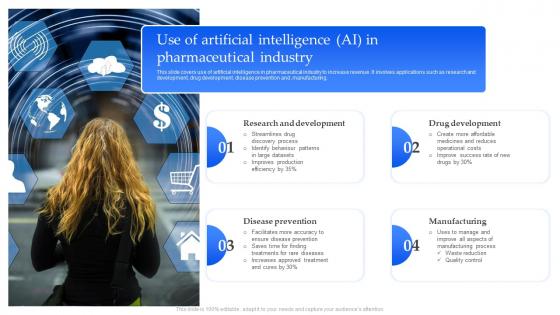
This slide covers use of artificial intelligence in pharmaceutical industry to increase revenue. It involves applications such as research and development, drug development, disease prevention and manufacturing.
People who downloaded this PowerPoint presentation also viewed the following :
Use Of Artificial Intelligence AI In Pharmaceutical Industry with all 6 slides:
Use our Use Of Artificial Intelligence AI In Pharmaceutical Industry to effectively help you save your valuable time. They are readymade to fit into any presentation structure.






FAQs for Use Of Artificial Intelligence AI
Dude, AI is completely changing how drugs get discovered. Instead of taking 10-15 years, we're talking maybe 3-5 years now. Machine learning can actually predict if compounds will work before labs even make them—which honestly blows my mind. You can crunch through massive datasets super fast to spot promising candidates. Plus it helps figure out which patients will actually respond to treatments, so fewer trials bomb. The whole process that used to take years now happens in months. If you're working in pharma, seriously look into AI partnerships. Companies not doing this are gonna get left behind.
Dude, ML is completely changing drug development right now. These algorithms crunch through insane amounts of data - molecular structures, patient genetics, old trial results - and spot patterns we'd never catch. Some models are getting scary accurate at predicting toxicity and figuring out which patients will actually respond to treatments. Honestly, the dosing predictions alone could save pharma companies millions. You should probably get your AI team involved way earlier in development than you think. I know it sounds like overkill, but it'll save you from years of expensive dead ends later.
Ugh, data quality is such a pain - you're basically trying to train AI on garbage half the time. Legacy systems are another headache since they weren't built for this stuff. FDA regulations make everything 10x slower too, which honestly makes sense but still. Finding people who actually get both AI and pharma is like finding a unicorn. Oh and don't even think about going big right away - start with one tiny workflow, prove it works, then expand. Trust me on that one.
So AI speeds up trials in a few ways - predictive algorithms help you find the right patients way faster, plus it automates all that tedious data collection stuff. Machine learning can actually predict which drugs will work before you even test them on people, which is honestly kind of wild when you think about it. Real-time safety monitoring is huge too since it catches problems early. Oh, and you'll spot efficacy signals much sooner than usual methods. My advice? Start small with focused pilots instead of going crazy trying to change everything at once. That approach backfires more often than not.
Honestly, NLP is a game-changer for lit reviews. It'll pull key findings and side effects from hundreds of papers in minutes - stuff that would take you weeks to dig through manually. What's really cool is it catches patterns you'd probably miss, like when only 3 studies out of 500 mention the same rare adverse event. It also helps clean up messy clinical data and spots when studies contradict each other. The summaries it generates are actually pretty decent too. My advice? Start with one therapeutic area first - see if it's worth the hype before you go all in.
Data privacy is huge - patient info needs bulletproof protection when training models. Your algorithms can't make healthcare disparities worse by being less accurate for certain groups. Who takes the blame when AI screws up a drug recommendation? That's still murky territory tbh. Regulators are honestly way behind the tech curve right now. Build diverse datasets from the start. Keep humans in the loop for big decisions. Be upfront about what your AI can and can't do - with everyone, patients included. Transparency saves headaches later.
So AI's getting crazy good at matching treatments to patients by crunching through genetic data, medical records, all that stuff humans can't possibly handle. Now doctors can predict which drugs will actually work based on your genes and lifestyle - honestly some of these predictions are scary accurate. The cool part is pharma companies use this to find smaller patient groups who'll respond to specific treatments, makes their trials way more focused. Oh and if you're doing personalized medicine stuff, definitely check out those AI biomarker platforms. They're pretty much changing everything.
Honestly, AI is turning regulatory compliance into a total headache right now. Black box algorithms? Regulators have no clue how to handle them yet. The FDA keeps pushing for explainable models, which means you're gonna need way more documentation - training data, validation, decision processes, the whole nine yards. It's like trying to hit a moving target tbh. On the flip side, once you nail down the frameworks, AI can actually automate a lot of compliance monitoring and adverse event stuff. My advice? Start digging into the FDA's AI/ML guidance docs. Fair warning though - they update them constantly as everything evolves.
So basically AI can rip through huge drug databases and figure out which existing meds might work for totally different diseases - it analyzes all the molecular patterns way faster than traditional lab work. Machine learning found some diabetes drugs could help with Alzheimer's, which is crazy. The best part? These repurposed drugs already passed safety testing, so you skip like 7 years of trials. Honestly the speed is insane compared to starting from scratch. Check out Atomwise or IBM Watson for Drug Discovery if you wanna dive deeper into this stuff.
Dude, the AI stuff happening in pharma supply chains is actually insane. Demand forecasting got way more accurate - fewer shortages, less crap sitting around expiring. Algorithms track everything from raw materials to shipping hiccups, so procurement teams can see problems coming weeks out. Cold chain monitoring for temperature-sensitive drugs is ridiculously good now too. Routes and inventory levels optimize themselves, which honestly saves a fortune. Oh and the predictive analytics for supply planning? That's probably where you'd want to jump in first if you're not already using it.
So here's the thing - AI can catch bad drug reactions way faster than old-school methods. It scans tons of data from hospital records, social media posts, clinical reports, all in real-time. Pretty crazy stuff. Those subtle patterns humans miss? The algorithms pick them up instantly. We're talking early warnings that usually take months to show up. Once you spot problems early, you can yank dangerous meds from shelves or fix dosing before more people get hurt. My advice? Start with AI tools that work with whatever safety databases you've already got.
Dude, data security is hands down the biggest nightmare for pharma companies trying to use AI. They're sitting on patient info, secret drug recipes, clinical trial data - stuff that's worth millions if it leaks. HIPAA and GDPR make everyone paranoid about cloud solutions too. One breach and you're looking at huge fines plus your reputation is toast. My old boss used to say pharma moves slower than molasses for good reason. You really need AI vendors who can do on-premise setups and have bulletproof encryption. Don't cut corners here - spend the extra time vetting them properly.
So basically, machine learning can spot patterns in how patients refill prescriptions and show up to appointments - even tracks smartphone data if they're into that. It flags people who'll probably skip doses before they actually do it. Pretty neat, honestly. The system learns as it goes, which is the best part. Different patients need different nudges too - some want texts, others prefer calls from their pharmacy or app alerts. Oh, and you gotta build this into your workflow early on. Don't wait until someone's already missing doses to react.
Yeah, there's definitely a massive surge in AI partnerships for drug discovery right now. Google, Microsoft, NVIDIA - they're all jumping into bed with big pharma companies. It's wild how many announcements we're getting weekly! What's interesting is these aren't just quick projects anymore. Companies are doing long-term deals with shared IP agreements and everything. Oh, and definitely watch the real-world evidence space - that's where serious money's going. Personalized medicine partnerships too. Honestly feels like we're hitting a tipping point where this stuff might actually work at scale.
Basically these startups are using AI to figure out which drug compounds will actually work before wasting time in the lab. Pretty smart honestly. Machine learning helps them spot good targets, tweak molecules, even predict how clinical trials might go. The whole process that normally takes like 10-15 years? They're shrinking it down fast. Sure, some companies are probably overhyped - but the legit ones have Big Pharma nervous. Recursion and Atomwise are already getting real results. If you're thinking about investing, look for the ones with actual pharma partnerships. That's how you know they're not just burning cash on fancy algorithms.
-
Innovative and creative templates with high-quality designs. Helped me with my presentation as the slides were easy to edit.
-
I am not the best at presentations but using SlideTeam’s PPT template made it easier for me. Thank you SlideTeam!