


Artificial Intelligence In Agriculture Industry Training Ppt




Try Before you Buy Download Free Sample Product
 Impress Your
 Audience
 100%
100% Editable
 Save Hours
 of Time


These slides depict how the implementation of AI can help increase productivity in agriculture. They also list the advantages of AI in the agriculture sector, such as analyzing market demand, managing risks, protecting crops, and harvesting.
People who downloaded this PowerPoint presentation also viewed the following :
Content of this Powerpoint Presentation
Slide 1
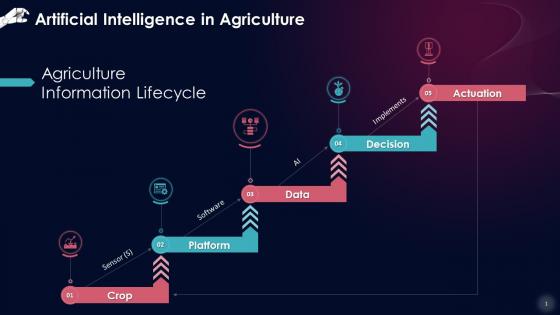
This slide depicts the agriculture information life cycle and how the implementation of AI can be useful in increasing productivity.
Instructor’s Notes: Agriculture entails processes and phases, the majority of which are performed manually. AI can help with the most complex as well as the routine jobs by supplementing existing technology. When integrated with other technologies, it can gather and evaluate massive data on a digital platform, determine the best course of action, and even initiate that action.
Slide 2
This slide lists advantages of AI in the agriculture sector such as analyzing market demand, managing risks, protecting crops, harvesting, etc.
Instructor’s Notes:
- Analyzing Market Demand: AI can make crop selection easier and assist farmers in determining which product is the most profitable
- Managing risks: Forecasting and predictive analytics can help farmers reduce errors in business processes and lower the chance of crop failure
- Breeding seeds: AI can assist in developing crops that are less prone to disease and are better adaptable to environmental conditions by gathering data on plant growth
- Feeding crops: AI can help determine the best irrigation patterns and fertilizer treatment times and predict the best agronomic product mix
- Monitoring soil health: AI systems may perform chemical soil analyses; based on this, reliable estimations of missing nutrients can be provided
- Protecting crops: AI can track the health of plants in order to detect and even predict diseases, identify and eradicate weeds, and make pest control recommendations
- Harvesting: It is possible to automate harvesting and even forecast the ideal time for it with the use of AI
Slide 3
This slide lists applications of Artificial Intelligence in agriculture which is being used to help produce healthier crops, control pests, monitor soil and growing conditions, organize data for farmers, reduce effort, and greater efficiencies a wide range of agriculture-related operations along the food supply chain.
Slide 4
This slide discusses issues associated with the adoption of Artificial Intelligence in the agriculture sector. Some of these problems are lengthy technology adoption process, lack of technical experience, and privacy & security issues.
Instructor’s Notes:
- Lengthy Technology adoption process: Farmers must realize that Artificial Intelligence is a more advanced version of essential technologies for processing, acquiring, and analyzing field data. For AI to function, technological infrastructure is needed. As a result, even the farms with some technology in place may find it difficult to upgrade
- Lack of Technical Experience: The agricultural industry in emerging countries differs from Western Europe and the United States. Artificial Intelligence in agriculture could assist some locations, but it may be challenging to sell it in areas where agricultural technology is not being popular. Farmers and agriculture business owners ready to adopt innovative solutions will need training and continuing support from digital businesses and their products
- Privacy & Security Issues: Precision agriculture and smart farming creates several legal difficulties that often go unanswered because there are no defined policies and regulations surrounding the use of AI, not just in agriculture but in general. Farmers may encounter significant challenges due to privacy and security threats like cyberattacks and data breaches
Slide 5
This slide talks about the scope of Artificial Intelligence and how it can be combined with other technologies to help agriculture.
Instructor’s Notes:
- Big data for informed decision making: Data analytics in agriculture can result in large productivity gains and significant cost reductions. By merging AI and big data, farmers can acquire credible recommendations based on well-sorted real-time information on crop demands. As a result, guesswork will be eliminated, allowing for more precision in farming methods such as irrigation, fertilization, crop protection, and harvesting
- IoT sensors for capturing and analyzing data: Farmers can monitor, measure, and save data from fields in real-time using IoT sensors and other supporting technology (such as drones, GIS, and other tools). Farmers may acquire more accurate information faster by combining AI agricultural technologies with IoT sensors and software. Better data equals better judgments and less trial and error. On balance, there is net savings of both time and money
- Automation & Robotics for minimizing manual work: One of the most challenging problems in farming is workforce shortage, which can be solved with AI, autonomous tractors, and the Internet of Things. Since these technologies are more accurate and hence eliminate errors, they have the potential to be cost-effective. When combined, AI, autonomous tractors, and the Internet of Things are the key to precision agriculture with less time and money invested on trial and error
Artificial Intelligence In Agriculture Industry Training Ppt with all 21 slides:
Use our Artificial Intelligence In Agriculture Industry Training Ppt to effectively help you save your valuable time. They are readymade to fit into any presentation structure.







FAQs for Artificial Intelligence In Agriculture
Dude, the AI stuff in farming is getting crazy good. Drones can spot pest problems or nutrient issues before they get out of hand. There's machine learning that crunches weather data and soil info to tell you the best planting times - honestly way better than my dad's old "feel the dirt" method. Smart irrigation adjusts water automatically based on moisture sensors. You can even get satellite imagery tracking your crops in real-time, which still feels like sci-fi to me. Bottom line: you'll cut waste and boost yields because you're making decisions based on actual data instead of just winging it.
Dude, the accuracy you can get with AI for yield forecasting is honestly kind of crazy. Weather data, soil conditions, satellite images, historical patterns - it crunches way more variables than you'd ever track manually. Plus the system learns as it goes. You'll spot problems months out instead of scrambling later. Better resource planning, smarter planting decisions, the whole deal. I'd start by figuring out what data you're already collecting, then find a platform that can tie it all together. My buddy switched last season and swears by it now.
Honestly, AI soil monitoring is a game changer. Smart sensors track pH, nutrients, and moisture in real-time instead of you guessing from random samples. What's crazy is it spots problems before your plants even look stressed. The whole field gets analyzed, not just a few test spots - way better coverage. You'll save cash on fertilizer since you only apply what's needed where it's needed. No more dumping chemicals everywhere and messing up soil biology. I'd start small though, maybe just put sensors in your worst areas first and see how it goes.
Dude, it's like having a super scout for your crops. Train algorithms to scan drone or phone pics and they'll catch pest/disease signs you'd totally miss. The models spot patterns - weird leaf colors, bug damage, fungal stuff. Honestly, sometimes I'm amazed how much better this tech is than just eyeballing it. Catching issues before they wreck your whole field is huge. I'd say test some image recognition apps on trouble spots first - see if it actually works for what you're growing before going all-in.
So basically, you can set up soil moisture sensors and weather tracking to figure out exactly when your crops need water. Machine learning actually predicts this stuff days ahead - saves you from drowning your plants or letting them get too thirsty. Both mess with your water bills more than you'd think. Satellite images and drones will show you which patches are struggling, so you're not wasting water on areas that don't need it. Honestly, just start with some basic sensors and scheduling software - you'll see results pretty quick.
Honestly, the big issues are pretty predictable but still messy. Job displacement hits first - rural workers get squeezed out when farms automate. Data privacy's another nightmare since nobody really knows who owns all that farm info being collected. The cost thing bugs me most though - only big agribusinesses can afford this stuff, so small farms get left behind even more. You'd need to think about whether you're screwing over local jobs and actually be upfront with farmers about what happens to their data. It's basically the same tech inequality we see everywhere else.
Dude, AI farming is actually pretty sick. Basically you can pinpoint exactly where to spray pesticides instead of dousing everything - cuts chemical use by like 30%. Smart sensors tell you when soil's actually thirsty so you're not wasting water. The coolest part? It predicts pest problems before they happen. My buddy started with just soil monitors and now swears by the whole setup. Yeah, there's upfront costs but you end up spending way less on fertilizer and stuff while growing more. Weather prediction is surprisingly accurate too. Start small if you're interested - those soil sensors are a good entry point.
Honestly, it's gonna be tough at first - the upfront costs are brutal and most AI stuff is built for huge commercial farms, not smaller operations like yours. You'll probably struggle with the tech side since these systems need really good data to function properly. The learning curve is no joke either, especially without IT support on hand. Most small farms just don't have the infrastructure set up for it yet. But don't get overwhelmed trying to automate everything right away. Pick one specific thing first - maybe soil monitoring or something simple. Way easier to wrap your head around one problem than completely overhauling how you farm.
Dude, these AI drones are game-changers for farming. They fly over your fields capturing data you can't see from the ground - soil issues, crop health, pest problems, the whole deal. The AI spots stuff like nutrient deficiencies way before you'd notice walking around. My buddy started using them last season and cut his fertilizer costs by like 30% because he wasn't just dumping chemicals everywhere. Instead of treating the whole field, you only hit the problem areas. Way better for your wallet and the environment too. I'd start with whatever's your biggest headache right now - usually pest monitoring or irrigation issues.
Honestly, AI is pretty game-changing for supply chain stuff. You can predict crop yields way ahead of time and spot problems before they blow up. Real-time tracking helps you see where things get stuck, plus it figures out market demand so you don't end up with a warehouse full of rotting tomatoes (been there, right?). The algorithms also nail storage conditions and timing for different crops. Transportation routes get optimized too, which cuts down waste. I'd start with demand forecasting first - that ripples through everything else and gives you the biggest bang for your buck.
Honestly, the drone stuff is pretty wild now - you can get real-time updates on soil moisture, pests, all that. Your phone buzzes when something needs attention, like irrigation or disease popping up. Weather analysis helps time your fertilizing and spraying perfectly too. My buddy swears by the systems that connect directly to his equipment for automatic responses, though I'd probably start smaller. Test it on just one field first to see what actually works for your setup. The tech moves so fast it's hard to keep up sometimes.
Yeah AI is totally changing farm work right now. Those autonomous tractors and robot harvesters are replacing a lot of manual labor - harvesting, weeding, crop monitoring, all that stuff. But honestly? It's not all doom and gloom. New tech jobs are popping up because someone's gotta run and fix these machines. The whole workforce is shifting toward more technical roles instead of just physical labor. My cousin's farm had to retrain half their crew last year. If you're dealing with this, maybe start getting your people some basic tech training. Community colleges usually have decent programs for this kind of thing.
So basically, AI can crunch through tons of data about your soil, weather, pests - all that stuff - and predict which crops will actually work. Way faster than the old-school breeding methods too. Machine learning goes through genetic info super quick to find traits like drought resistance. Pretty crazy how much time it saves vs just guessing and hoping for the best. You can even run simulations before planting anything, which honestly seems like cheating but whatever works, right? Just need solid data from your farm first, then find some AgTech companies with the right prediction tools.
Dude, the money you'll save on labor alone makes AI worth it. Soil sensors and drones help you use way less fertilizer and pesticides - you're only putting stuff where it's actually needed. Most farmers see yields jump 10-20% while cutting costs, which is pretty wild. The predictive stuff is crazy useful too, like getting warnings before diseases hit your crops. I'd probably start with just soil monitoring or maybe drone mapping to see how it works for you first. No point going all-in until you know the numbers make sense on your land.
Track your yield per acre, input costs, and soil health over a few seasons. Weather's gonna mess with your numbers though, so set up some control plots without AI to compare. Honestly, the hardest part is figuring out what's actually working versus just lucky timing. Start measuring everything now - water usage, fertilizer, labor hours - even before you implement anything. That way you'll have solid baseline data. Monitor your profit margins too, obviously. Resource efficiency usually shows results faster than yield improvements, at least from what I've seen.
-
Thank you for showering me with discounts every time I was reluctant to make the purchase.
-
Great product with highly impressive and engaging designs.