


AI Revolution In Gaming Industry Training Ppt




Try Before you Buy Download Free Sample Product
 Impress Your
 Audience
 100%
100% Editable
 Save Hours
 of Time


This set of slides provides information about AI in gaming, which refers to a responsive and adaptive video gaming experience AI-powered Non-Player Characters or NPCs achieve that are creative and behave as if a human player is in-charge. Applications include pathfinding, decision-making, data mining, procedural content generation, player experience modeling, and cheating. The most commonly used AI techniques in the field of gaming are either deterministic or non-deterministic.
People who downloaded this PowerPoint presentation also viewed the following :
Content of this Powerpoint Presentation
Slide 1
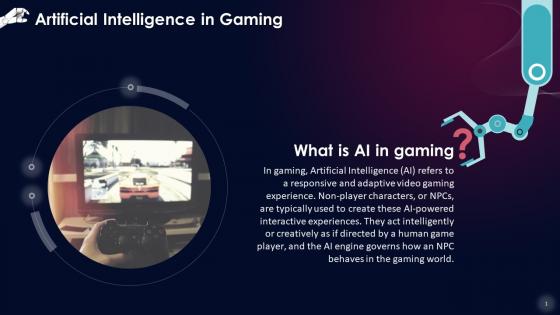
This slide gives an overview of Artificial Intelligence in gaming. It refers to a responsive and adaptive video gaming experience AI powered Non-Player Characters or NPCs achieve that are creative and behave as if a human player is in-charge.
Slide 2
This slide highlights the importance of Artificial Intelligence in gaming as it aims to improve the gaming experience for a player. AI allows developers to create console-like experiences on a varied devices like smartphones, VR headsets, and other gadgets.
Slide 3
This slide discusses Non-Player Characters or NPCs which are the most common targets for gaming AI. These are intelligent gaming characters that Artificial Intelligence algorithms and systems control.
Instructor’s Notes: For example, consider the game named Monster Hunter: World; there's practically a living ecosystem in there with AI-powered monsters going about their business. The game's director, Yuya Tokuda, even mentions NPCs fighting each other at a mere whim in the game. He recalls a time in the game when his character was fighting a monster, when another one barged in, smashed the first creature with a stone, and fled.
Slide 4
This slide lists the applications of Artificial Intelligence in the field of gaming. These applications include pathfinding, decision-making, data mining, procedural content generation, player experience modeling, and cheating.
Instructor’s Notes:
- Pathfinding: Pathfinding concerns getting from one point to another. The most significant aspect of pathfinding is the gaming environment as a whole. As you move around the game environment, the game AI can generate its landscape or world. Your motions, playing style, in-game decisions, appearance, and techniques can all provide feedback to the AI, which can be used to construct the terrain
- Decision-Making: The AI will allow your decisions to have a more significant impact on the action. For example, in Red Dead Redemption 2, NPC behavior and contact with you are influenced by factors such as bloodstains on your clothes or the hat you're wearing
- Data Mining: Artificial Intelligence enables game designers and studios to do data mining on players’ behavior to better understand how players end up playing the game, which areas they play the most, and why they stop playing. This enables game producers to improve gameplay or find new ways to monetize their games
- Procedural Content Generation: Artificial Intelligence (AI) can be used in games to automatically generate fresh content, interactive narrative, environmental conditions, levels, and even music
- Player Experience Modeling: Game AI can determine a player's skill level and emotional condition and customize the game in light of this data. This might even include dynamic game difficulty balancing, in which the game's complexity is altered in real-time based on the player's skill level. Game AI may even assist in determining the player's intent
- Cheating: The most typical method of cheating by NPCs is when they use information that the players in that situation do not have access to. For example, in a fighting game, an NPC may be given human-like senses such as vision and hearing, yet they may cheat by monitoring the player's position on the game engine
Slide 5
This slide demonstrates the most commonly used AI techniques in the field of gaming. These techniques are either deterministic or non-deterministic.
Instructor’s Notes:
- Deterministic AI Techniques: The most-used game AI algorithms are deterministic AI techniques. Deterministic conduct or performance is predetermined and is easy to predict, and there isn't a single element of uncertainty in these procedures. They're quick and straightforward to set up, comprehend, test, and debug. The problem is that deterministic approaches require developers to plan for all conceivable cases and code all behavior manually
- Non-Deterministic AI Techniques: This is contrary to deterministic behavior. There is some uncertainty in non-deterministic behavior (which depends on the AI method used and how well that AI method is understood). For instance, an NPC learns a player's actions and tactics and changes to counter them. A neural network, Bayesian approach, or genetic algorithm could be used to learn this way
Slide 6
This slide lists advantages of Artificial Intelligence in gaming. These benefits include smart & realistic games, saving time & money, easier to play, and eliminates predictability.
Instructor’s Notes:
- Smart & realistic games: The NPCs in these games develop by self-learning from their activities, using techniques such as pattern learning and reinforcement learning. Because the games interpret and adapt to the player's actions, they become more lifelike. Several programs can generate virtual worlds without the use of human interfaces
- Saves time & cost: Usually, creating a game necessitates a significant amount of time and money. And you have no idea how well the market will receive the game. AI can assist in minimizing the time it takes to create a game and save a lot of money that would otherwise be used on development
- Easier to play: The use of AI aids in making the game more intuitive. Furthermore, the game can employ AI to determine the user's skill level and competence and alter the game's difficulty level in real-time to match that
- Eliminates predictability: When nondeterministic behavior is applied, the game becomes unpredictable, indicating that even the game's developer cannot foresee what will happen in the game. This delivers a novel, refreshing experience and extends the game's playability by preventing it from becoming predictable and uninteresting
Slide 7
This slide lists the possible AI innovations in the gaming industry. These include cloud-based and blockchain-based gaming along with voice recognition in game, VR gaming, and improved mobile gaming.
Instructor’s Notes:
- Cloud-based gaming: Cloud gaming is a concept that allows users to play games without downloading and installing them. This innovation has been in development for a long time, but it is still not widely used
- Blockchain-based gaming: Blockchain gaming is a relatively unknown concept. It implies that both gamers and developers must collaborate on a blockchain platform to play these games. At the same time, to be a part of this gaming community, players must purchase or own digital properties
- Voice or audio recognition in games: The use of audio recognition in gaming will alter our perceptions of games. In gaming, speech recognition allows the user to manage game movements, monitor controls, and even eliminate the need for a controller
- VR gaming and wearable support: The advancements in Augmented Reality, Virtual Reality, and Mixed Reality have raised the bar for immersive games based on Virtual Reality and Mixed Reality, making them more realistic and innovative in their approach to entertainment. The finest example of a wearable gadget used for wearable gaming is the Oculus Quest, a fully-featured PC-quality Virtual Reality device
- Improved mobile gaming: Mobile gaming is a new trend that allows players to play an unlimited number of games. Phone manufacturers have been concentrating on making smartphones that can handle high resolution and graphics
AI Revolution In Gaming Industry Training Ppt with all 23 slides:
Use our AI Revolution In Gaming Industry Training Ppt to effectively help you save your valuable time. They are readymade to fit into any presentation structure.







FAQs for AI Revolution In Gaming
So AI is changing gaming in some pretty cool ways. NPCs actually have real conversations now instead of just repeating the same boring lines over and over. The difficulty automatically adjusts based on how you're playing - no more getting stuck on impossible boss fights. Plus games can generate unique quests and levels just for you, which is honestly kind of mind-blowing when you think about it. Oh and the procedural stuff means storylines adapt to your choices too. If you're into game design, definitely look into how these systems track player behavior.
So basically procedural generation lets you create endless unique stuff without designing every tiny detail manually - like how No Man's Sky has those infinite planets or Spelunky's random levels. Instead of crafting specific moments, you're building systems that generate content automatically. Pretty cool concept, right? Players get fresh experiences every playthrough, which is huge for replayability. The tricky part though is making sure your generation rules create actually meaningful variety. You don't want it feeling like random chaos that gets boring after a few runs - been there with some games and it's disappointing.
Oh totally! AI NPCs are game-changers for storytelling. They remember what you did yesterday and actually respond to your specific choices instead of just spitting out the same canned lines. Way more natural than clicking through those rigid dialogue trees we're all tired of. Each conversation feels real, you know? Your story becomes uniquely yours based on how you play. If you're working on game design stuff, this could make your narrative feel way less predictable. Characters that adapt = stories that don't feel scripted to death.
Dude, the AI stuff happening in games right now is insane. These algorithms are crunching player data constantly - tracking win rates, spotting OP strategies, all that. Way faster than designers could ever keep up. They're tweaking weapon damage and matchmaking in real-time to keep things balanced. Honestly, I didn't realize how crazy advanced it'd gotten until recently. Your spawn rates, ability cooldowns - everything gets adjusted on the fly. If you're building multiplayer systems, reinforcement learning is where it's at for dynamic balancing.
Honestly, you're gonna run into three big headaches. First up is data privacy - your AI's gonna hoover up massive amounts of player info, so make sure you get proper consent and lock that stuff down. Bias is another nightmare. NPCs might treat players differently based on demographics, and trust me, it happens way more than studios want to admit. The worst part though? Using AI to mess with player psychology for cash grabs through addiction mechanics or sketchy microtransactions. Set up some solid ethical rules for your team early on. Oh, and audit your systems regularly - AI does weird unexpected stuff sometimes.
You should totally try AI for testing - it'll handle all that boring repetitive stuff while you focus on the fun parts. Set it loose on thousands of player scenarios at once and watch it catch bugs you'd miss completely. I started with just regression testing (baby steps, right?) then moved into the cooler stuff like predicting where players rage quit. The ML models are surprisingly good at digging through crash logs too. Way faster than hunting through code manually. Performance bottlenecks become obvious when you've got AI simulating player behavior patterns. Honestly saves me hours every week.
So basically the game watches how you play - like your reaction times, death count, how fast you finish levels. Then it tweaks things automatically to keep you challenged but not rage-quitting. Way better than those generic difficulty settings that never feel right, you know? The AI might make enemies smarter or dumb them down, change spawn rates, whatever keeps you engaged. Honestly pretty cool tech. Just don't make the adjustments too obvious or jarring - I've played games where you could totally tell it was messing with you and it felt weird.
So AI is basically revolutionizing game graphics right now. Those super realistic character movements you see? That's AI enhancing motion capture data and creating procedural animations. It also handles realistic lighting, generates textures, and does facial expressions that actually react to what's happening in the game. The best part is it creates variations in real-time - no more repetitive animations that drive you crazy. Oh, and if you're doing any game dev work, definitely check out AI animation tools. They'll cut your development time in half, honestly.
Dude, the AI basically watches how you play and learns your style. It'll bump up difficulty when you're crushing it, dial it back when you're struggling. Plus it figures out what content you actually like - no more random quest suggestions that make zero sense for your playstyle. The storylines even change based on your decisions, which is pretty sick honestly. Gets smarter every time you play too. Oh and if you're making games, definitely look into those adaptive systems that track player stuff - total game changer for keeping people hooked instead of rage-quitting.
Dude, AI is gonna change gaming in crazy ways. Anti-cheat systems will get ridiculously good at catching cheaters, and matchmaking will actually work properly for once. You'll have AI coaches breaking down your gameplay to show you exactly where you're screwing up. Tournament organizers are already using this stuff to spot cheating with insane accuracy. Oh, and we might finally get AI teammates that don't rage quit mid-match. The downside? Players with money for premium AI training tools will have a huge advantage. Honestly, you should probably start messing around with AI training platforms now before everyone else catches on.
So basically, developers are throwing AI at player feedback now - reviews, forums, chat logs, all of it. The AI sorts everything into positive/negative buckets and flags specific complaints like "this boss fight sucks" or whatever. Way faster than having some poor intern read thousands of angry Steam reviews, right? You can catch problems early before they spiral, plus track if your updates actually fixed what people were mad about. Pretty clever honestly - sentiment tracking shows you exactly which fires to put out first.
Dude, AI is actually insane for this stuff. It'll dig through tons of player data and find patterns you'd miss - like what keeps people hooked or makes them quit. Social media monitoring is huge too, plus tracking what competitors are doing. I honestly think the telemetry data alone gives you the most bang for your buck. You can even predict which genres might blow up next. Just don't only look at sales numbers though - throw in forum chats, streaming stats, beta feedback, whatever. Pick one specific trend question first, then figure out what data you'd need to answer it.
Honestly, performance is the worst part - your AI can't be a resource hog or it'll murder your frame rate. Players will absolutely break your systems in ways you never saw coming too. They'll find exploits or do completely random stuff that makes your "smart" AI look stupid. Oh, and there's this tricky balance where you want challenging AI but not something that feels cheap or overpowered. I'd say start basic first - like really basic - then layer on complexity bit by bit. Test with actual people early because they'll definitely do things you didn't think of.
So AI in mobile games is basically watching everything you do to figure out when you're most likely to spend money. Then it hits you with offers right at those moments - pretty sneaky honestly. The crazy part? That $5 deal you see might cost me $10 because the algorithm knows I spend more. It'll even mess with difficulty levels to keep you hooked longer, making those power-ups seem more tempting. Oh and if you're building this stuff, start with the behavioral prediction models first since those usually pay off quickest.
Dude, the AI stuff is gonna be wild. Real-time world generation that actually adapts to how you play - like the game learns your style and builds around it. NPCs you can actually talk to instead of just clicking through those boring dialogue trees (finally!). Procedural environments are cool but honestly? I'm way more excited about characters that feel real. Plus difficulty that adjusts automatically based on your skills. Oh, and AI creating custom quests from your gaming history - that's pretty sick too. Watch the companies messing with language models in games. That's where it'll happen first.
-
Unique research projects to present in meeting.
-
Well-designed and informative templates. Absolutely brilliant!