


AI Transformation Playbook Powerpoint Presentation Slides




Try Before you Buy Download Free Sample Product
 Impress Your
 Audience
 100%
100% Editable
 Save Hours
 of Time


Successful AI transformation needs a proven playbook that aligns solutions to business bottlenecks. Our AI transformation playbook proposes a series of phases to assist enterprises in implementing AI in their operations. Here is an efficiently designed AI Transformation Playbook template that will help organizations transform their business operations through AI. The presentation begins with slides titled pilot project canvas, which will assist organizations in providing an in-depth overview of the AI transformation project and details about the areas where it will have the most significant impact and the capabilities required for project success. The section Identifying and Understanding AI Suitability includes five stages that will assist businesses in effectively determining AI suitability and integrating the solution into their operations. Finally, the KPI dashboard slide will assist organizations in tracking overall business performance following the integration of AI solutions. Book a free demo with our research team and customize this 100 percent editable playbook template based on your requirements.
People who downloaded this PowerPoint presentation also viewed the following :
Content of this Powerpoint Presentation
Slide 1: This slide introduces AI Transformation Playbook. State Your Company Name and begin.
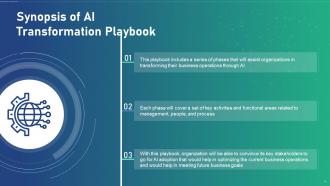
Slide 2: This slide shows Synopsis of AI Transformation Playbook.
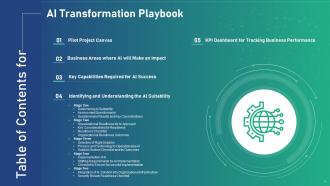
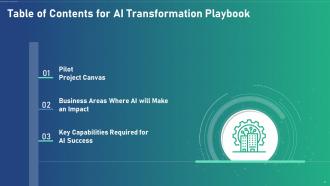
Slide 3: This slide presents Table of Content for the presentation.
Slide 4: This slide highlights title for topics that are to be covered next in the template.
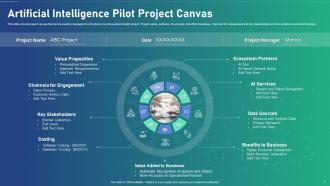
Slide 5: This slide displays Artificial Intelligence Pilot Project Canvas.
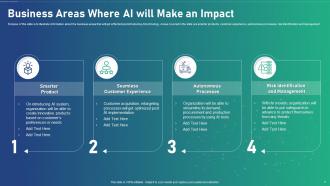
Slide 6: This slide represents Business Areas Where AI will Make an Impact.
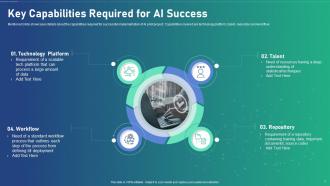
Slide 7: This slide showcases Key Capabilities Required for AI Success.
Slide 8: This slide highlights title for topics that are to be covered next in the template.
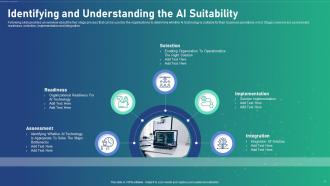
Slide 9: This slide shows Identifying and Understanding the AI Suitability.
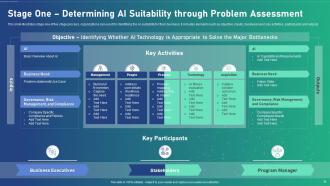
Slide 10: This slide illustrates stage one of five stage process, organizations can use it for identifying the AI suitability.
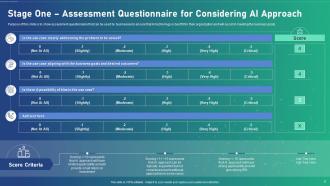
Slide 11: This slide shows Assessment Questionnaire for Considering AI Approach.
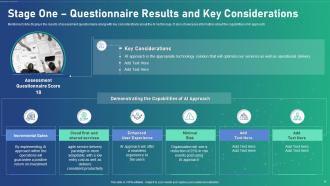
Slide 12: This slide presents Questionnaire Results and Key Considerations.
Slide 13: This slide highlights title for topics that are to be covered next in the template.
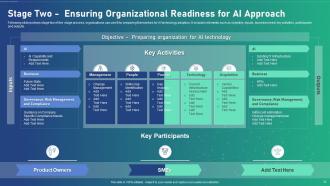
Slide 14: This slide displays Ensuring Organizational Readiness for AI Approach.
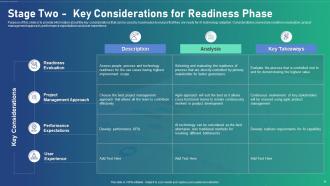
Slide 15: This slide represents key considerations that can be used by businesses to ensure that they are ready for AI technology adoption.
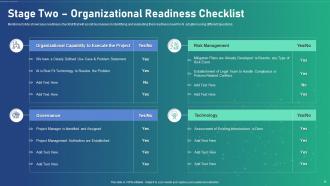
Slide 16: This slide showcases checklist that will assist businesses in identifying and evaluating their readiness.
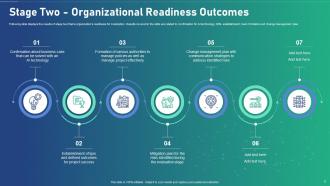
Slide 17: This slide shows results of stage two that is organization’s readiness for AI adoption.
Slide 18: This slide highlights title for topics that are to be covered next in the template.
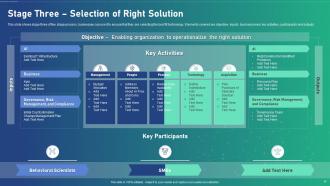
Slide 19: This slide presents three of five stage process, businesses can use it to ensure that they are selecting the best fit technology.
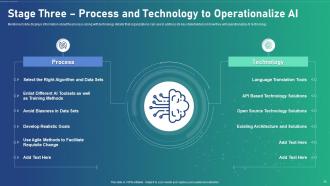
Slide 20: This slide displays information about the process along with technology details that organizations can use.
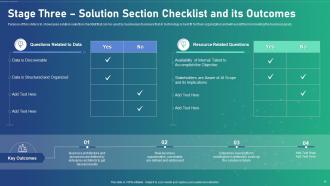
Slide 21: This slide represents Solution Section Checklist and its Outcomes.
Slide 22: This slide highlights title for topics that are to be covered next in the template.
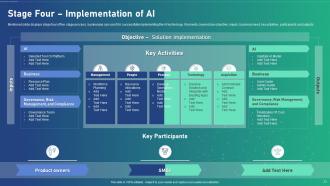
Slide 23: This slide showcases stage four of five stage process, businesses can use it for successfully implementing the AI technology.
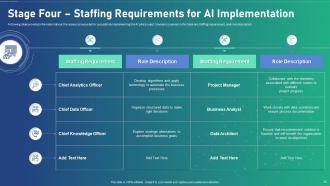
Slide 24: This slide shows Staffing Requirements for AI Implementation.
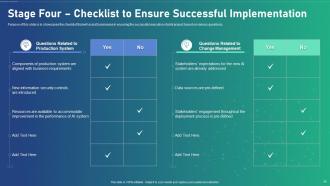
Slide 25: This slide presents Checklist to Ensure Successful Implementation.
Slide 26: This slide highlights title for topics that are to be covered next in the template.
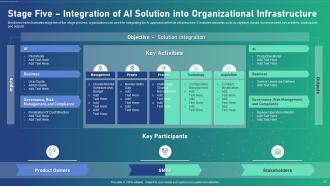
Slide 27: This slide displays Integration of AI Solution into Organizational Infrastructure.
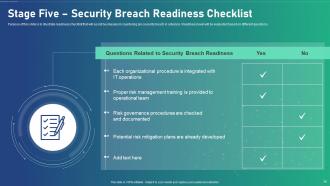
Slide 28: This slide represents readiness checklist that will assist businesses in countering any security breach.
Slide 29: This slide highlights title for topics that are to be covered next in the template.
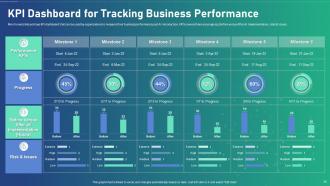
Slide 30: This slide showcases KPI Dashboard for Tracking Business Performance.
Slide 31: This slide displays Icons for AI Transformation Playbook.
Slide 32: This slide is titled as Additional Slides for moving forward.
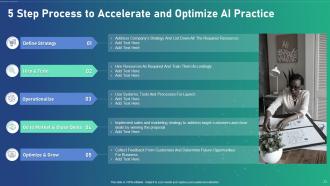
Slide 33: This slide represents 5 Step Process to Accelerate and Optimize AI Practice.
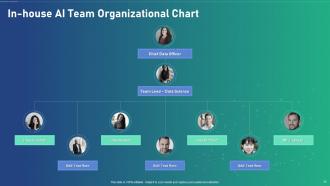
Slide 34: This slide showcases In-house AI Team Organizational Chart.
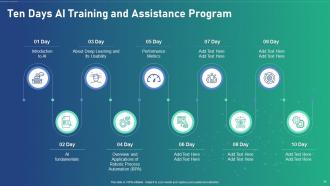
Slide 35: This slide shows Ten Days AI Training and Assistance Program.
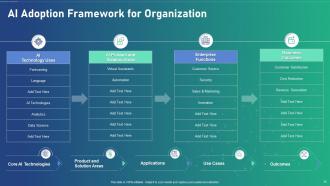
Slide 36: This slide presents AI Adoption Framework for Organization.
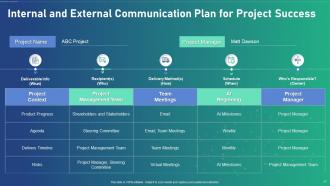
Slide 37: This slide displays Internal and External Communication Plan for Project Success.
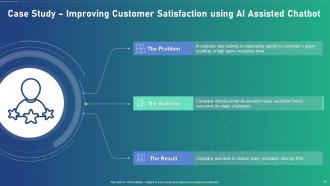
Slide 38: This slide showcases Improving Customer Satisfaction using AI Assisted Chatbot.
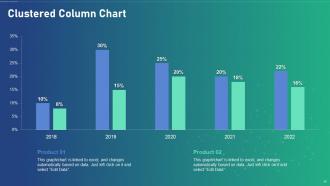
Slide 39: This slide provides Clustered Column chart with two products comparison.
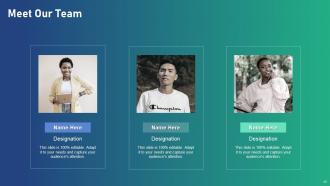
Slide 40: This is Our Team slide with names and designation.
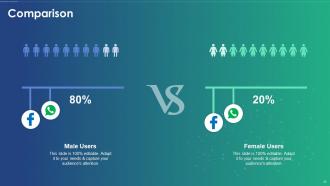
Slide 41: This is a Comparison slide to state comparison between commodities, entities etc.
Slide 42: This slide contains Puzzle with related icons and text.
Slide 43: This slide shows Post It Notes. Post your important notes here.
Slide 44: This slide depicts Venn diagram with text boxes.
Slide 45: This is Our Target slide. State your targets here.
Slide 46: This is a Thank You slide with address, contact numbers and email address.
AI Transformation Playbook Powerpoint Presentation Slides with all 51 slides:
Use our AI Transformation Playbook Powerpoint Presentation Slides to effectively help you save your valuable time. They are readymade to fit into any presentation structure.






FAQs for AI Transformation Playbook
You'll need three main things sorted first - your data setup, the right people, and some smart pilot projects to test things out. Clean, accessible data is non-negotiable because messy data just breaks everything downstream. For talent, I'd start by training your existing team before hiring externally (way cheaper honestly). Pick pilots that won't tank the company if they fail but still get noticed when they work. Oh and heads up - people freak out about AI replacing them, so you'll want to handle that communication carefully. I'd honestly just figure out which of these three you're weakest on and tackle that first.
Honestly, start with a good hard look at four main things: your data setup, tech capabilities, company culture, and your team. Is your data actually clean and easy to access? Can your systems even handle AI stuff? And here's the thing - leadership might say they support innovation, but do they really when push comes to shove? I've seen so many companies where the data is just a hot mess. Check if your team actually gets AI basics and won't freak out about changing how they work. Getting outside consultants to assess everything objectively is probably your best bet. That'll show you exactly what needs fixing.
Honestly, change management can totally make or break your AI project. The tech might be amazing, but if people aren't on board? You're screwed. Most resistance comes from folks worrying about losing their jobs or just feeling overwhelmed by new stuff. Communication is huge - start early, keep talking, and actually listen to concerns. Training helps too, obviously. Oh, and find those people who get excited about change first. They'll help sell it to everyone else way better than you can from the top down.
Honestly, healthcare is crushing it with AI right now - they're automating diagnostics and speeding up drug discovery like crazy. Finance is another goldmine for fraud detection and trading algorithms. Manufacturing gets insane ROI from predictive maintenance, plus quality control stuff. You've also got retail doing personalization and logistics optimizing supply chains. The pattern I see? These industries are drowning in data and have repetitive processes you can actually measure results on. I'd look at whatever manual work you're doing that involves spotting patterns or making predictions - that's your sweet spot.
Track the obvious stuff first - cost savings, revenue bumps, how much faster people work. Executives eat that up. But honestly? The really good AI benefits are sneaky and take time to surface. Customer satisfaction, better decisions, that kind of thing. Oh, and definitely measure everything before you flip the switch so you can actually compare later - learned that one the hard way. Most AI projects need like 6-12 months minimum before you'll see anything meaningful. Don't panic if results look meh at first.
Honestly, you can't afford to ignore the ethical stuff when rolling out AI. Bias is huge - your algorithms might accidentally discriminate against certain groups without you realizing it. Privacy's another big one; treat customer data like it's toxic waste or something. People also get super uncomfortable with the whole "black box" thing where they can't figure out how decisions get made, so be transparent about your AI use. Oh, and definitely think about your employees - nobody wants to get replaced by a robot. Setting up some kind of ethics committee with different perspectives before launching projects isn't a bad idea either.
Dude, you gotta bake privacy right into your AI from the start - trust me on this one. Only grab the data you actually need, because most companies just hoard everything and it comes back to haunt them. Try stuff like differential privacy and federated learning so you're not exposing sensitive info when training models. Oh, and encrypt literally everything - data moving around, data sitting there, whatever. Set up tight access controls too. I know it sounds like extra work, but your customers will totally notice when you treat their privacy like it matters instead of just slapping it on at the end.
Honestly, you can't really compete with AI anymore, so work with it instead. Learn one AI tool that's actually useful for your job - just 15 minutes a day makes a huge difference. Critical thinking is clutch because you'll need to spot when AI screws up (and trust me, it does). Being able to explain tech stuff to non-tech people is gold right now. Data skills matter too since everything runs on data. The cool thing is creativity and reading people are still totally human territory. Oh, and stay flexible - these tools change constantly so you gotta roll with it.
Honestly, AI is pretty solid for customer stuff. It personalizes interactions without you having to manually track every person's history. Your chatbots actually get context instead of giving those robotic responses that make everyone want to throw their phone. The recommendation engines? Way better at guessing what people want. Plus it flags customers who seem pissed before they bail completely. What's wild is it keeps learning from each conversation - like that one coworker who actually remembers everything you tell them. I'd start with just your chat support, see how response times improve, then add more features.
Honestly, psychological safety is huge - people won't try cool stuff if they're scared of getting fired for failing. Get your AI team talking to the business folks regularly (seriously, some of my best project ideas came from random hallway chats). Block out time for people to mess around with side projects, even the weird ones. Actually celebrate the smart failures alongside wins - share what everyone learned. Send people to conferences or do internal demos. Oh, and definitely start with small pilots first. Way easier to get buy-in when you've got some quick wins under your belt.
Don't try to do everything at once - that's where most people mess up. Get your data sorted first or you'll regret it later. I can't tell you how many teams I've watched crash and burn because they skipped the boring foundation stuff. Change management is huge too. People freak out if they don't know what's going on. Start with something small that actually makes money, then grow from there. Find one thing, do it really well, and build on that success. Way less stressful than trying to revolutionize everything day one.
Honestly, you gotta find the sweet spot between letting AI do the boring stuff and keeping humans for the big calls. Map out what you're doing now - see what's just mindless busy work versus stuff that actually needs a brain behind it. Let AI handle data crunching and basic filtering, but jump in for anything involving real relationships or money decisions. I've watched companies automate everything then totally panic when things break. Build in review points so someone's eyes are on AI outputs before they go out the door. Short version: automate the grunt work, not the judgment calls.
So there are a bunch of decent frameworks out there for AI transformation stuff. McKinsey's got one that covers strategy and governance - pretty standard but solid. MIT has this adoption model that's all about experimenting first, then scaling up. Google's guide is super comprehensive but honestly kinda dense if you're just getting started. Oh, and Accenture has a responsible AI framework that's worth checking out. The EU also published some ethics guidelines, though I feel like those are more theoretical. My take? Just pick whichever one fits where your company's at right now. Don't try juggling multiple frameworks - you'll just confuse everyone.
So basically, AI gives you an edge by handling all the boring repetitive stuff while you focus on the big picture. You'll make faster decisions because you're actually using your data instead of just collecting it. Plus you can personalize things for customers without hiring a massive team. Here's the thing though - just buying some AI tool won't magically fix everything. You need to be smart about where you use it. The companies winning right now? They're the ones who figured out how to weave AI into what they already do well, then use those insights to move quicker than their competition. It's honestly less about the tech and more about execution.
Dude, AI's about to get crazy conversational - we're talking ChatGPT that handles videos, audio, all that stuff without breaking a sweat. Your team's gonna use these tools anyway, so might as well get ahead of it with some basic rules. Edge computing is ramping up too, which means less cloud dependency. The really cool part? AI agents that can knock out entire workflows instead of just Q&A. Oh, and seriously - start organizing your data now. I know it sounds boring, but that's what'll make or break you when this stuff really takes off. The pace is honestly insane right now.
-
Excellent design and quick turnaround.
-
Excellent template with unique design.