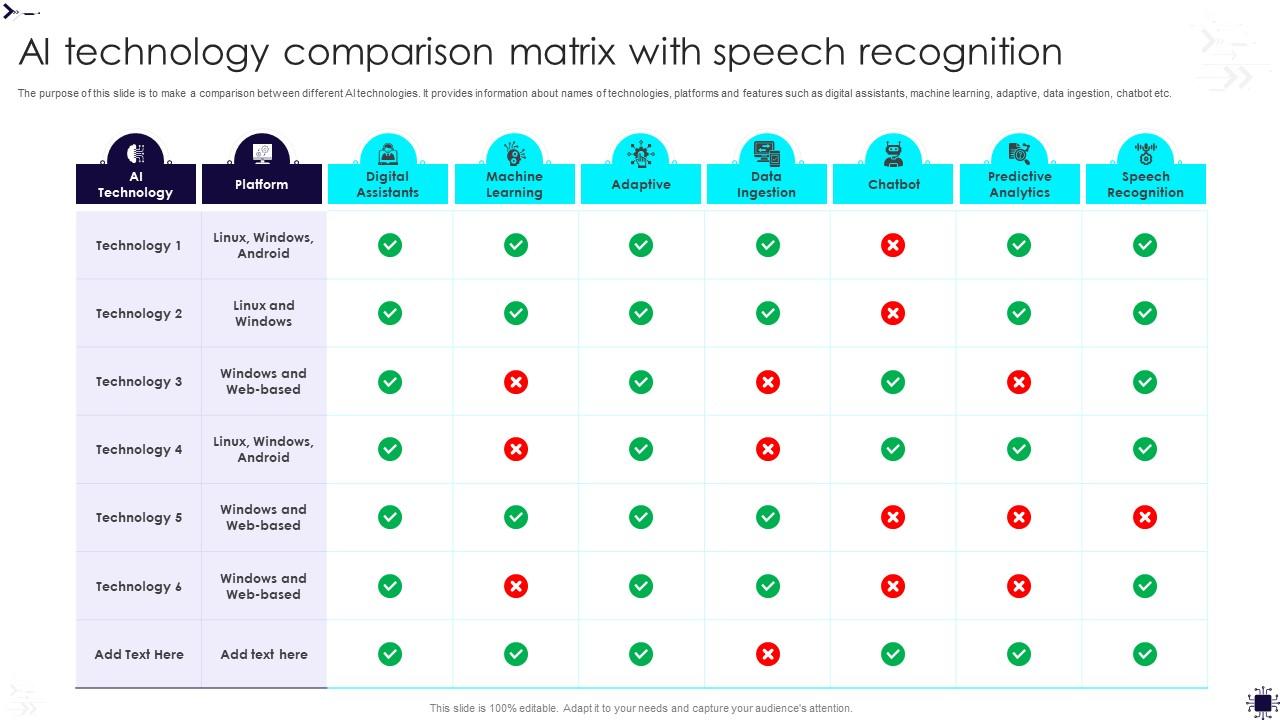
AI Technology Comparison Matrix With Speech Recognition
Try Before you Buy Download Free Sample Product
Audience
Editable
of Time
The purpose of this slide is to make a comparison between different AI technologies. It provides information about names of technologies, platforms and features such as digital assistants, machine learning, adaptive, data ingestion, chatbot etc.
People who downloaded this PowerPoint presentation also viewed the following :
AI Technology Comparison Matrix With Speech Recognition with all 6 slides:
Use our AI Technology Comparison Matrix With Speech Recognition to effectively help you save your valuable time. They are readymade to fit into any presentation structure.
FAQs for AI Technology Comparison Matrix
So in perfect conditions, the top AI speech systems hit like 95-98% accuracy, but real-world? More like 85-92% depending on noise and accents. Google's usually best for general stuff, Amazon crushes it for smart home things, and Microsoft's solid for business. Apple's decent too but kinda locked into their ecosystem - though honestly they're all getting pretty close these days. My advice? Test a few with your actual setup first, because what rocks in your quiet office might totally suck in a loud warehouse or whatever.
Honestly, it's all over the place depending on what you're working with. Google and Microsoft do pretty solid work with normal accents since they've got tons of training data. But throw in heavy regional dialects? Accuracy takes a hit. Whisper from OpenAI actually blew me away - super good with multilingual stuff and when people switch languages mid-sentence. Amazon's thing though... eh, not great with non-native speakers from what I've seen. My advice? Test it out first with real audio samples from whoever's gonna be using it. Don't just pick one blindly.
Google's Speech-to-Text usually hits around 200-500ms, which is pretty solid. Azure does similar but can get wonky during busy times. Amazon Transcribe? Eh, 300-700ms range. We tried OpenAI's Whisper for live stuff once - total disaster. It's built for batch processing so you're stuck with 1-2 second delays, which kills any real-time vibe. Assembly AI consistently stays under 300ms though, same with Google. Just heads up - background noise screws with everything and can literally double those times. Test with your actual setup first.
Yeah background noise totally kills speech recognition - you'll see it drop from like 95% down to 60% in noisy spots. I've had the best luck with Google's Speech-to-Text, their enhanced model has pretty solid filtering. Azure works well too. Amazon's decent but seems to struggle more when there's constant chatter going on. Honestly though, your best move is cleaning up the audio first with noise reduction before you send it anywhere. Coffee shop background hits way different than construction noise, so definitely test it with whatever environment you're actually dealing with.
Accuracy is huge - you'll want something that gets your industry jargon right, plus handles different accents well. Speed matters too because lag during calls is super annoying. I made that mistake once with a tool that kept freezing up mid-sentence! Check how it plays with your current systems and whether the security is decent for confidential stuff. Multilingual support might be key depending on your team. Oh, and honestly? Their API docs will tell you everything - if they're garbage, you're in for a rough setup. Test it on real scenarios first before signing anything.
Healthcare's where I'm seeing the most action right now - doctors love using it for transcribing notes instead of typing everything out. Customer service is exploding too, call centers are all over automated responses and routing calls. Cars are getting pretty wild with voice controls lately. Banks jumped in for phone banking and catching fraud through voice patterns, which is actually pretty smart when you think about it. My cousin works at a tech company and they started small - just figured out what repetitive voice stuff was eating up their time first. That's probably your best bet.
Yeah, speech recognition totally chokes on technical stuff at first since it's trained on everyday language. But here's the thing - you can actually teach it your industry terms! Google Speech-to-Text, Azure, and Amazon Transcribe all let you build custom vocabularies with your acronyms and company lingo. Some platforms claim they learn from corrections too, though that's painfully slow in my experience. Honestly, just pick one with custom dictionaries and front-load the work by training it on your most common terms. You'll thank yourself later when you're not fixing every other word.
So machine learning is what makes speech recognition actually get better over time. These systems learn from tons of different accents and speaking patterns - kinda like they're always studying. The more voices they hear, the smarter they get at handling background noise and even guessing what you'll say next. Neural networks can adapt to how YOU specifically talk, which is pretty cool. Oh, and if you're shopping around for speech recognition tools, definitely pick ones that mention continuous learning. Trust me, they'll work way better down the road than the basic ones.
Yeah, privacy stuff is killing adoption rates right now. Employees won't use voice tools during confidential calls - they're terrified everything gets recorded. Companies are freaking out about compliance too, especially healthcare and legal firms. Can't really blame them honestly. The whole "always listening" thing creeps people out even when companies swear they're not actually recording. Personal use is sketchy too since nobody trusts big tech with family conversations. Your best move? Find tools that process locally, have clear data policies, and let you opt out easily. Makes the whole thing way less sketchy upfront.
Honestly, speech recognition pricing is all over the place. Free tiers exist, but most decent services charge around $0.006-$0.024 per 15-second chunk. Google's usually your cheapest bet for basic stuff. AWS and Azure are solid too, though Microsoft's surprisingly competitive if you're already using their other tools. Want fancy features like speaker ID or custom models? Yeah, that'll cost extra. Real-time processing and multi-language support bump prices up too. My advice? Start with the free versions first - test how well they handle your specific audio before spending money. Some services are way better with certain accents or background noise.
So basically speech recognition is just the starting point - it turns your voice into text, then passes that to NLP models that actually figure out what you mean. Machine learning is what makes it get better over time by learning from speech patterns. Think of it like a relay race where each piece does its thing. Voice assistants do this all the time, and honestly call centers are obsessed with this setup right now. The speech-to-text connects to sentiment analysis or chatbot stuff. If you're shopping around for systems, just make sure their APIs actually talk to each other properly.
Honestly, it depends what you need it for. Google's voice typing works pretty well right off the bat - I use it sometimes when I'm being lazy about typing. Dragon NaturallySpeaking is way more powerful but you'll spend forever training it first. It's like the difference between an automatic and manual car, you know? Apple's dictation is decent too if you're already in their ecosystem. I'd just try whatever's already on your phone or computer first. No point dropping money on Dragon unless the free stuff doesn't cut it. Most people are fine with the basic options anyway.
Google and Azure are honestly your best bet - they're really good at figuring out who's talking and labeling speakers. Amazon Transcribe works too but gets wonky when people interrupt each other (which happens constantly in meetings, ugh). Basic systems? They'll just throw everything into one messy transcript with zero speaker separation. Definitely test the speaker diarization feature first if you're doing interviews or group calls. Trust me, you don't want to spend your weekend manually sorting through who said what.
Oh man, speech recognition is about to get crazy good. Emotion detection is coming - like, systems will actually know if you're frustrated or excited while talking. Multi-language stuff is improving too, so no more awkward switching when you mix languages mid-conversation. The context awareness thing is pretty sweet - it'll remember what you talked about before instead of starting fresh every time. Honestly though, the coolest part might be offline processing. No internet needed! You should probably start looking at which companies are actually investing in this stuff now.
Dude, compliance is such a pain for healthcare and finance deployments. HIPAA and SOX/PCI-DSS will literally shut you down if you screw up - they're not messing around. Your speech recognition suddenly needs all this crazy stuff: end-to-end encryption, audit trails, data residency controls. Sometimes you can't even use cloud solutions and have to go on-premise (ugh). Auditors are super paranoid about AI systems too since they're still relatively new. Honestly, I've seen compliance overhead double both timeline and costs. But trust me, it's way better to over-engineer the security upfront than deal with angry regulators later.
-
Attractive design and informative presentation.
-
Graphics are very appealing to eyes.