

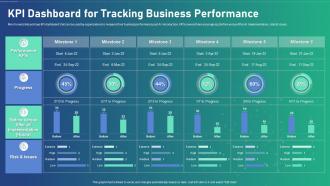
Ai Transformation Playbook Kpi Dashboard For Tracking Business Performance





Try Before you Buy Download Free Sample Product
 Impress Your
Audience
 100%
Editable
 Save Hours
of Time


Mentioned slide portrays KPI dashboard that can be used by organizations to measure their business performance post AI introduction. KPIS covered here are progress, Before versus After AI Implementation, risks and issues.
People who downloaded this PowerPoint presentation also viewed the following :
Ai Transformation Playbook Kpi Dashboard For Tracking Business Performance with all 7 slides:
Use our Ai Transformation Playbook Kpi Dashboard For Tracking Business Performance to effectively help you save your valuable time. They are readymade to fit into any presentation structure.






FAQs for Ai Transformation Playbook Kpi Dashboard For
So you'll basically go through four stages. Discovery first - figuring out where AI actually makes sense and getting the bosses on board. Then pilot testing, which honestly is where most companies face-plant because they rush it. After that comes scaling the stuff that worked across different teams (plus building up your data setup). Last is optimization where it's just part of how you work. Oh, and seriously - don't let leadership pressure you into skipping those pilot tests. I know they want fast results but trust me, those small experiments will save your ass later when you're doing the real rollout.
Honestly? Figure out what's actually broken in your business first. Don't just grab whatever AI tool is trending - I've seen too many companies do that and waste a ton of money. Where are you bleeding time or losing customers? Find those spots, then hunt for AI that fixes those specific problems. Your data needs to be decent quality though, otherwise you're just automating garbage. Try small projects first, see what actually works, then expand from there. The whole point is solving real problems, not just using AI because everyone else is.
Honestly, data quality is everything when it comes to AI - like, your whole system depends on it. Bad data means bad results, and that can seriously mess up your business decisions. You know that old saying "garbage in, garbage out"? Same thing here, except now you're paying way more for the garbage lol. Your AI can only be as good as what you feed it. So before you even start building models, take time to check what data you actually have. Set some standards for quality. Trust me, dealing with messy data upfront is way better than trying to fix broken AI later.
Look, people won't even touch AI if they think they'll get roasted for messing up. Start small - let teams play around with tools on low-stakes stuff. Honestly, the coolest AI breakthroughs I've witnessed? Random Friday experiments that seemed pointless at first. Your bosses need to admit they're figuring this out too, not pretend they're experts. Set up casual demo sessions where it's totally fine if something crashes and burns. Oh, and definitely celebrate the epic fails that actually teach you something useful about what sucks.
Honestly, bias is your biggest headache - training data can mess things up fast if you're not watching it. Privacy's another nightmare since people freak out about their data (rightfully so). Make sure you can actually explain how your AI makes decisions, especially for stuff like hiring. Nobody wants to get rejected by some mysterious algorithm, you know? Job displacement is real too, so figure out how to retrain people whose roles will shift. Oh, and definitely get an ethics committee going before you launch anything major. Trust me on that one.
So measuring AI ROI is honestly kind of a pain compared to regular projects. You've got your obvious stuff like cost savings and revenue bumps, but then there's the fuzzy benefits too - happier customers, quicker decisions, that sort of thing. What works is setting up clear baselines before you launch anything. Then pick specific targets upfront - maybe cut processing time 30% or save $X per year. My old boss was obsessed with this stuff and he always said pick what "winning" looks like first, then track everything religiously after. Otherwise you're just guessing if it actually worked.
Honestly, don't try to compete with AI - work with it instead. Critical thinking is huge right now since AI can process tons of data but someone still needs to figure out what it actually means. Communication skills matter more than ever too. People crave real human connection, especially when everything's getting automated. I'd also get comfortable learning new tools because things are changing crazy fast. Oh, and creativity - that's still very much a human thing. Start by looking at your current job and see what could get automated, then focus on the bigger picture stuff that requires actual judgment.
Look, IT and business teams HAVE to work together or you're basically screwed. Business people know what actually needs solving, while IT handles all the technical stuff - infrastructure, security, getting models to work properly. When they don't collaborate, you get either cool tech that solves nothing important, or brilliant ideas that can't be built. Honestly, I've seen this fail so many times when teams work in silos. The trick is getting them talking from the start. Set up regular meetings where both sides can be honest about what's realistic and what's not.
Honestly, the worst part is when your data's all over the place in different systems that don't talk to each other. Your IT folks want everything stable while business teams are pushing for quick wins - classic tension there. Skills are another huge gap since AI moves so fast. Here's what actually works: get people cross-training instead of keeping teams in silos. Pick maybe 2-3 solid use cases to start with rather than going crazy with everything at once. And seriously, set up some kind of governance structure early because I've seen companies where nobody knows who's responsible for what AI project. Oh, and breaking down those data silos should be priority one.
So here's the thing - AI can totally change how your customers experience your business. Chatbots give you crazy fast response times, and the product recommendations actually start making sense instead of suggesting random stuff. What's really cool is the predictive support that catches problems before customers even notice them. You get 24/7 availability, better answers, and everything feels more personalized to each person. Oh, and don't try to do everything at once - that's a recipe for disaster. Just pick one area like your help desk first, see how it goes, then expand from there.
Honestly, just pick one thing that's driving you crazy right now and find a cheap AI tool for it. ChatGPT's obvious for content stuff. Customer service bots work great too. Don't build anything custom - that's where people blow their budget. I'd focus on whatever's eating up most of your time first, then see if it actually helps before going nuts with more tools. The trick is finding something that plays nice with your current setup so you're not starting over. Test one thing, measure if it's worth it, then maybe add more. Way better than trying to automate everything at once.
Oh man, the worst myth is thinking AI will fix everything instantly. Spoiler alert: it won't. You don't need some huge budget or army of data scientists either - tools today are way more accessible. Most people freak out about AI stealing jobs, but honestly? It's more like having a really good assistant. Your data doesn't need to be pristine before you start - mine was a total mess when I began, and that worked out fine. Pick one thing to test first instead of going crazy trying to revolutionize your entire operation. Trust me on that one.
Dude, you've gotta build compliance right into your AI plan from the start - don't try to slap it on afterward. Figure out what regulations hit your specific use case first. GDPR, industry rules, whatever new AI laws are dropping (and honestly, they're changing constantly right now, it's kinda nuts). Set up solid governance early. Document how your models make decisions. Regular audits are non-negotiable. Oh, and loop in your legal team while you're still building, not after you've created some compliance nightmare. Trust me on this one.
Honestly, continuous learning is what stops your AI from becoming useless garbage over time. Models get stale fast when new data patterns pop up or business stuff changes. It's like ignoring phone updates - eventually everything breaks down on you. You've gotta retrain with fresh data regularly and adapt to new requirements. The smart move? Build those learning loops right into your workflow from the start. Don't make it an afterthought later. Set up automated retraining and actually watch your performance metrics. Trust me, consistency here saves you so many headaches down the road.
Look, partnerships are seriously your best bet for getting into AI without going crazy. Find vendors or consulting firms who actually know what they're doing - way better than fumbling around on your own. Plus you'll dodge all the stupid mistakes everyone makes when they're starting out. The timeline thing alone makes it worth it. Honestly, I'd figure out what you don't know first (be real about it), then hunt down partners who can cover those gaps. Your team's probably great, but they can't know everything about AI yet. Makes total sense to get help.
-
Understandable and informative presentation.
-
Excellent work done on template design and graphics.