

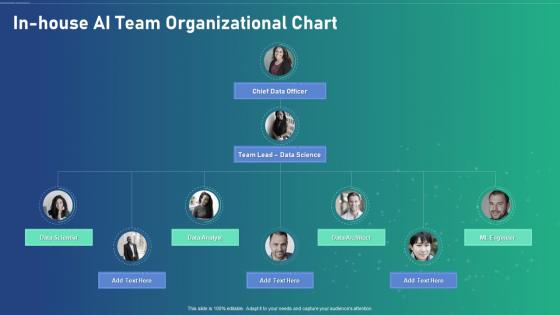
Ai Transformation Playbook In House Ai Team Organizational Chart




Try Before you Buy Download Free Sample Product
 Impress Your
 Audience
 100%
100% Editable
 Save Hours
 of Time


Our Ai Transformation Playbook In House Ai Team Organizational Chart are topically designed to provide an attractive backdrop to any subject. Use them to look like a presentation pro.
People who downloaded this PowerPoint presentation also viewed the following :
Ai Transformation Playbook In House Ai Team Organizational Chart with all 6 slides:
Use our Ai Transformation Playbook In House Ai Team Organizational Chart to effectively help you save your valuable time. They are readymade to fit into any presentation structure.





FAQs for Ai Transformation Playbook In House Ai
Look, it's mostly the obvious stuff - cutting costs and staying competitive. Everyone's scrambling because customers expect better experiences now. AI handles the boring repetitive work so people can focus on real problems. Healthcare wants smarter diagnostics, banks need fraud protection, retailers push those "you might like" suggestions. COVID definitely sped things up since companies had to stretch budgets further. Honestly though, I'd start small - figure out what's driving you crazy operationally and test if AI actually helps there first.
Honestly, you need to track the obvious stuff first - labor costs, processing speed, error reduction. That's your bread and butter. Revenue impact comes next through better sales or customer retention. Here's the thing though - some benefits won't show up for months, so don't freak out if early numbers suck. I'd set baselines before you even start, then check progress monthly. Oh, and define success upfront! Can't stress this enough. You don't want to be scrambling later trying to justify why you spent all that money.
Dude, data quality will make or break your whole project. Seriously - if your data's messy or biased, your model learns that garbage and spits it right back out. I've watched entire teams waste months on fancy algorithms when their training data was complete trash from day one. Clean, representative datasets come first, then you worry about the cool stuff. Oh and audit whatever data you have now - trust me, you'll find weird gaps you never noticed. Way better to catch that early than debug a broken model later.
So AI's definitely changing work, but not how most people think. Yeah, boring repetitive stuff gets automated. But honestly? More interesting jobs are popping up that need actual human skills. Companies are scrambling faster than they expected - it's kinda wild to watch. Focus on the stuff robots can't do: creative thinking, reading people, solving weird problems. Oh, and you'll probably end up working WITH AI tools rather than competing against them. Keep your tech skills sharp, but really lean into what makes you uniquely human. That's where the money will be.
Start with bias - that's what'll really screw you over if you ignore it. Your algorithms can't be discriminating against certain groups, period. Also be upfront about how decisions get made, especially anything touching customers or staff. Privacy's another massive thing since you're probably drowning in data now, so get your data governance sorted. The regulations are honestly still a mess and playing catch-up, but you want to be ahead of that curve. Oh, and definitely set up some kind of ethics committee with actual guidelines before you go crazy with scaling everything up.
Honestly, AI can completely change how customers experience your business. Start with something simple like a chatbot for support - way easier than you'd think. Netflix does this perfectly with their recommendations, right? They're basically reading your viewing habits and serving up exactly what you want. You can also do predictive stuff that anticipates needs, dynamic pricing, and those follow-up messages that don't feel annoying. Sentiment analysis is huge too for understanding feedback. Just pick one thing first and see how it goes with your crowd before expanding.
Dude, healthcare and finance are getting absolutely slammed by AI right now. Doctors are using it to spot diseases, banks catch fraud instantly - it's pretty crazy. Retail's right there too with all the personalized shopping stuff. Oh and manufacturing, they're preventing SO much equipment downtime with predictive maintenance (my cousin works at a plant and says it's actually insane). Basically these industries have mountains of data and make decisions that either save tons of cash or actually save lives. If you're working in any of these, don't go overboard - just pick one thing to test AI on first.
Dude, you don't need a huge budget for AI stuff anymore. ChatGPT's like $20/month for content creation, and there are cheap chatbots for customer service. Being small actually helps - you can move fast while big companies are stuck in meetings forever. Pick your biggest time-waster first. Social media posts? Invoice stuff? Whatever's eating your day. I started with automating our appointment booking and honestly wish I'd done it sooner. You can always add more tools later once you see what's working. The hardest part is just picking something and starting.
Honestly, the biggest pain points are usually messy data, finding actual AI talent (not just people who throw around buzzwords), and your team freaking out about being replaced. Data cleanup takes forever - it's always worse than you expect. Good AI people are stupid expensive right now too. But the real killer is resistance from employees who think they're getting automated out of jobs. You end up spending more time on change management than the actual tech implementation. My advice? Clean up your data first, then go heavy on training and communication. Oh, and maybe don't mention "AI replacing jobs" in your kickoff meeting.
Honestly, AI is a total game-changer for supply chains. It gives you crazy accurate demand forecasting and real-time inventory tracking that actually works. The route optimization alone will save you a fortune on shipping. Plus there's this predictive maintenance thing where it warns you before equipment breaks down - pretty neat stuff. Warehouse ops get way smoother with automated sorting and robotics too. But here's what's really cool: it spots disruptions coming and adjusts everything automatically. My advice? Pick your worst supply chain headache first and find an AI solution that tackles exactly that problem.
Honestly, start with something small that has clear goals and exec support - you don't want to bite off more than you can chew. Clean your data first because messy data will just screw everything up later. Get a mixed team of tech people and actual subject matter experts together. Here's the thing nobody tells you - data prep takes forever. Like, way longer than you think. Keep everyone in the loop constantly since AI feels super mysterious to most people. Oh, and figure out how you'll measure success beforehand, plus have a backup plan if things go sideways. Trust me on that last part.
Get your leadership actually playing with AI tools themselves - not just nodding along in PowerPoints. Build some sandbox spaces where people can mess around without getting fired for breaking stuff. Honestly, the weirdest experiments usually lead somewhere cool even if they seem dumb at first. Train your team so they don't think AI's coming for their jobs. Instead they'll see it as their sidekick. Oh, and celebrate the failures just as loud as the wins. People need to know it's safe to try stuff. The whole point is making AI feel like a teammate, not some robot overlord.
Look at Netflix - they ditched DVDs completely and built their whole thing around AI recommendations. Total game changer for how we watch stuff. Amazon did something similar with their logistics and personalization tech. JPMorgan's using AI to catch fraud (saved them crazy money). Even John Deere - yeah, the tractor company - is killing it by putting AI into farming equipment. The thing is, none of these were just "let's add some AI features." They completely rethought what their business could be. That's honestly where the magic happens. Figure out how AI could totally change your customer experience, not just improve it.
Look, regulatory frameworks are basically setting up the rules for how you can use AI in business. They decide what's okay, what you need to disclose, and how much trouble you could get into. It's like GDPR but for AI stuff. The EU's AI Act is already making companies sort their AI systems by risk level - honestly, it's kind of a mess but you gotta deal with it. Similar rules are popping up everywhere else too. You can't just slap compliance on later; build it into your AI plan from the start. Map out what AI you're using now against these new regulations, or you'll be scrambling when they start cracking down.
Honestly, just pick one cloud platform first - AWS, Azure, or Google Cloud. They handle all the boring infrastructure stuff. Python's basically unavoidable for AI work, so get comfortable with TensorFlow or PyTorch. You'll need something like Snowflake for data management (that part's actually kind of fun once you get into it). MLflow helps with deploying models without losing your mind. Oh, and Tableau for making pretty charts that executives actually understand. Don't try learning everything simultaneously - that's a recipe for burnout. Start simple and add tools as you need them.
-
Informative presentations that are easily editable.
-
Professional and unique presentations.