

Investment Pitch Deck For Agriculture Development Ppt Template




Try Before you Buy Download Free Sample Product
 Impress Your
 Audience
 100%
100% Editable
 Save Hours
 of Time


Here is a competently designed Investment Pitch Deck for Agriculture Development PowerPoint Presentation. iGrow is bridging farmers and investors through a pioneering platform, fostering income generation and sustainable agriculture. Our pitch deck delves into agricultures pressing challenges limited farming skills, fallow land and outdated tech. Additionally, the Startup Pitch Deck illuminates our tech driven solution an online nexus connecting farmers, landowners and investors. Furthermore, the investor deck unveils iGrows essence introduction, key facets, product array, unique selling proposition, pivotal milestones, business model, competition insights, market potential and financial prowess. Lastly, the Fundraising Elevator Pitch Deck presents an investment appeal, fund allocation, funding trajectory, core team expertise, exit strategy and equity distribution. Download this 100percentage editable presentation and get access to our highly researched and skillfully designed pitch deck.
People who downloaded this PowerPoint presentation also viewed the following :
Content of this Powerpoint Presentation
Slide 1: This slide introduces Investment Pitch Deck for Agriculture Development. State your company name and begin.
Slide 2: This slide shows Table of Content for the presentation.
Slide 3: This slide highlights major challenges of agriculture sector and farmers of country.
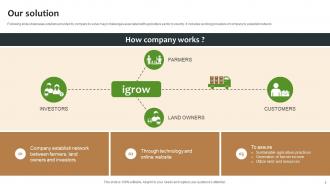
Slide 4: This slide showcases solutions provided by company to solve major challenges associated with agriculture sector in country.
Slide 5: This slide provides comprehensive overview of company. It includes elements such as founders, legal name, website, business model, industries etc.
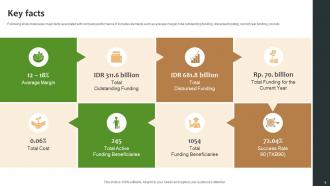
Slide 6: This slide showcases major facts associated with company performance. It includes elements such as average margin, total outstanding funding, disbursed funding etc.
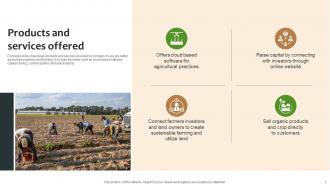
Slide 7: This slide presents products and services provided by company to assure better agriculture practices and farming.
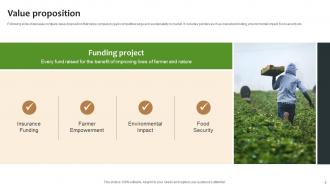
Slide 8: This slide showcases company value preposition that helps company to gain competitive edge and sustainability in market.
Slide 9: This slide displays key milestones achieved by company. It includes information about number of disbursement, agricultural land empowered, lenders associations etc.
Slide 10: This slide exhibits customer reviews and testimonials about company services. It includes viewpoints of happy clients.
Slide 11: This slide showcases major customers that require company services. It includes clients such as skilled farmers, land owners and investors.
Slide 12: This slide displays market potential that helps company to grow and expand.
Slide 13: This slide showcases business and operational model of company. It includes elements such as key partners, resources, channels etc.
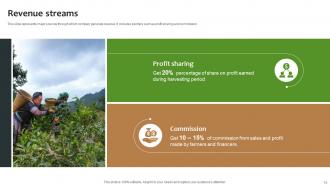
Slide 14: This slide represents major sources through which company generate revenue. It includes pointers such as profit sharing and commission.
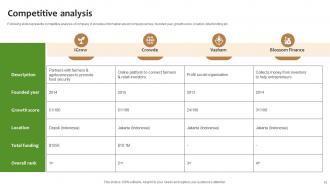
Slide 15: This slide presents competitive analysis of company. It includes information about company names, founded year, growth score, location, total funding etc.
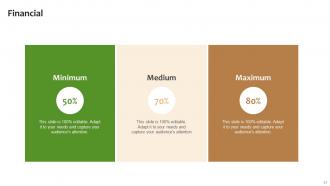
Slide 16: This slide showcases company financial statements to understand performance. It provides insights about gross profit, ROI, gross merchandise value, profit and loss report.
Slide 17: This slide displays forecasted financial performance of company. It includes elements such as operating revenue, total expenses, profits, cash from operations etc.
Slide 18: This slide highlights major reasons that helps to attract investors for fund raising. It includes pointers such as impact funding, farmer empowerment etc.
Slide 19: This slide represents funding requirement for company development activities. It includes information about total funding amount requirement along with usage of funds.
Slide 20: This slide showcases company funds usage for various agriculture and farming development. It includes funds allocated for technology, marketing, food security etc.
Slide 21: This slide exhibits company funding history. It includes elements such as announced date, funding round, amount raised, number of investors, total funding amount etc.
Slide 22: This slide represents major exit strategies of company to be used during financial crisis. It includes strategies such as acquisitions, mergers and initial public offerings.
Slide 23: This slide exhibits key members associated with company. It includes members such as CEO, COO and Community based development organization (CBDO) with experience and designation details.
Slide 24: This slide showcases company organizational structure that helps to understand roles and responsibilities. It includes members such as chairman, director, operations manager etc.
Slide 25: This slide showcases shareholding pattern of company. It include details about company shareholders name, designation and percentage of shares holdings.
Slide 26: This is a Thank You slide with address, contact numbers and email address.
Slide 27: This slide shows all the icons included in the presentation.
Slide 28: This slide is titled as Additional Slides for moving forward.
Slide 29: This is a Sand Clock Timeline slide. Show data related to time intervals here.
Slide 30: This slide contains Puzzle with related icons and text.
Slide 31: This slide shows Post It Notes for reminders and deadlines. Post your important notes here.
Slide 32: This slide presents Roadmap with additional textboxes.
Slide 33: This is an Idea Generation slide to state a new idea or highlight information, specifications etc.
Investment Pitch Deck For Agriculture Development Ppt Template with all 39 slides:
Use our Investment Pitch Deck For Agriculture Development Ppt Template to effectively help you save your valuable time. They are readymade to fit into any presentation structure.


















FAQs for Investment Pitch Deck For Agriculture
Hit the basics first: problem, solution, market size, business model, traction, competition, team, money stuff, and your funding ask. The problem-solution part is make-or-break - investors have to actually feel why this sucks for people. Oh, and throw in a "why now" slide if you can, though honestly you could just weave that into market timing. Keep it simple - one big idea per slide. Practice till you're not just reading off them like a robot. Start strong with your best proof points right away. The story should flow naturally from one slide to the next, not feel choppy.
Honestly, your pitch deck needs to tell a story, not just dump data on investors. Charts and visuals should make complex stuff instantly clear - I can't tell you how many decks I've seen that are just text walls where people's eyes glaze over. Map out your narrative first, then build slides around each key moment. Show the problem, demonstrate traction with clean graphs, illustrate where you're headed. Each slide is basically a scene in your company's journey. Sounds cheesy but it works - investors remember stories way better than spreadsheets. Start with the story arc, visuals come after.
Dude, the biggest thing I see is people being super vague about market size or going completely overboard with unrealistic numbers. Also - and this drives me crazy - everyone thinks they have zero competition. Like, come on. Another huge one is spending forever on product features but totally glossing over how you'll actually make money. Keep your slides clean too, don't cram a novel onto each one. Focus on the problem you're solving, show some real traction if you have it, and be honest about your financials. Oh and practice your timing! Going over just looks unprofessional.
Look, same pitch deck but you gotta tweak what you emphasize. VCs are all about that massive scale - hit them with your TAM and growth projections first. Angels? They're literally betting on YOU, so lean into your founder story and whatever early wins you've got. Strategic investors care about fit - how do you slot into what they're already doing? Research their past deals first (obvs). It's basically like... I dunno, job interviews where you tailor your answers but don't lie about who you are. Short sentences for impact. Longer ones when you need to explain the nuances of your approach. Don't change your core story though - just shuffle the order.
Look, market research is what makes or breaks your pitch deck - without it you're just throwing random claims at investors. You've got to prove there's actually demand for your thing and show the market's big enough to matter. Understanding your customers is huge too. And please don't say you have zero competitors because that just screams amateur hour. Your research needs to hit multiple slides - market size, customer proof, competitive stuff. Honestly the best approach? Get your data locked down first, then craft your story around what it actually shows you. Way more convincing that way.
Dude, just focus on the stuff investors actually want to see - revenue growth, margins, and when you'll be profitable. Skip all the tiny details (like seriously, no one cares about your printer ink costs). Clean charts work best - maybe 3-5 years out with monthly stuff for year one. You'll need to explain your assumptions behind everything. Oh and if you have room, throw in both a conservative and optimistic scenario. The whole thing should make sense together and match your actual business model. That's honestly the hardest part - making sure it all connects.
Honestly, white space is everything - cluttered slides look so amateur. Pick one font, one color scheme, and stick with it throughout. Don't cram everything onto one slide either. One main point per slide max, and let people actually listen to you instead of reading walls of text. Good visuals help but skip the cheesy stock photos (we've all seen that handshake picture). Make sure someone in the back row can actually read your text too. Oh, and your charts should actually mean something - not just there to look fancy. Start simple with a clean template and don't overthink it.
Don't just list what could go wrong – show how you're already handling it. When you mention competition, talk about your actual competitive advantages and how you're different. Investors already expect you to know your risks anyway, so being upfront about them makes you look more credible. Frame each risk as something you're actively tackling. Some risks can even work in your favor – like if there's tons of competition, that proves the market's worth going after. Always pair each potential problem with your game plan for dealing with it. That's what separates prepared founders from wishful thinkers.
Keep it to 10-12 slides max, then throw everything else in an appendix for later. Hit these basics: problem, solution, market size, business model, traction, competition, team, financials, funding ask, use of funds. Honestly, I've watched so many founders kill their momentum with 20+ slide decks - investors just check out. One key point per slide, that's it. You're trying to start a conversation, not deliver a lecture. Oh, and practice your story in exactly 10 minutes first, then build slides around that. Way easier than the other way around.
Oh absolutely, throw those testimonials in there! Put them right after your product explanation - that's where they hit hardest. I'd go with maybe 1-2 solid customer quotes that show actual numbers or results. Case studies are clutch too if you've got clear before/after data. Honestly, investors eat up that stuff because it proves you're not just another startup with big promises. Keep it snappy though - nobody wants to read a wall of text. Oh and pick testimonials that tackle the concerns investors will probably have anyway. Makes you look like you actually thought this through.
Honestly, visuals will save your pitch deck. Bar charts are perfect for comparisons, line graphs show growth trends, and flowcharts explain your business model way better than paragraphs of text. I've watched so many promising pitches die because of messy, overcrowded slides - it's painful. Use consistent brand colors and tons of white space. Make sure people can actually read everything from the back of the room. Here's my test: if you can't explain what a chart shows in under 10 seconds, scrap it. Oh, and definitely run your slides by someone who knows nothing about your company first.
Make sure your value prop is super clear in one sentence - what problem you solve and why you're the only ones who can do it that way. Everyone claims they're "faster and cheaper" so that's basically meaningless at this point. Focus on whatever unique insight or approach you have that competitors can't just rip off. Stick it early in your deck, like slide 2 or 3. Has to connect to an actual pain point your customers deal with - not something you think they should care about. Oh and test it on random people outside your industry. If they look confused, you need to make it simpler.
Clean visuals are everything - ditch the wall of text that puts everyone to sleep. Start with a problem they actually care about, then show real proof with customer quotes and solid numbers. None of that generic fluff. Practice your transitions so you're not fumbling around between slides (awkward silence kills momentum). Oh, and don't just talk at them - pause for questions. They'll stay way more engaged if they feel like part of the conversation. Each section needs a clear "here's why this matters for your wallet" moment. Story should flow: problem → solution → why now → money opportunity.
Oh man, this is huge. US investors want you coming in hot with bold projections and big claims right away. Europeans? Total opposite - they want conservative, data-heavy stuff. I bombed hard in Singapore once because I didn't realize Asian markets care way more about relationships and your team's background than flashy numbers. Germans will eat up detailed financial models, but show too many spreadsheets to Silicon Valley VCs and watch their eyes glaze over. Even your colors and storytelling style matter depending on where you're pitching. Research your investors' backgrounds first - it'll save you from looking clueless.
Send them the full package within 48 hours - exec summary, financials, business plan, the works. Customer testimonials are gold here since investors eat that stuff up. Get your data room ready with legal docs, team bios, competitive analysis, and IP stuff they'll want to poke around in. Also line up references from advisors or previous investors who can back you up. Honestly, half the battle is just having everything organized so they're not constantly bugging you for random documents. Makes the whole process way smoother.
-
I am not the best at presentations but using SlideTeam’s PPT template made it easier for me. Thank you SlideTeam!
-
Very unique and reliable designs.