


Rice Farming Business Plan Powerpoint Presentation Slides




Try Before you Buy Download Free Sample Product
 Impress Your
 Audience
 100%
100% Editable
 Save Hours
 of Time


A business plan is a document that defines in detail the organizations objectives and how it plans to achieve its short and long term goals. The agricultural and farming sector is considered the prime sector for any country. Check out our professionally designed Rice Farming Business Plan ppt, which provides detailed information on agriculture industry statistics, growth drivers, market trends, and key challenges of the industry, including lucrative opportunities. Moreover, it focuses on the company overview which includes vision, mission, goals, start up expenses, key products offered and success factors. Also, it describes the customer analysis for agriculture industry, buyers persona, and market sizing. Additionally, it covers the competitor analysis, SWOT analysis, PORTERS framework and detailed marketing plan. The document also covers a financial summary section including a revenue model, economic impact, profit and loss statement, break even analysis, etc. Get access now.
People who downloaded this PowerPoint presentation also viewed the following :
Content of this Powerpoint Presentation
Slide 1: This slide displays the title Rice Farming Business Plan.
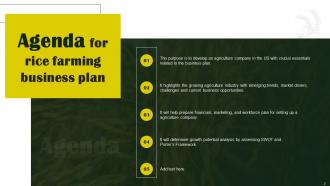
Slide 2: This slide displays the title Agenda.
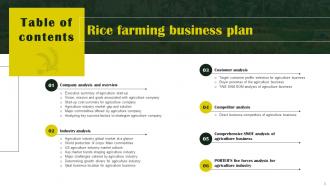
Slide 3: This slide exhibit table of content.
Slide 4: This slide exhibit table of content.
Slide 5: This slide exhibit table of content that is to be discuss further.
Slide 6: This slide provides a glimpse of the agriculture company including a quick pitch that describes the current market status of the industry.
Slide 7: This slide covers the agriculture company vision, mission, and goals.
Slide 8: This slide provides information about start-up expenditures that incur during the process of establishing a agriculture company.
Slide 9: This slide covers the problem associated with the agriculture industry and how the company will implement an effective service solution to overcome the existing gap.
Slide 10: This slide highlights the agriculture commodities by the company. It includes wheat (heard, soft and spring wheat), Rice (basmati, brown, sushi and jasmine rice) etc.
Slide 11: This slide covers the essential points to be considered while offering agriculture products in the market.
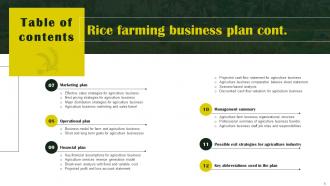
Slide 12: This slide exhibit table of content that is to be discuss further.
Slide 13: The purpose of this slide is to highlight the market size of the global agriculture industry.
Slide 14: The purpose of this slide is to highlight the world production of crops which includes sugar cane, maize, wheat, rice, paddy, oil palm fruit and potatoes.
Slide 15: This slide highlights the United States of America agriculture industry outlook which includes market share by industry, average farm size etc.
Slide 16: This slide highlights the market trends that have the potential to change the current market scenario, as well as ways that the company can stay ahead of competitors.
Slide 17: This slide highlights the key market trends that have the potential to change the current market scenario.
Slide 18: This slide portrays details about various challenges faced by the agriculture industry.
Slide 19: This slide portrays details about various challenges faced by the agriculture industry.
Slide 20: This slide caters to details about various growth drivers for agriculture industry.
Slide 21: This slide portrays an ideal business location for a agriculture business which highlights that US boats the biggest consumer market in the world.
Slide 22: This slide exhibit table of content that is to be discuss further.
Slide 23: This slide covers an assessment of how the company’s service will fit into a particular market and where they will acquire the most traction with customers.
Slide 24: This slide provides a glimpse of how to better understand the target audience, to fine-tune marketing campaigns, and increase e-commerce personalization.
Slide 25: The purpose of this slide is to depict the market potential of agriculture industry in terms of TAM, SAM, and SOM to assist startups and enterprise firms.
Slide 26: This slide exhibit table of content that is to be discuss further.
Slide 27: This slide is to provide a glimpse of major participants and key competitors of the industry to gain insight into their products, sales, and marketing tactic.
Slide 28: This slide exhibit table of content that is to be discuss further.
Slide 29: The purpose of this slide is to identify the industry' strengths, weaknesses, opportunities, and threats related to the business.
Slide 30: This slide exhibit table of content that is to be discuss further.
Slide 31: The threat of substitute products or services in the agriculture industry is moderate, as there are some alternative products.
Slide 32: This slide exhibit table of content that is to be discuss further.
Slide 33: This slide highlights the top sales strategies for agriculture business which include direct sales, focus niche markets, strong distribution, partnership.
Slide 34: This slide highlights the top pricing strategies for agriculture and farming business which include volume-based pricing strategies, cost-plus pricing strategies.
Slide 35: This slide highlights the top sales strategies for agriculture business.
Slide 36: This slide highlights customer journey mapping to track users' actions and key touch points across levels.
Slide 37: This slide exhibit table of content that is to be discuss further.
Slide 38: This slide highlights the business model for farm and agriculture business which includes key partners, key activities, value propositions, customer relationships.
Slide 39: This slide highlights the short-term and long-term milestones which includes establishing the company and acquiring land.
Slide 40: This slide provides a glimpse of important financial assumptions in terms of income, expense, and balance sheet.
Slide 41: This slide exhibit table of content that is to be discuss further.
Slide 42: The slide shows the effective revenue model of the agriculture industry, which displays the cost incurred and the various sources of income.
Slide 43: The slides highlight the break-even analysis of the firm.
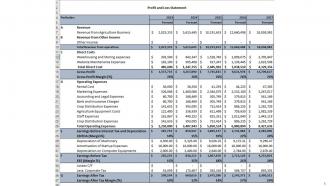
Slide 44: The slides provide a glimpse of the projected profit and loss statement to visualize the agriculture business financial performance for the next five years.
Slide 45: The slides provide a glimpse of the projected profit and loss statement to visualize the agriculture business financial performance for the next five years.
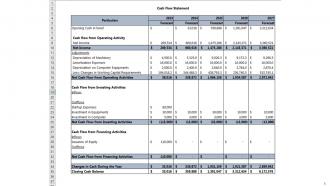
Slide 46: The slides highlight the company's cash flow statement to provide a detailed picture of what happened to a business's cash during a specified period.
Slide 47: The slides highlight the company's cash flow statement to provide a detailed picture of what happened to a business's cash during a specified period.
Slide 48: The slides cover the snapshot of the company's financial position at a specific time by showing the details of the assets of the company along with its liabilities.
Slide 49: The slides cover the snapshot of the company's financial position at a specific time by showing the details of the assets of the company along with its liabilities.
Slide 50: This slide is to examine the effects of potential future events on the company’s performance by considering different outcomes.
Slide 51: This slide is to examine the effects of potential future events on the company’s performance by considering different outcomes.
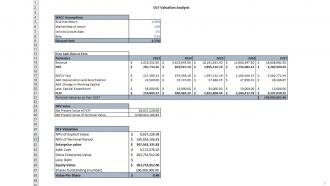
Slide 52: The purpose of this slide is to calculate the amount of money an investor would get from an investment after adjusting for the time value of money.
Slide 53: This slide exhibit table of content that is to be discuss further.
Slide 54: The slide highlights the organizational hierarchy in the company.
Slide 55: This slide highlights the founder’s biggest professional achievements and most valuable skills and the proven ways in which he will use those skills.
Slide 56: This slide highlights the job roles and responsibilities of agriculture staff to determine what kind of job has to be done and what kind of person is ideal for it.
Slide 57: This slide highlights the job roles and responsibilities of agriculture staff to determine what kind of job has to be done and what kind of person is ideal for it.
Slide 58: This slide exhibit table of content that is to be discuss further.
Slide 59: This slide represents exit strategies such as sell-offs, IPOs, mergers, and acquisitions that enable the entrepreneur to liquidate their position in a financial asset.
Slide 60: This slide exhibit table of content that is to be discuss further.
Slide 61: The purpose of this slide is to highlight the shorter version of existing words to save time and take up less space.
Slide 62: This is the icons slide.
Slide 63: This slide presents title for additional slides.
Slide 64: This slide display Venn.
Slide 65: This slide shows puzzle for displaying elements of company.
Slide 66: This slide exhibits ideas generated.
Slide 67: This slide display Our goal.
Slide 68: This slide exhibit Roadmap.
Slide 69: This slide presents your company's vision, mission and goals.
Slide 70: This is thank you slide & contains contact details of company like office address, phone no., etc.
Rice Farming Business Plan Powerpoint Presentation Slides with all 77 slides:
Use our Rice Farming Business Plan Powerpoint Presentation Slides to effectively help you save your valuable time. They are readymade to fit into any presentation structure.






































































FAQs for Rice Farming Business Plan
Okay so for your rice farming plan, definitely start with the basics - executive summary, market analysis, what varieties you're gonna grow and expected yields. Financial stuff is huge: startup costs, operating expenses, revenue projections. Honestly, talk to other local farmers first because their numbers will be way more realistic than whatever you find online. You'll also need sections on land acquisition, equipment, labor, and marketing strategy for actually selling your rice. Oh and don't forget risk management and regulatory compliance - agriculture has tons of rules. It's a lot but break it down piece by piece.
Dude, location and soil are huge for rice profits - they'll literally make or break you. You want fertile soil that drains well but still holds water, plus reliable irrigation access. Consistent rainfall or good water systems will save you tons on costs. Crappy drainage or nutrient-poor soil? You'll be throwing money at amendments and drainage fixes while getting terrible yields. Don't get me started on being stuck way out in the middle of nowhere - transport costs to processing plants and markets will eat your margins alive. Find spots near existing rice infrastructure and definitely test that soil before you buy or lease anything.
Hey! So japonica varieties like Calrose work great if you're dealing with cooler temps - Akitakomachi's another solid choice. Tropical areas? Go indica all the way. IR64 and Swarna love that heat and humidity. Honestly, hybrids are totally worth the extra cost if you can swing it - the yield difference is pretty crazy. Oh, and if water's an issue where you are, Sahbhagi Dhan handles drought like a champ. Your extension office probably has local trial data too, which is way more useful than generic recommendations online.
Honestly, I'd start with your local credit union - they actually get farming way better than those massive banks. USDA has some decent agricultural loans and grants too, especially if you're doing anything sustainable. Traditional bank loans work but you'll need solid financials and a business plan ready. Equipment financing is clutch for the big stuff like tractors. Oh, and definitely shop around - get quotes from like 2-3 places before you sign anything. The rates can vary more than you'd think. My cousin went straight to his first option and totally regretted it later.
Dude, policies literally control everything about rice farming. Subsidies can save your ass or sink you. Import rules mess with prices constantly. Land use laws decide where you can even plant, and don't get me started on water rights - that's becoming a nightmare with all these droughts. Price supports sometimes guarantee you won't lose money, which is nice I guess. Environmental regs are everywhere now too. Honestly, just stay connected with your extension office and farm bureau. They actually know what's coming down the pipeline before it hits you.
Definitely plan for both prevention stuff and emergency treatments. Regular field checks are key, plus IPM tactics like releasing beneficial bugs. Chemical backups too when things go sideways. Disease control is huge though - get resistant seeds, make sure drainage is solid, and have fungicides ready during those sketchy growth phases. Honestly, crop insurance is worth it because sometimes pests just demolish everything no matter what you do. I'd budget around 10-15% of production costs for the whole pest and disease thing - learned that one the hard way last season.
Keep about 2-4 inches of standing water once your rice gets established - maybe two weeks after planting. This kills weeds and boosts your yields big time. Drain everything before harvest though, or your equipment's gonna get stuck in the mud (learned that one the hard way). Water level gauges are worth every penny - beats guessing constantly. If you're dealing with water shortages, look into alternate wetting and drying. Track your water usage per acre from day one. Trust me, it'll save you headaches later when you're trying to figure out where costs went wrong.
Track your yields for at least 3-5 seasons and note stuff like weather, soil quality, seed types. Break down every cost - seeds, fertilizer, labor, equipment, irrigation. Most farmers I've met totally lowball labor costs by like 20%, so watch that. Your local ag extension office has good benchmark data you can use. Also factor in how input prices swing seasonally - fertilizer's way cheaper in fall usually. Start conservative your first year since you don't know what you don't know yet. Then dial it in as you get real numbers. Keep records of everything, even though it's boring as hell.
Dude, honestly three things are huge right now for rice farming. Organic and specialty varieties are where the money is - people will totally pay more for that stuff. Weather's been so crazy lately, so drought-resistant varieties are becoming a no-brainer. Plus Asian export markets are solid since rice consumption there never really drops. I'd say start by checking what your local market actually wants first. Then maybe look into export stuff through ag cooperatives or distributors - that part can get complicated but worth exploring.
Dude, tech can totally change your rice game. GPS tractors and drones help you map fields better - way less waste when planting. Smart irrigation is huge too, those soil sensors tell you exactly when to water instead of just eyeballing it. Oh and the data stuff tracks weather, crop health, all that - beats going off hunches. I know the upfront cost sucks, but honestly? Pick whatever fixes your biggest headache first. My cousin started with just the irrigation sensors and it paid for itself pretty quick.
Yeah so rice farming does mess with the environment pretty badly - those flooded fields pump out tons of methane, plus you've got fertilizer runoff and habitat destruction. Honestly the methane thing is wild when you think about it. But there's ways around this stuff for your business plan. Try that alternate wetting/drying method to cut methane, be strategic about fertilizer so it doesn't all wash away, maybe throw in some cover crops or fish systems. Oh and apparently farmers can get carbon credits now for doing things right? I'd budget for the sustainable stuff from day one since everyone's moving that direction anyway.
Dude, you've gotta try crop rotation - it's seriously a lifesaver for rice farming. When you rotate with legumes like beans, they'll fix nitrogen in your soil naturally, so your next rice harvest will be way better. Plus you're not dealing with the same pests every season. I'd honestly start small though - maybe rotate like 20-30% of your fields this year and see how it goes. Your soil health improves, you're not dumping as many chemicals, and you've got backup income if rice prices tank. My neighbor swears by it after that weird fungus problem he had two years back.
I'd hit both angles - selling direct to people and working with businesses. Farmers markets are gold for connecting with customers who actually care about where their rice comes from. Online sales work too. Social media's perfect for this stuff since rice fields are honestly gorgeous to photograph. B2B side means getting tight with local restaurants and specialty stores first - way easier than big chains. Distributors want consistent supply and good pricing (obviously). Build one solid relationship and expand from there. Oh, and local grocery stores are usually pretty open to featuring local products if you pitch it right.
Dude, cooperatives are honestly a game-changer for boosting profits. Bulk buying power means way cheaper seeds and fertilizer, and you'll get better prices selling together too. The knowledge sharing alone is worth it - older farmers know tricks you'd never figure out yourself. Group insurance and loans are sweet perks, plus sometimes you can split costs on expensive equipment. My neighbor's been bugging me to join his for months actually. Just look up local rice co-ops and hit up a meeting or two to see if they're your vibe.
Look, crop insurance is basically your lifeline for weather disasters and pests - get it. Don't plant just one rice variety either, mix it up across your fields. Forward contracts can lock in prices early which is clutch. My uncle always said keep 6 months of operating costs saved up (easier said than done but still). Those agricultural extension people are actually super helpful for early warnings about diseases and stuff. Oh and never rely on just one of these things - stack them together. Farming's risky enough without putting everything on one bet.
-
The Designed Graphic are very professional and classic.
-
Innovative and Colorful designs.