


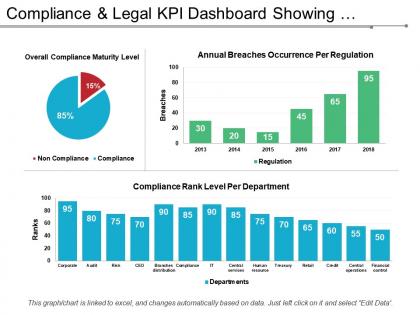
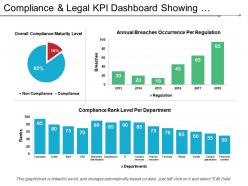
Compliance and legal kpi dashboard showing overall compliance maturity level




Try Before you Buy Download Free Sample Product
 Impress Your
 Audience
 100%
100% Editable
 Save Hours
 of Time


Delve on your corporate journey with our Compliance And Legal Kpi Dashboard Showing Overall Compliance Maturity Level. Encourage folks to continue to improve.
People who downloaded this PowerPoint presentation also viewed the following :
Compliance and legal kpi dashboard showing overall compliance maturity level with all 6 slides:
Belief becomes firm and genuine with our Compliance And Legal Kpi Dashboard Showing Overall Compliance Maturity Level. Faith will get further cemented.
FAQs for Compliance and legal kpi dashboard showing overall
Key compliance metrics for KPI dashboards include regulatory adherence rates, audit findings resolution times, policy violation frequencies, training completion percentages, and incident response durations. These metrics enable organizations to streamline oversight by tracking risk exposure, monitoring corrective actions, and ensuring regulatory alignment, with many financial services and healthcare institutions finding that comprehensive dashboards ultimately deliver enhanced transparency and reduced compliance costs.
Organizations can effectively visualize compliance data through interactive dashboards, heat maps, trend charts, real-time monitoring displays, and risk assessment matrices. These visualization tools enhance understanding by transforming complex regulatory data into intuitive formats, enabling stakeholders to quickly identify compliance gaps, track performance metrics, and make informed decisions, with many finding that visual dashboards significantly improve regulatory oversight and response times.
Real-time data transforms compliance KPI dashboards by enabling immediate detection of violations, continuous monitoring of regulatory adherence, and instant alert generation for critical issues. Through real-time integration, organizations can proactively address compliance gaps, respond to regulatory changes as they occur, and maintain audit readiness, ultimately delivering enhanced risk management and operational transparency.
Compliance KPI dashboards help identify potential risks by monitoring regulatory violations, tracking audit findings, analyzing trend patterns, and highlighting performance gaps across departments. These systems streamline risk detection by providing real-time alerts, automated compliance scoring, and predictive analytics, with many financial services and healthcare organizations finding that early warning capabilities significantly reduce regulatory penalties and operational disruptions.
Best practices for designing interactive compliance KPI dashboard include clear visual hierarchy, real-time data integration, customizable filtering options, automated alert systems, and role-based access controls. These dashboards streamline regulatory oversight by enabling drill-down capabilities, trend analysis, and exception reporting, with many financial institutions and healthcare organizations finding that intuitive design ultimately enhances compliance monitoring efficiency and reduces regulatory risk.
Compliance KPIs should be reviewed monthly for operational metrics and quarterly for strategic indicators, with real-time monitoring for critical risk areas like regulatory violations or audit findings. Many organizations find that automated dashboards enable continuous tracking while scheduled reviews ensure metrics remain aligned with evolving regulations, ultimately delivering proactive compliance management and reduced regulatory risk.
Effective compliance KPI dashboard tools include Tableau, Power BI, QlikSense, Looker, and specialized GRC platforms like ServiceNow and MetricStream. These solutions streamline regulatory reporting by automating data collection, providing real-time monitoring capabilities, and delivering customizable visualizations, with many financial services and healthcare organizations finding that integrated dashboards significantly reduce compliance costs while enhancing audit readiness.
Regulatory changes directly reshape compliance KPI dashboards by introducing new measurement requirements, modifying risk thresholds, and establishing updated reporting frequencies for various compliance areas. Organizations must recalibrate their dashboards to track emerging regulatory metrics, with financial institutions and healthcare providers finding that proactive dashboard adaptation enables faster regulatory alignment, reduces compliance gaps, and ultimately delivers competitive advantage through enhanced regulatory readiness.
Methods to ensure data accuracy within compliance KPI dashboards include automated data validation, real-time monitoring systems, regular audit trails, standardized data entry protocols, and cross-verification processes. These approaches streamline compliance tracking by minimizing human error, enabling continuous oversight, and maintaining regulatory standards, with many financial institutions and healthcare organizations finding that automated validation significantly reduces reporting discrepancies while enhancing operational efficiency.
Stakeholders can customize compliance KPI dashboards through configurable metrics, personalized alerts, role-based access controls, flexible reporting periods, and customizable visualizations. These features enable departments like finance, healthcare, and manufacturing to tailor dashboards for their regulatory requirements, ultimately delivering targeted insights and streamlined compliance monitoring across diverse organizational needs.
Common pitfalls include tracking too many metrics simultaneously, selecting vanity metrics over actionable indicators, lacking real-time data integration, poor visualization design, and insufficient stakeholder input during development. These issues often result in dashboards that overwhelm users rather than streamline decision-making, with many compliance teams finding that focusing on 5-7 critical KPIs delivers clearer insights and faster regulatory responses.
Compliance KPI dashboards facilitate regulatory communication by providing standardized, transparent reporting formats that demonstrate adherence to requirements, track key metrics in real-time, and generate automated compliance reports. These dashboards enable organizations to proactively share performance data with regulators, streamline audit processes, and maintain consistent documentation standards, ultimately building trust while reducing regulatory scrutiny and potential penalties.
Historical compliance data on dashboards reveals trend patterns, violation frequencies, regulatory gaps, audit outcomes, and risk hotspots across different departments and time periods. These insights enable organizations to identify recurring issues, predict future compliance challenges, optimize resource allocation for high-risk areas, and demonstrate regulatory improvements to stakeholders, ultimately delivering proactive risk management.
User feedback enhances compliance KPI dashboards by identifying missing metrics, improving data visualization clarity, streamlining navigation workflows, and highlighting automation opportunities. Through direct user insights, organizations can optimize dashboard layouts, integrate additional regulatory requirements, and enhance real-time monitoring capabilities, ultimately delivering more intuitive compliance management and faster regulatory response times across departments.
Integration of compliance training metrics enhances dashboards by providing comprehensive visibility into employee knowledge gaps, training completion rates, and skill development progress across departments. This strategic combination enables organizations to correlate training effectiveness with actual compliance performance, identify at-risk areas proactively, and demonstrate regulatory adherence, ultimately delivering improved audit outcomes and reduced compliance risks.
-
Qualitative and comprehensive slides.
-
Unique design & color.