


Comprehensive Swot Analysis Of Call Center Business It And Tech Support Business Plan BP SS




Try Before you Buy Download Free Sample Product
 Impress Your
 Audience
 100%
100% Editable
 Save Hours
 of Time


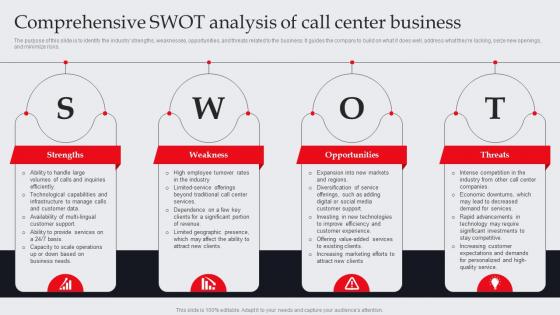
The purpose of this slide is to identify the industry strengths, weaknesses, opportunities, and threats related to the business. It guides the company to build on what it does well, address what theyre lacking, seize new openings, and minimize risks.
People who downloaded this PowerPoint presentation also viewed the following :
Comprehensive Swot Analysis Of Call Center Business It And Tech Support Business Plan BP SS with all 9 slides:
Use our Comprehensive Swot Analysis Of Call Center Business It And Tech Support Business Plan BP SS to effectively help you save your valuable time. They are readymade to fit into any presentation structure.









FAQs for Comprehensive Swot Analysis Of Call Center Business It And Tech Support Business
So SWOT has four parts: Strengths and Weaknesses (stuff you can control), then Opportunities and Threats (external market stuff you can't). But here's the thing - don't just make boring lists. The cool part happens when you connect them. Match your strengths to opportunities you spot. Figure out how weaknesses might bite you if threats show up. Sometimes opportunities can actually fix your weak spots too. I learned this the hard way in a strategy class, but honestly the cross-connections between sections matter way more than the individual lists.
Focus on what you're already killing it at and push those advantages harder. Got incredible customer service? Use that to break into markets where people actually care about being treated well. I'd honestly ignore most of your weaknesses for now - sounds counterintuitive but your strengths are literally your best weapons for growth. Pick your top 2-3 things you dominate at, then brainstorm ways each one could help you expand or grab more market share. Don't overthink it. Match your biggest wins with your best opportunities and run with that strategy first.
Honestly? Most people mess up by trying to cram everything in there - like they're afraid they'll miss something important. Pick your top 3-5 things per section, that's it. Don't mix up what's internal versus external either. Your team's skills = internal. Market trends = external. Simple but people screw it up constantly. Oh, and actually DO something with it afterward! I've seen so many companies spend hours on these things just to shove them in a drawer. Also watch out for that whole "our company is perfect" thing - we all have real weaknesses, might as well be honest about them.
So SWOT's pretty flexible - you just swap in stuff that actually matters for your industry. Tech companies? Think IP, how fast you can ship products, cyber threats, that kind of thing. Healthcare's totally different though - they're worried about regulations, patient results, licensing drama. The basic SWOT structure stays the same, but honestly the content changes completely based on what makes or breaks companies in your space. I'd start by figuring out the 3-4 things that really drive success in your industry first, then build everything around those. Makes way more sense than generic analysis.
SWOT's actually perfect for building your whole strategic plan around. Map those findings straight to your goals and use them for budget calls and market decisions. I'd revisit it every quarter though - strategies shift fast these days. Mix it with Porter's Five Forces if you really want to go deep (total nerd move but worth it). The trick is treating it like your North Star instead of some checkbox exercise. Short version: SWOT → strategic objectives → annual planning. Don't overthink it, just make sure you're actually acting on what you find.
Honestly? Do it every 6 months if you're in a fast-moving industry, but at minimum once a year. When big stuff happens - new competitors pop up, market changes, internal shake-ups - that's when you should definitely squeeze in an extra one. Some companies I know do mini versions quarterly during planning meetings. It's kinda like... you wouldn't wait until your car breaks down to check the oil, right? Same logic here. The trick is making it a habit instead of something you only think about during a crisis. Schedule your next one today before it slips your mind.
So market research is what makes your SWOT analysis actually worth doing. Look at your performance data and customer feedback to figure out your real strengths and weaknesses - not just what you think they are. For the external stuff, you need to track industry trends, what competitors are doing, and any regulatory changes coming down the pipeline. I've seen too many companies skip this step and end up with completely pointless SWOT charts. Mix hard data with qualitative insights - otherwise you're basically just making educated guesses about your business position.
Honestly, you've got a massive edge over big companies with SWOT analysis. They're drowning in committee meetings while you can spot a problem Monday and actually fix it by Friday. Your customer relationships are real - you talk to these people, not just stare at spreadsheets all day like corporate analysts do. That direct feedback makes your analysis way more accurate than their abstract market research BS. Just block out 30 minutes and focus on your top 3 strengths, weaknesses, opportunities, and threats. Don't overthink it.
Canva's my go-to for SWOT matrices - their templates actually look modern and colorful instead of boring corporate stuff. Lucidchart works well too if you want something cleaner. PowerPoint's fine but honestly their designs are pretty meh. For team brainstorming, Miro and Mural are clutch because everyone can drop sticky notes and collaborate live. That's super helpful when you're trying to get input from multiple people. If you're doing a virtual presentation, Prezi adds some nice movement so people don't zone out. Just pick whatever fits your vibe and audience really.
So basically, those external threats and opportunities become your crisis playbook. Supply chain gets wrecked? You're making defensive calls immediately. But if your competitors are drowning worse than you - honestly, that's when you can swoop in and grab market share. The tricky part is everything moves so damn fast during a crisis. Your SWOT analysis that you used to update quarterly? Yeah, throw that timeline out the window. I'm talking weekly updates now, maybe even more if things get really wild. Those external factors shift constantly when everything's on fire.
Honestly, you really want different people on your SWOT team. Your finance guy might spot risks that marketing would never think of, and marketing could see opportunities finance would miss completely. Different backgrounds = way fewer blind spots. I always think diverse teams are better at questioning stuff too - like when someone goes "wait, why do we assume that?" Short teams miss so much. Make sure people actually feel like they can speak up though. Grab folks from different departments and levels if you can.
Keep it visual - those 2x2 grids work great because people actually get them. Nobody wants to wade through bullet points (trust me on this one). Pick your biggest insights and explain what they actually mean for the business. Like, will this opportunity make you money or not? Executives want the big picture stuff while managers need the day-to-day implications. Oh, and definitely match your message to who's listening. The whole thing falls flat without clear next steps though - people need to know what to do with all this info you're giving them.
Apple's the obvious one - they knew they were great at design and went all-in on premium stuff that people would pay crazy money for. Netflix caught onto streaming way before Blockbuster even knew what hit them. Dollar Shave Club basically said "screw you" to Gillette's insane prices and went straight to customers online. Starbucks figured out how to take their whole coffee shop vibe global without losing what made them special in the first place. But honestly? Most companies do these SWOT analyses and then just... nothing. The chart looks nice in PowerPoint but nobody actually changes anything based on what they found.
Honestly, tech changes everything about SWOT analysis. Maybe you've got solid data tools as strengths, or outdated systems dragging you down as weaknesses. The opportunities part gets me excited though - AI automation, new digital markets, better customer data insights. Threats are just as real: cyber attacks, competitors who figured out tech before you did, or your whole industry getting disrupted overnight. Here's the thing - you gotta be brutally honest about your actual tech situation, not what you wish it was. That's where most people mess up.
Look, you need to pick metrics that actually match your SWOT strategies - don't just track random stuff. Revenue growth and customer satisfaction work great for strength-based moves. When you're fixing weaknesses, measure things like cost cuts or how much faster your processes get. New market penetration rates are perfect for opportunities (though honestly, partnership ROI can be tricky to nail down). Pick maybe 2-3 metrics per strategy max - otherwise you'll drown in spreadsheets. For threats, watch competitive response times or compliance rates. Oh, and set your baselines first so you can prove you actually moved the needle later.
-
I am extremely pleased with these PPT slides that we used for our event. They were easy to modify and came out great in all aspects!
-
The service is fast, and I could access any presentation after buying the subscription. I don’t think I’ll ever have to worry about a presentation in my life.