


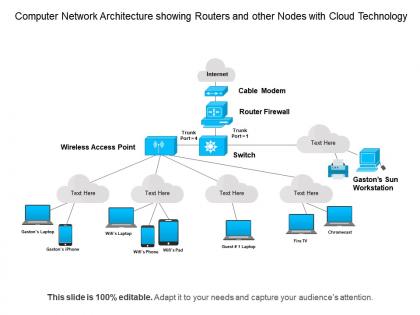
Computer network architecture showing routers and other nodes with cloud technology




Try Before you Buy Download Free Sample Product
 Impress Your
 Audience
 100%
100% Editable
 Save Hours
 of Time


Explain how you conducted the inquiry with our Computer Network Architecture Showing Routers And Other Nodes With Cloud Technology. Highlight the basis for your findings.
People who downloaded this PowerPoint presentation also viewed the following :
Computer network architecture showing routers and other nodes with cloud technology with all 5 slides:




FAQs for Computer network architecture showing routers and other nodes
Computer network architectures include peer-to-peer, client-server, hybrid, three-tier, and distributed architectures, each offering distinct advantages for different organizational needs. These architectures differ in resource management, scalability, and control distribution, with enterprises increasingly adopting hybrid models that combine centralized security with distributed processing, ultimately delivering enhanced performance and operational flexibility.
Client-server architecture operates through centralized servers providing resources, data, and services to multiple client devices that request and consume these offerings. This model delivers enhanced security, centralized management, and scalable resource allocation, while presenting challenges including server dependency, higher infrastructure costs, and potential bottlenecks, with many organizations finding that strategic implementation ultimately streamlines operations and improves system reliability.
The OSI model provides a standardized seven-layer framework for understanding how data moves through network systems, from physical transmission to application interfaces. This reference model enables network engineers, system administrators, and IT professionals to troubleshoot connectivity issues, design scalable infrastructure, and ensure interoperability across different vendors and technologies, ultimately streamlining network management and reducing operational complexity.
Peer-to-peer networking enables devices to connect directly without centralized servers, sharing resources like files, processing power, and bandwidth equally among participants. This architecture streamlines collaboration in organizations, enhances content distribution for media companies, and accelerates data sharing in research institutions, ultimately delivering cost efficiency and improved scalability while reducing single points of failure.
Network topologies significantly impact performance and reliability through their unique structural characteristics, with star topologies offering centralized management and fault isolation, ring topologies providing predictable data flow, and mesh topologies delivering redundant pathways for maximum reliability. These architectural choices enable organizations to balance factors like cost, scalability, and fault tolerance, with many enterprises finding that hybrid approaches ultimately deliver optimal performance while minimizing single points of failure across their infrastructure.
Scalability ensures networks can accommodate growing demands without compromising performance, enabling organizations to expand operations, add users, and integrate new technologies seamlessly. Through modular design approaches and flexible infrastructure, businesses achieve sustained operational efficiency, reduced upgrade costs, and competitive advantage, with many enterprises finding that scalable architectures ultimately deliver faster response times and enhanced user experiences across expanding digital operations.
Virtualization technologies revolutionize modern network architecture by enabling software-defined networking, network function virtualization, and dynamic resource allocation across distributed infrastructures. Through virtual switches and containerized applications, organizations streamline operations, reduce hardware costs, and enhance scalability, with many enterprises finding that virtualized networks deliver greater flexibility and faster deployment of services.
Security considerations in network architecture design include access control systems, firewalls, intrusion detection systems, data encryption protocols, and network segmentation strategies. These security measures work together by creating multiple defense layers, monitoring traffic patterns, and isolating critical systems, with many financial institutions and healthcare organizations finding that comprehensive security architecture ultimately delivers enhanced data protection and regulatory compliance.
Network latency significantly impacts application performance by delaying data transmission between components, reducing response times, and creating bottlenecks in real-time processes. Applications requiring instant communication, such as video conferencing platforms, online gaming systems, and financial trading software, experience degraded user experiences, with many organizations finding that optimizing network architecture through edge computing and content delivery networks ultimately delivers faster services and enhanced operational efficiency.
Essential protocols include TCP/IP for internet communication, HTTP/HTTPS for web services, SMTP for email, FTP for file transfers, and DNS for domain resolution. These protocols enable seamless data exchange across client-server, peer-to-peer, and hybrid architectures, with organizations finding that strategic protocol implementation streamlines operations, enhances security, and delivers scalable network performance.
Cloud computing and network architecture work together by providing scalable infrastructure, enabling seamless data flow, and supporting distributed resource allocation across multiple locations. Through software-defined networking and hybrid cloud models, organizations streamline operations, reduce latency, and enhance system reliability, with many enterprises finding that this strategic combination ultimately delivers greater operational efficiency and competitive advantage in increasingly complex business environments.
Wired networks use physical cables like Ethernet for connections, offering higher speeds, better security, and more stable performance, while wireless networks rely on radio frequencies for connectivity, providing greater mobility and easier installation. While wired architectures deliver consistent bandwidth and minimal interference, wireless solutions enable flexible device placement and scalability, with many organizations finding that hybrid approaches optimize both performance and accessibility.
SDN transforms traditional network architecture by centralizing network control, enabling programmable network behavior, and separating control planes from data planes. Through software-based management, organizations streamline network operations, enhance scalability, and reduce infrastructure costs, while financial institutions and healthcare providers find that SDN delivers faster service deployment and improved network agility.
Network management plays a crucial role by monitoring performance, configuring devices, troubleshooting issues, ensuring security protocols, and optimizing resource allocation across the architecture. Through automated monitoring tools and centralized control systems, IT teams can proactively identify bottlenecks, minimize downtime, and maintain seamless connectivity, ultimately delivering enhanced operational efficiency and reliable network performance for organizational productivity.
Future network architecture trends include edge computing, software-defined networking, 5G integration, AI-driven network management, and distributed cloud architectures to handle massive IoT device proliferation. These technologies streamline data processing, enhance security protocols, and optimize bandwidth allocation, with manufacturing, healthcare, and smart city initiatives finding that localized processing and intelligent automation ultimately deliver faster response times and reduced operational costs.
-
Unique research projects to present in meeting.
-
Excellent Designs.