


Computer Networking Devices Repeater For Generating Signal




Try Before you Buy Download Free Sample Product
 Impress Your
 Audience
 100%
100% Editable
 Save Hours
 of Time


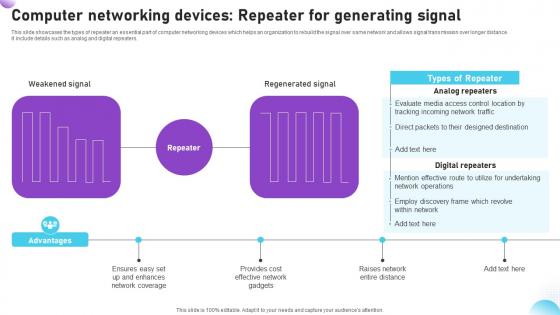
This slide showcases the types of repeater an essential part of computer networking devices which helps an organization to rebuild the signal over same network and allows signal transmission over longer distance. It include details such as analog and digital repeaters.
People who downloaded this PowerPoint presentation also viewed the following :
Computer Networking Devices Repeater For Generating Signal with all 9 slides:
Use our Computer Networking Devices Repeater For Generating Signal to effectively help you save your valuable time. They are readymade to fit into any presentation structure.








FAQs for Computer Networking Devices Repeater
A repeater is a network device that amplifies and retransmits signals to extend communication range by regenerating weakened data signals, eliminating noise, and maintaining signal integrity across longer distances. Through signal amplification and regeneration, organizations in telecommunications, manufacturing, and data centers enhance network reliability, reduce data loss, and ensure seamless connectivity across extensive facilities, ultimately delivering improved operational efficiency.
Repeaters are typically used when network signals weaken over long cable distances, in large buildings requiring extended coverage, connecting remote locations, bridging network segments across floors, and expanding wireless range in dead zones. These devices prove essential in hospitals extending connectivity across wings, manufacturing facilities linking production areas, and office complexes ensuring seamless coverage, ultimately delivering consistent network performance and eliminating connectivity gaps.
Analog repeaters amplify signals along with any accumulated noise and distortion, potentially degrading quality over long distances, while digital repeaters regenerate clean signals by decoding and re-encoding data. Digital repeaters deliver superior signal integrity, reduced interference, and consistent quality across extended networks, with telecommunications companies and broadcasting organizations increasingly adopting digital infrastructure to enhance reliability and minimize signal degradation.
Repeater limitations include signal degradation with each hop, increased network latency, potential security vulnerabilities, bandwidth reduction, and collision domain expansion in older networks. While repeaters cost-effectively extend range, many organizations find that modern alternatives like switches, access points, and fiber optic solutions deliver better performance, enhanced security, and greater scalability for expanding network infrastructure.
Yes, repeaters function in both wired and wireless networks by amplifying and retransmitting signals to extend range. In wired networks, they boost electrical signals across copper cables or regenerate optical signals in fiber systems, while wireless repeaters capture, amplify, and rebroadcast radio frequencies, with many organizations finding that strategic placement ultimately delivers seamless connectivity and enhanced network coverage.
Repeaters enhance Wi-Fi connectivity in large spaces by amplifying and retransmitting wireless signals, extending network coverage to areas with weak or no connectivity. These devices strategically bridge dead zones in warehouses, office buildings, and retail complexes, ultimately delivering seamless connectivity and improved user experiences across expansive environments.
Environmental factors significantly impact repeater performance through temperature fluctuations, humidity levels, electromagnetic interference, physical obstructions, and atmospheric conditions that affect signal propagation. These challenges can cause signal degradation, increased error rates, and reduced coverage areas, with many telecommunications and networking companies finding that strategic environmental monitoring, protective housing, and adaptive signal processing ultimately deliver more reliable network performance and consistent connectivity across varying operational conditions.
Repeaters amplify and retransmit signals at the same frequency to boost weak signals over long distances, while range extenders create new network access points to expand wireless coverage areas. Repeaters work best in wired networks and radio communications for maintaining signal strength, whereas range extenders enhance Wi-Fi coverage in homes and offices, ultimately delivering improved connectivity and eliminating dead zones.
**INPUT**: How can having too many repeaters in a network impact overall performance? **OUTPUT**: Having excessive repeaters creates cumulative signal degradation, increased latency, and potential network bottlenecks that significantly reduce data transmission speeds and reliability. While repeaters enhance coverage, organizations in manufacturing and healthcare find that strategic placement optimization, rather than quantity maximization, delivers better network performance and operational efficiency.
Repeater placement significantly impacts network coverage by determining signal strength distribution, eliminating dead zones, and ensuring seamless connectivity across extended areas. Strategic positioning enables telecommunications providers, healthcare facilities, and enterprise networks to minimize interference while maximizing coverage overlap, ultimately delivering consistent service quality and reducing infrastructure costs through optimized resource allocation.
Modern technology advancements, particularly mesh networking, significantly reduce traditional repeater dependency by creating self-healing networks where devices communicate directly with each other, eliminating single points of failure. While mesh systems streamline connectivity and enhance reliability, repeaters remain valuable for extending coverage in challenging environments, with many organizations finding that combining both technologies delivers optimal network performance and scalability.
Yes, repeaters can introduce latency through signal processing delays, propagation delays as signals travel through additional hardware components, and regeneration time required to amplify and retransmit data. While this latency is typically minimal, measured in microseconds, it becomes more significant in time-sensitive applications like financial trading or real-time communications, with many organizations finding that strategic repeater placement helps balance signal integrity with performance requirements.
Key specifications include frequency range, gain level, output power, noise figure, and coverage area requirements. These parameters determine signal quality and reach, with cellular repeaters needing different gain settings than Wi-Fi extenders, while industrial applications require higher output power and broader frequency support, ultimately ensuring optimal signal strength and reliable connectivity across your specific environment.
Repeaters receive, amplify, and retransmit signals on different frequencies, providing bidirectional communication enhancement, while boosters simply amplify existing signals on the same frequency in one direction. This distinction enables repeaters to deliver superior coverage across larger areas, minimize interference, and support multiple simultaneous connections, with telecommunications companies and enterprises increasingly finding that repeaters offer more strategic scalability for complex network infrastructures.
Businesses can effectively utilize repeaters by strategically placing them between floors to amplify network signals, installing dedicated repeater units in central locations like stairwells or elevator shafts, and implementing multi-band repeaters that support various communication frequencies. This approach enables hospitals, office complexes, and retail centers to maintain consistent wireless coverage, enhance employee productivity, and deliver uninterrupted customer experiences across all levels.
-
Professionally designed slides with color coordinated themes and icons. Perfect for enhancing the style of the presentations.
-
Fantastic collection of visually appealing PowerPoint templates. They certainly uplift the look of the presentation.