Computer Vision Powerpoint Ppt Template Bundles
Try Before you Buy Download Free Sample Product
Audience
Editable
of Time
Our Computer Vision Powerpoint Ppt Template Bundles are topically designed to provide an attractive backdrop to any subject. Use them to look like a presentation pro.
People who downloaded this PowerPoint presentation also viewed the following :
Computer Vision Powerpoint Ppt Template Bundles with all 27 slides:
Use our Computer Vision Powerpoint Ppt Template Bundles to effectively help you save your valuable time. They are readymade to fit into any presentation structure.
-
Computer Vision
-
Comparative assessment of computer vision software
-
Key elements of computer vision system for object detection
-
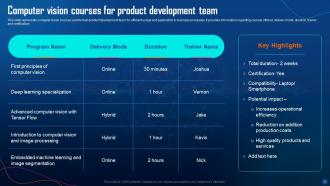
Computer vision courses for product development team
-
Key steps involved in application of computer vision system
-
Key technological achievements and trends in computer vision
-
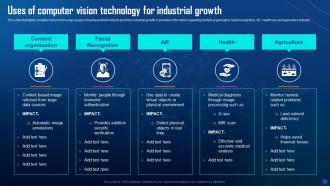
Uses of computer vision technology for industrial growth
-
Various computer vision algorithms used for machine learning
-
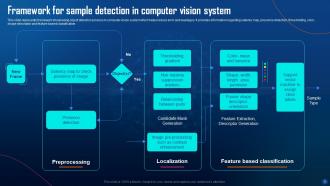
Framework for sample detection in computer vision system
-
Key components of computer vision system
-
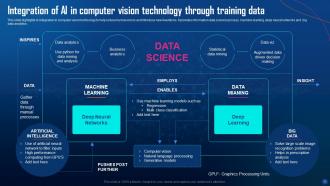
Integration of AI in computer vision technology through training data
-
Application of computer vision system in healthcare
-
Application of deep learning and computer vision in financial services
-
Effective techniques used for implementing computer vision
-
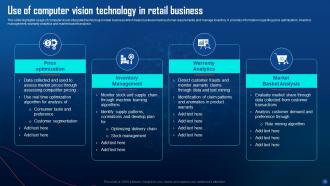
Use of computer vision technology in retail business
-
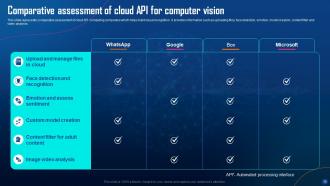
Comparative assessment of cloud API for computer vision
-
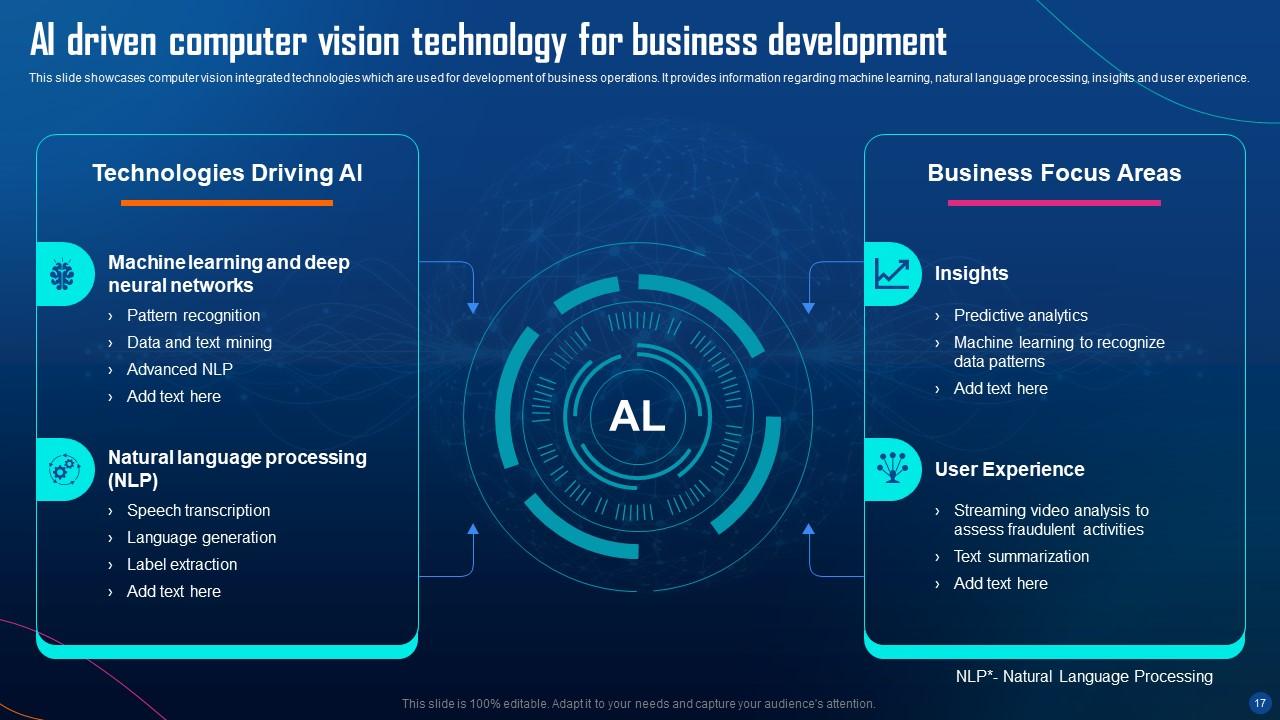
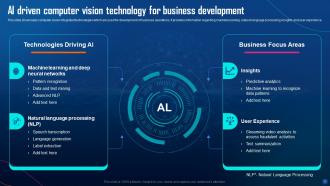
AI driven computer vision technology for business development
-
Checklist to develop automatic structured data through computer vision
-
Icon showcasing application of computer vision in healthcare
-
Icon showcasing application of computer vision in digital security
-
Icon showcasing computer vision and data science projects
-
Thanks for watching
-

-

-

-

-

FAQs for Computer Vision Powerpoint
Honestly, computer vision is pretty much everywhere these days. Retail stores use it for inventory tracking and those Amazon Go-style checkout places. Manufacturing does quality control with it - catches defects way faster than humans. Healthcare's big on it too for medical imaging stuff. Oh, and obviously self-driving cars need it to not crash into things. Security systems do facial recognition (sketchy territory there). Agriculture uses it for monitoring crops, finance for fraud detection. Look for anything in your field that involves looking at stuff and spotting patterns - that's usually where you'll see the biggest wins right off the bat.
Oh man, deep learning totally changed the game for object detection! So instead of you having to manually code what edges and shapes to look for (which was honestly such a nightmare), neural networks just learn all that stuff automatically from huge datasets. They start simple with basic edges, then gradually build up to recognizing full objects. Works way better than old methods, especially when you've got messy scenes with objects overlapping everywhere. Quick tip though - don't build from scratch. Just grab a pre-trained model like YOLO or R-CNN and save yourself weeks of headaches.
So preprocessing is basically cleaning up your images before throwing them at your model. You're resizing stuff to match, normalizing pixel values, cutting down noise - all that fun stuff. Honestly, it's like prepping ingredients before you cook (random comparison but whatever). Your model will thank you for it though. Without this step, algorithms have to work overtime just to make sense of messy data. Start simple - just normalizing and resizing can bump your accuracy up 10-20%. Trust me, it's worth the extra effort upfront.
Basically, your car's cameras work like super-fast eyes scanning everything around you. They spot pedestrians, other cars, signs - all that stuff - way quicker than we ever could. The tech automatically hits the brakes or steers you away from danger before you even realize what's happening. Pretty crazy, right? Works better in bad weather or at night compared to older sensors too. My buddy just got a new car with this stuff and honestly, it's kind of unsettling how good it is. If you're shopping around, definitely go for something with cameras on multiple sides.
Privacy invasion is huge - these systems track people who never agreed to it. Women and people of color get misidentified way more often, which leads to unfair targeting. Plus there's the whole Big Brother thing where governments are building massive face databases. Honestly, it's pretty unsettling when you really think about it. Algorithmic bias is another major problem you can't ignore. Before building anything like this, you've got to weigh whether the benefits are actually worth these serious risks and test thoroughly for bias.
Dude, computer vision is totally changing how doctors diagnose stuff. These algorithms can spot early cancers in scans, find diabetic retinopathy in eye photos, even catch skin cancer from those dermoscopy images - and they're crazy accurate now. Way faster than humans too. What's wild is they'll pick up on tiny patterns we'd completely miss, especially when you're screening tons of patients. Oh, and if you're thinking about healthcare tech opportunities? Look into how these CV models actually get plugged into existing hospital workflows. That's where the real action is happening right now.
Honestly, the speed vs accuracy thing will drive you nuts - you're constantly trying to balance real-time processing with actually decent results. Data quality is brutal too since video datasets are huge and annotating them costs a fortune. Plus you've got all the usual suspects: weird lighting, shaky cameras, objects getting blocked. Memory becomes a real headache when you're dealing with continuous streams instead of just single images. Oh, and definitely start with something lightweight like MobileNet or EfficientDet. Trust me on the preprocessing - get that pipeline solid from day one or you'll regret it later.
Dude, computer vision is a game changer for conservation stuff. Drones can catch illegal loggers red-handed, and satellites track coral reef health automatically. The tech identifies individual animals and counts populations without you having to trudge through forests manually - which honestly beats the hell out of traditional surveys. You'll get real-time data on habitat changes, oil spills, even plastic waste in oceans. My buddy started with basic camera traps using CV for local wildlife tracking. Pretty wild results for something so simple. Makes conservation way more efficient since you're getting continuous monitoring instead of occasional manual checks.
AR is forcing computer vision to get way better at real-time stuff - object detection, tracking, all that spatial understanding tech. Everything has to recognize environments instantly and overlay digital content without that jittery mess that makes you nauseous. SLAM algorithms are getting crazy good because of this. Depth estimation too. Plus they're optimizing everything for mobile since nobody wants to carry around a gaming laptop, right? AR projects are honestly becoming the best testing ground for computer vision breakthroughs. If you're doing any CV work, definitely check out AR research - they're solving problems you'll hit eventually.
So watershed and region growing are super fast but they kinda fall apart with tricky images - you get quick results but the accuracy isn't great. Deep learning stuff like U-Net and Mask R-CNN? Way better accuracy, especially on hard cases, but man they eat up compute power and you really need a decent GPU. What works "best" really comes down to what you're doing though. Real-time stuff? Go classical or find a lightweight model. High accuracy and you've got the hardware for it? Modern CNN segmentation is your friend. Honestly I'd just test a few methods on your actual data first - that'll tell you way more than any theory.
Dude, computer vision is totally changing retail right now. Smart shelves automatically reorder when stuff runs low - pretty neat. Heat mapping shows exactly where customers hang out in your store, while facial recognition tracks what displays people actually look at vs ignore. Amazon's cashierless stores are the big example everyone knows, but smaller retailers are doing virtual try-ons for clothes and makeup too. The behavior data you get from this stuff can seriously reshape your whole merchandising approach. I mean, who wouldn't want to know where customers spend their time? Sales definitely go up when you use it right.
So basically you've got all these smart cameras around the city that actually know what they're looking at - not just recording random footage. Traffic flow, parking spots, air quality, crowds... they're processing all of it in real time. The cameras do the "seeing" part while IoT sensors grab the data, then boom - traffic lights adjust themselves, incidents get flagged automatically, energy systems optimize. Pretty cool honestly. My advice? Pick one specific problem first instead of trying to fix everything at once. Way easier to prove it works that way.
So for lighting issues, histogram equalization is clutch - especially CLAHE (adaptive version). Gamma correction helps too. Perspective problems need geometric transforms like homography estimation. Honestly, data augmentation saves my butt constantly - just create fake variations during training and your model gets way more robust. Oh, and illumination-invariant features like LBP or HOG are naturally less sensitive to lighting weirdness. I'd start with CLAHE preprocessing first though. It's dead simple but works surprisingly well for most lighting headaches you'll run into.
Dude, transfer learning is a game changer for computer vision stuff. You grab a pre-trained model like ResNet that's already seen millions of images, then just fine-tune it on your data instead of starting from zero. Way better accuracy with less training time - it's honestly pretty wild how well it works. The model already knows edges and textures, so it just needs to figure out your specific classes. Oh, and you need way less data too, which is clutch when you're working on smaller projects. Seriously, just try it first before doing anything else. Building from scratch is usually overkill.
Honestly, edge computing is where it's at right now - phones doing complex image stuff without needing the cloud. Also multimodal AI that mixes vision with language understanding. Vision transformers are basically replacing CNNs everywhere, which is wild. Foundation models are huge too - one giant pre-trained model handling tons of different vision tasks. Real-time processing keeps getting better. Oh, and synthetic data generation for training is advancing fast, plus way better 3D scene understanding. The crazy part? These models are shrinking while getting more powerful. That's gonna unlock so many real-world uses.
-
Attractive design and informative presentation.
-
I had them make a presentation for an office retirement party. They were very helpful in understanding what we wanted and delivered the perfect presentation. Highly recommended!