


Computational Intelligence Powerpoint Ppt Template Bundles




Try Before you Buy Download Free Sample Product
 Impress Your
 Audience
 100%
100% Editable
 Save Hours
 of Time


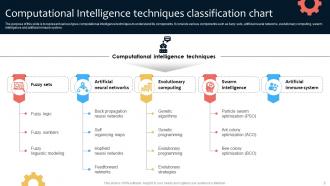
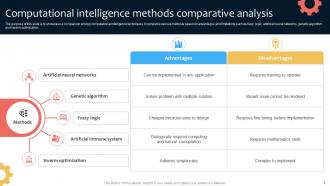
Venture into the cutting edge realm of Computational Intelligence with our in depth PPT presentation. Plunge into the intricate world of Artificial Neural Networks, designed to mimic the human brains capabilities, providing robust solutions to complex problems. Discover the magic of Evolutionary Computing, which harnesses the power of natural selection principles to optimize and adapt systems. Delve into Swarm Intelligence, an arena inspired by the collaborative behaviors of natural organisms, optimizing computational processes. Moreover, our guide sheds light on Fuzzy Systems, which capture the essence of uncertainty and vagueness in decision making. Let our PPT be your compass in navigating the dynamic and evolving landscape of Computational Intelligence, where biology and computing converge for breakthrough innovations.
People who downloaded this PowerPoint presentation also viewed the following :
Computational Intelligence Powerpoint Ppt Template Bundles with all 20 slides:
Use our Computational Intelligence Powerpoint Ppt Template Bundles to effectively help you save your valuable time. They are readymade to fit into any presentation structure.













FAQs for Computational Intelligence Powerpoint
Computational intelligence emphasizes bio-inspired approaches like neural networks, fuzzy systems, and evolutionary algorithms, while traditional AI relies on symbolic reasoning, rule-based systems, and logical inference. These paradigms differ in learning mechanisms, with computational intelligence mimicking natural processes for pattern recognition and optimization, ultimately delivering more adaptive solutions for complex, uncertain environments where traditional programming falls short.
Machine learning serves as a core subset of computational intelligence, working alongside neural networks, evolutionary computing, fuzzy systems, and swarm intelligence to solve complex problems. These technologies enhance decision-making by automating pattern recognition, optimizing resource allocation, and enabling adaptive responses, with many organizations finding that strategic combinations ultimately deliver competitive advantages and operational efficiency.
Neural networks serve as foundational components in computational intelligence systems, enabling pattern recognition, predictive analytics, decision-making automation, and adaptive learning capabilities. These architectures enhance system performance by processing complex data relationships, mimicking human cognitive functions, and continuously improving accuracy through experience, with financial institutions and healthcare organizations finding that neural network integration delivers faster fraud detection, improved diagnostic accuracy, and enhanced operational efficiency.
Swarm intelligence leverages collective behaviors of decentralized systems, including particle swarm optimization, ant colony algorithms, and bee colony methods, to tackle complex optimization challenges. These algorithms excel in supply chain management, financial portfolio optimization, and manufacturing scheduling by exploring multiple solution paths simultaneously, adapting to changing conditions, and converging on optimal solutions faster than traditional methods.
Computational intelligence techniques enhance real-time data analysis through neural networks for pattern recognition, fuzzy logic for uncertain data processing, evolutionary algorithms for optimization, and swarm intelligence for distributed analysis. These approaches streamline decision-making in financial trading, network monitoring, and manufacturing quality control, with many organizations finding that automated analysis delivers faster responses, improved accuracy, and competitive advantage in dynamic environments.
**INPUT**: What ethical considerations arise when implementing computational intelligence in decision-making processes? **OUTPUT**: Ethical considerations include algorithmic bias, transparency in automated decisions, data privacy protection, accountability for AI-driven outcomes, and ensuring human oversight remains intact. These challenges present both risks and opportunities, with many organizations finding that establishing clear governance frameworks, regular bias audits, and explainable AI systems ultimately delivers more trustworthy decision-making and enhanced stakeholder confidence. [Word count: 57 words]
Evolutionary algorithms model natural selection through population-based optimization, where candidate solutions undergo selection, crossover, and mutation processes to evolve toward optimal outcomes. These algorithms enhance problem-solving by iteratively refining solution quality, adapting to complex constraints, and exploring diverse solution spaces, with organizations in logistics, manufacturing, and financial services finding significantly improved resource allocation and operational efficiency.
Integration challenges include legacy system compatibility, data quality inconsistencies, workforce skill gaps, computational resource requirements, and change management resistance. While organizations face initial implementation complexity and training needs, many find that strategic phased approaches in sectors like manufacturing and healthcare ultimately deliver enhanced automation, improved decision-making capabilities, and competitive operational advantages.
Fuzzy logic enhances decision-making in uncertain environments by processing imprecise data, handling multiple variables simultaneously, and mimicking human reasoning patterns that work with degrees of truth rather than binary outcomes. Through fuzzy inference systems, organizations in healthcare, finance, and manufacturing can automate complex decisions, reduce processing times, and improve accuracy, ultimately delivering more adaptive responses to ambiguous situations.
Healthcare, finance, manufacturing, retail, and transportation have experienced the most transformative impacts from computational intelligence technologies. These industries leverage AI-powered diagnostics, algorithmic trading, predictive maintenance, personalized recommendations, and autonomous systems to streamline operations, reduce costs, and enhance customer experiences, with many organizations finding that computational intelligence delivers measurable competitive advantages and operational efficiency gains.
Computational intelligence facilitates natural language processing advancements through machine learning algorithms, neural networks, evolutionary computing, and fuzzy logic systems that enhance language understanding and generation capabilities. These technologies streamline text analysis, automate translation services, and improve conversational AI systems, with many financial institutions and healthcare organizations finding that intelligent language processing delivers faster customer interactions and more accurate document analysis.
Popular computational intelligence development tools include TensorFlow, PyTorch, Scikit-learn, MATLAB, Weka, and specialized frameworks like Keras and Apache Spark. These platforms streamline model development, training, and deployment by offering pre-built algorithms, scalable processing capabilities, and intuitive interfaces, with many organizations finding that combining multiple frameworks enhances flexibility and accelerates time-to-market for AI solutions.
Computational intelligence enhances human-computer interaction by enabling natural language processing, adaptive learning algorithms, and predictive user modeling. These technologies streamline communication through voice recognition, gesture control, and personalized interfaces, with sectors like healthcare and finance finding that AI-powered systems deliver faster response times, improved accessibility, and ultimately more intuitive user experiences.
Future trends in computational intelligence include quantum-enhanced algorithms, neuromorphic computing, explainable AI systems, edge intelligence deployment, and hybrid human-AI collaboration frameworks. These advancements will revolutionize sectors like healthcare diagnostics, financial risk assessment, and autonomous manufacturing by delivering faster processing speeds, reduced operational costs, and enhanced decision-making transparency, ultimately enabling organizations to achieve unprecedented competitive advantages.
Computational intelligence enhances climate prediction through machine learning algorithms, neural networks, and optimization techniques that analyze vast environmental datasets, model complex weather patterns, and simulate future scenarios with greater accuracy. These systems enable governments and organizations to optimize renewable energy deployment, predict extreme weather events, and develop adaptive strategies, ultimately delivering more effective climate policies and resource allocation for mitigation efforts.
-
Definitely a time saver! Predesigned and easy-to-use templates just helped me put together an amazing presentation.
-
Extensive range of templates! Highly impressed with the quality of the designs.