


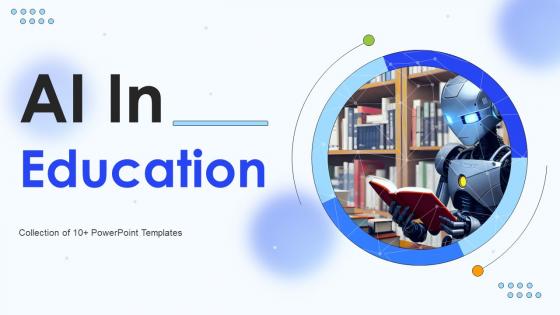
AI In Education Powerpoint Ppt Template Bundles




Try Before you Buy Download Free Sample Product
 Impress Your
 Audience
 100%
100% Editable
 Save Hours
 of Time


Our AI In Education Powerpoint Ppt Template Bundles are topically designed to provide an attractive backdrop to any subject. Use them to look like a presentation pro.
People who downloaded this PowerPoint presentation also viewed the following :
Content of this Powerpoint Presentation
Slide 1: The slide introduces AI In Education. State your company name and begin.
Slide 2: This slide shows the emerging trends of artificial intelligence deployed in the education sector to enhance the learning experience of students and teachers.
Slide 3: This slide shows how AI enhances the learning experience of students by efficiently streamlining the learning task.
Slide 4: This slide depicts trending AI education tools which help students to track real-time progress and deliver instant feedback and assessment.
Slide 5: This slide shows automating grading matrix of students in different subjects.
Slide 6: This slide highlights the top AI tools used by students to enhance learning experiences which cover features.
Slide 7: This slide shows the challenges faced while implementing the AI in education sector.
Slide 8: This slide shows the graphical presentation of the market size of AI in the education sector.
Slide 9: This slide shows the case study of Coursera company.
Slide 10: This slide shows the top trending AI tools for teachers to manage teaching tasks efficiently by automation designing assignments, grading, etc.
Slide 11: This slide shows the current market size of AI on the basis of application.
Slide 12: This slide displays the various AI courses to enhance the education system which provides multiple features.
Slide 13: This slide shows the major benefits of deploying AI in education sector which assist in streamlining the educational tasks in an efficient manner.
Slide 14: This slide demonstrates the digital lesson plan on the mobile application.
Slide 15: This slide represents the AI tools for the student to boost learning experiences.
Slide 16: This slide shows the KPI dashboard of an AI learning organisation.
Slide 17: This slide covers the case study of Duolingo company in which how they use AI algorithms to solve challenges.
Slide 18: This slide contains the KPI dashboard of an AI learning organisation.
Slide 19: This slide highlights the case study of Google company where it highlights how an organisation deploying AI algorithms to solve challenges.
Slide 20: This slide shows that AI boost learning experience which cover personalized learning, automated grading systems, and multiple lesson plans.
Slide 21: This slide renders the graphical presentation of the projected market size of AI in the education sector.
Slide 22: This slide shows the regional analysis of deploying AI in education sectors.
Slide 23: The slide displays Icon of AI in education for personalized learning.
Slide 24: The slide represents Icon of AI in education to boost digital learning
Slide 25: The slide presents Icon of AI in education to automate lesson planning.
Slide 26: This is a Thank You slide with address, contact numbers and email address.
AI In Education Powerpoint Ppt Template Bundles with all 34 slides:
Use our AI In Education Powerpoint Ppt Template Bundles to effectively help you save your valuable time. They are readymade to fit into any presentation structure.










FAQs for AI In Education Powerpoint
AI's pretty solid for education stuff. You get personalized learning that actually adjusts to how fast each kid learns - way better than the old cookie-cutter approach we all suffered through. Automated grading saves you tons of time too, plus you can spot kids who're struggling before they totally crash and burn. There's also 24/7 tutoring bots and predictive tools that flag at-risk students. My advice? Don't go crazy right away. Start with something simple like auto-feedback on assignments, then build from there once you see what works.
So basically AI tracks how each kid learns and adjusts everything on the fly. Like if someone needs more visuals or slower pacing, it figures that out automatically. Pretty neat how it spots knowledge gaps too and switches up the difficulty. For kids with disabilities, it'll throw in alternative formats without you having to set it up manually - which honestly saves so much time. The system even changes teaching methods based on different learning styles. I'd say try one of those adaptive platforms in just one subject first, see how your students react to it.
Dude, AI can seriously save your sanity with all that boring admin stuff. Automated enrollment, class scheduling, financial aid processing - it handles the grunt work. Attendance tracking becomes automatic too, which honestly should've happened years ago. You can set up chatbots for basic student questions, so your team deals with actual problems instead of "what's my GPA" for the hundredth time. Start small though - pick your most mind-numbing repetitive tasks first and automate those. Report generation is another big time-saver. Trust me, once you see how much time it frees up, you'll wonder why you waited.
Honestly, just pick one AI tool and get good at it first - don't do what I did and try five different things at once lol. ChatGPT's great for making quiz questions or discussion prompts when you're stuck. Those adaptive learning platforms are solid too for giving kids personalized practice. The whole point is using AI for the boring admin stuff so you can focus on actually teaching. Your students will probably figure it out way faster than you anyway (they always do). Don't stress about being perfect with it right away. Just mess around and see what works!
Data privacy's the big one - schools have so much student info and AI just gobbles it up. Then there's bias issues where the system might screw over certain kids unfairly. Parents need to actually understand how these algorithms are making decisions about their kid's education, which honestly most schools are terrible at explaining. Don't let it replace real human connection either - that's where learning actually happens. I'd say build your ethics rules first before rolling anything out. Student wellbeing should drive every decision you make.
So basically, AI personalizes stuff for each kid - matches their pace and what they're actually interested in. Students stay way more engaged when content hits at their level instead of being too easy or impossible. The instant feedback thing is huge too, keeps them from getting frustrated and giving up. Plus it gamifies everything which, let's be honest, kids are obsessed with that. I've noticed students actually spend more time on assignments because they're getting that constant feedback loop. Just make sure whatever AI tool you pick works with how you already teach - don't let it take over your whole classroom vibe.
So basically, these analytics tools can spot which kids might drop out by tracking stuff like attendance and how they're engaging with coursework. Pretty wild how accurate they're getting, honestly. Learning platforms adapt the difficulty based on how students are doing, and some even analyze discussion posts to catch emotional red flags - which seems slightly creepy but whatever, if it helps. The real trick though? You've got to act fast on what the data tells you instead of waiting around for traditional grades to reveal problems. Real-time knowledge gap detection is probably the coolest feature.
Look, AI can scan through all your students' work and catch learning gaps way quicker than you ever could doing it by hand. It pinpoints exactly which kids are struggling with what concepts - honestly saves so much time. You get instant feedback showing where everyone's falling behind, plus it'll suggest specific ways to help each student catch up. Most platforms recommend actual resources and activities too, which is clutch. Just make sure whatever tool you pick works with your existing setup so you're not creating more headaches for yourself. Trust me on that one.
So AI can actually group students way smarter than we usually do - like pairing people with different strengths or learning styles. It gives real-time feedback during group work and can jump in when someone's struggling. The tracking thing is pretty neat too - it watches who's contributing what so nobody gets stuck doing all the work (we've all been there, right?). Plus it knows when groups aren't clicking and suggests mixing things up. Just gotta find tools that make teamwork easier, not turn it into some weird robot thing.
Oh man, there's a bunch of stuff to watch out for. Money's obviously the biggest headache - AI tools cost serious cash and most schools are already broke. Training teachers is tricky too, especially if they're already skeptical about tech replacing them. Privacy's a massive deal since parents freak out (understandably) about their kids' data being stored somewhere. Honestly, resistance from staff who think they'll lose their jobs is probably inevitable. My brother's school tried this last year and it was chaos at first. Start with small pilot programs and get a few enthusiastic teachers on board early - makes everything way smoother.
So AI basically adapts to each student's level and gives them real-time feedback on pronunciation - which is honestly game-changing. Your ESL students can practice conversations with chatbots without feeling judged, plus they get instant grammar corrections that textbooks can't provide. The apps adjust difficulty as kids progress too. Oh, and the cultural context explanations are actually pretty solid. I'd say start with just one AI tool in your curriculum first. See how they react to getting immediate feedback - my guess is they'll love it way more than traditional methods.
Personalized AI tutors are huge right now - they actually adjust to how fast each kid learns. Real-time assessment tools are pretty cool too since you don't have to wait weeks for test scores. Your students are definitely already using AI writing assistants (probably more than you think), so might as well bring them into class officially. The whole game is shifting from just teaching content to teaching kids how to work alongside AI. Oh, and everything's moving way faster than anyone predicted. I'd honestly just pick one AI tool and start messing around with it in your classes.
Oh man, the accessibility stuff is where AI actually shines! Text-to-speech helps visually impaired kids, real-time captioning works great for hearing disabilities, and there's predictive text for motor challenges. The content can automatically adjust difficulty levels too - like converting text to audio or visual formats. Honestly, schools mess this up when they don't check if their AI plays nice with existing assistive tech first. I'd start by figuring out what disabilities your students actually have, then find AI tools that match those specific needs. Way more effective than just throwing random tech at the problem.
Honestly, I'd start with just one AI tool and really get to know it inside and out. Digital literacy is huge right now - you don't need to become some coding wizard, but understanding the basics helps you make smarter choices about when to actually use these things. Critical thinking matters way more than people realize because AI can spit out stuff that looks amazing but is totally wrong (learned that the hard way!). Stay curious since everything's changing so fast. Oh, and definitely work on being adaptable - what works today might be outdated next month.
Honestly, it's all over the place depending where you look. Singapore and South Korea are crushing it with AI tutoring built right into schools. Europe's doing pretty well too. The US? Super hit or miss - some districts are way ahead while others are stuck in the past. Developing countries are interesting though - a lot are skipping the whole computer lab thing and going straight to mobile AI apps, which is actually pretty smart. Oh and regulations matter way more than people think. If you're planning something, definitely check what policies your target area has first. Infrastructure readiness is huge too.
-
Kudos to SlideTeam for achieving the high success rate in delivering the top-notch slides.
-
Thank you for offering such helpful pre-designed templates. They are really beneficial to me in my job.