


Concentric Circles Business Marketing Strategy Development Management




Try Before you Buy Download Free Sample Product
 Impress Your
 Audience
 100%
100% Editable
 Save Hours
 of Time


Subscribe to our Concentric Circles Business Marketing Strategy Development Management and receive great value for your money. Be assured of finding the best projection to highlight your words.
People who downloaded this PowerPoint presentation also viewed the following :
Concentric Circles Business Marketing Strategy Development Management with all 12 slides:
Our Concentric Circles Business Marketing Strategy Development Management are aesthetically designed to attract attention. We guarantee that they will grab all the eyeballs you need.

FAQs for Concentric Circles Business Marketing
Concentric circles share identical centers while having different radii, creating constant equal distances between corresponding points on each circle. These mathematical properties enable precise geometric calculations, proportional scaling relationships, and systematic radial measurements, with many engineering firms, architectural practices, and design organizations finding that concentric circle principles streamline complex spatial planning and deliver enhanced structural accuracy.
Concentric circles enhance architectural and design projects by creating focal points, organizing spatial hierarchies, and guiding visual flow through structured layering. Architects leverage these patterns in amphitheaters, plazas, and building layouts, while designers apply them to logos, garden landscapes, and interior spaces, ultimately delivering balanced aesthetics and improved user navigation experiences.
Concentric circles are commonly used in astronomy, physics, chemistry, biology, and geology for modeling phenomena like planetary orbits, electromagnetic fields, atomic structures, cell organization, and geological formations. These fields leverage concentric circle models because they effectively visualize radial relationships, energy distributions, and hierarchical systems, enabling scientists to represent complex spatial patterns, predict behaviors, and communicate findings with clarity and precision.
Concentric circles in data visualization effectively display hierarchical data, comparative metrics, nested categories, radial relationships, and multi-layered information structures. These circular formats enable viewers to understand proportional relationships, identify patterns across different data dimensions, and compare values within centralized layouts, with many analysts finding that concentric designs enhance comprehension of complex datasets while maintaining visual clarity.
Concentric circles effectively represent psychological theories through models like Bronfenbrenner's ecological systems, where individual psychology sits at the center surrounded by family, community, and cultural influences. These visual frameworks help therapists, researchers, and educational institutions map complex psychological relationships, assess environmental impacts on behavior, and develop targeted interventions, ultimately enhancing treatment planning and therapeutic outcomes.
Art Nouveau, Bauhaus, Op Art, and Aboriginal Australian art have prominently featured concentric circles, representing unity, infinity, and spiritual connection across cultures. These movements used circular forms to explore visual rhythm and symbolic meaning, with Aboriginal dreamtime paintings using concentric circles to represent sacred sites, while modernist movements emphasized geometric harmony and optical effects that continue influencing contemporary design.
Concentric circles appear in nature through tree rings, flower petals, ripples on water, spider webs, and cellular structures. These patterns represent growth cycles, resource distribution, and structural efficiency in biological systems, with many organisms using concentric arrangements to optimize space utilization, enhance stability, and facilitate systematic development processes that ensure survival advantages.
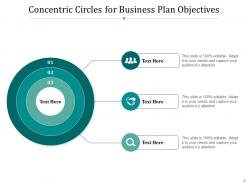
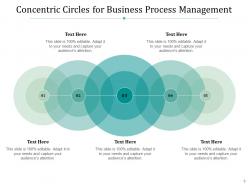
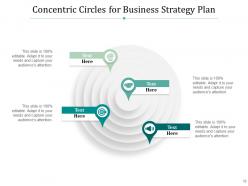
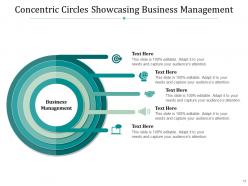
Concentric circles share the same center point but have different radii, while other circular patterns like overlapping circles, spiral arrangements, or scattered circles have varying center points and spatial relationships. These distinct characteristics make concentric circles particularly effective for representing hierarchical data, organizational structures, and layered processes in business presentations, with many companies finding that concentric designs clearly communicate core-to-periphery relationships and strategic priorities.
Concentric circles enhance strategic planning by visualizing hierarchical priorities, stakeholder relationships, market segments, and organizational layers from core to periphery. Through this framework, companies streamline decision-making processes, allocate resources more effectively, and map customer engagement strategies, with many organizations finding that concentric models deliver clearer strategic focus and improved operational alignment.
Concentric circle theories trace back to ancient philosophical traditions, including Confucian social hierarchies, Aristotelian ethics of expanding moral circles, and early sociological frameworks by thinkers like Georg Simmel and Émile Durkheim. These concepts evolved through modern organizational theory and social network analysis, with contemporary businesses finding that understanding these nested relationship structures enhances stakeholder engagement, team dynamics, and strategic community building across industries.
Technology enhances concentric circle presentations through interactive visualization tools, automated data mapping, real-time updates, and dynamic scaling capabilities. These advanced presentation platforms streamline complex data representation by enabling seamless layer manipulation, integrated analytics dashboards, and collaborative editing features, with many organizations finding that digital tools ultimately deliver more engaging stakeholder presentations and faster decision-making processes.
**INPUT**: What tools or software are best for creating visual representations of concentric circles? **OUTPUT**: Effective tools for creating concentric circle visuals include PowerPoint, Canva, Adobe Illustrator, Lucidchart, and specialized diagramming software like Visio. These platforms streamline design workflows by offering pre-built templates, customizable formatting options, and collaborative features, with many organizations finding that PowerPoint and Canva deliver professional results while minimizing technical complexity and design time. [Word count: 54 words]
Concentric circles enhance spatial awareness in navigation and mapping by creating intuitive distance references, establishing clear proximity zones, and providing systematic radius-based organization of geographic information. These visual frameworks enable GPS systems, urban planners, and maritime navigation to deliver more accurate positioning data, streamlined route optimization, and enhanced user orientation, ultimately improving navigational precision and spatial decision-making across transportation industries.
Educational activities for concentric circles include hands-on drawing exercises, interactive digital tools, geometric construction projects, real-world measurement tasks, and collaborative problem-solving scenarios. These approaches enhance spatial reasoning by combining visual learning, practical application, and analytical thinking, with many educators finding that students grasp complex geometric relationships more effectively through this multi-modal instructional strategy.
Concentric circles symbolize layered themes, character development, expanding consequences, cyclical narratives, and interconnected relationships in storytelling. Writers use this visual metaphor to represent deepening mysteries, social hierarchies, emotional journeys, and ripple effects of actions, with many authors finding that concentric structures enhance narrative depth and reader engagement through symbolic resonance.
No Reviews