


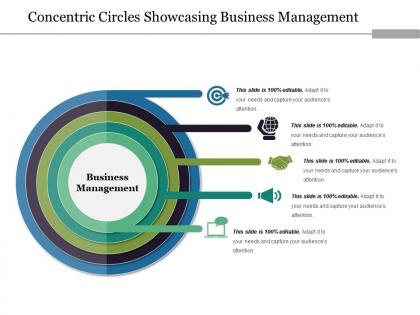
Concentric circles showcasing business management ppt sample




Try Before you Buy Download Free Sample Product
 Impress Your
 Audience
 100%
100% Editable
 Save Hours
 of Time


Increase the degree of devotion felt with our Concentric Circles Showcasing Business Management Ppt Sample. Build intensity of feeling.
People who downloaded this PowerPoint presentation also viewed the following :
Concentric circles showcasing business management ppt sample with all 5 slides:
Control the drift with our Concentric Circles Showcasing Business Management Ppt Sample. Ensure everyone gets back on course.

FAQs for Concentric circles showcasing business
Concentric circles business management operates on principles of centralized leadership, clear hierarchical layers, defined responsibility boundaries, streamlined communication flows, and strategic resource allocation from core to periphery. This approach enables organizations to maintain operational control while scaling efficiently, with many corporations finding that concentric structures enhance decision-making speed and accountability across departments.
Concentric circles enhance stakeholder engagement by organizing stakeholders into prioritized rings based on influence and impact, enabling targeted communication strategies, resource allocation, and relationship management approaches. This strategic framework helps organizations streamline engagement efforts, with many companies finding that inner-circle stakeholders like investors and key customers receive intensive attention while outer circles get broader communications, ultimately delivering more effective stakeholder relationships.
Concentric circles enable strategic resource allocation by visualizing business priorities from core operations outward, helping managers distribute budgets, personnel, and time based on organizational impact levels. Through this framework, companies systematically allocate resources to essential functions first, then secondary initiatives, with many organizations finding that this approach minimizes waste while maximizing operational efficiency and strategic focus.
Concentric circles enhance customer relationship management by segmenting customers based on value, engagement levels, and strategic importance, enabling tailored communication strategies and resource allocation. Through this framework, businesses prioritize high-value clients in inner circles while systematically nurturing outer segments, ultimately delivering personalized experiences and stronger retention rates across all customer tiers.
Visualizing business processes as concentric circles improves team collaboration by creating shared understanding of interconnected workflows, clarifying role dependencies, and establishing clear communication pathways between departments. This approach enables teams to identify collaboration bottlenecks, streamline cross-functional handoffs, and align priorities more effectively, with many organizations finding that circular process mapping enhances transparency and reduces silos across projects.
Businesses can optimize project management using concentric circles by organizing projects into core, important, and peripheral categories, enabling strategic resource allocation and priority focus. Through this visual framework, organizations streamline decision-making, enhance team coordination, and minimize project overlap, with many companies finding that this approach delivers faster project completion and improved operational efficiency.
Concentric circles for organizational hierarchies offer enhanced visual clarity, improved communication flow, better understanding of reporting relationships, streamlined decision-making processes, and clearer role definitions across all levels. This approach enables organizations to identify bottlenecks, optimize resource allocation, and strengthen coordination between departments, with many companies finding that circular mapping reduces confusion and accelerates strategic implementation.
Concentric circles enable marketers to segment audiences by positioning core customers at the center, surrounded by secondary prospects, potential leads, and broader market segments in outer rings. This strategic approach allows companies to allocate resources efficiently, customize messaging intensity for each segment, and systematically expand outreach, with many organizations finding that targeted campaigns deliver higher conversion rates and stronger customer loyalty.
Integrating concentric circles into existing frameworks presents challenges including resistance to organizational restructuring, difficulty aligning traditional hierarchical systems with circular models, resource allocation complexities, and potential disruption to established workflows. However, many organizations find that gradual implementation, starting with pilot departments, enables smoother transitions while ultimately delivering enhanced collaboration, improved decision-making speed, and stronger strategic alignment across business units.
Concentric circles help identify and prioritize core business values by placing fundamental principles at the center, with supporting values radiating outward in order of strategic importance and operational impact. This visual framework enables organizations to distinguish between non-negotiable core values and adaptive secondary principles, ultimately ensuring consistent decision-making and resource allocation across departments while maintaining cultural integrity during growth phases.
Technology supports concentric circles business strategy through integrated CRM systems, data analytics platforms, automation tools, cloud-based collaboration software, and AI-driven customer segmentation solutions. These technologies streamline resource allocation by centralizing customer data, automating priority-based workflows, and enabling real-time performance tracking across different customer tiers, ultimately delivering enhanced operational efficiency and strategic competitive advantage.
Feedback loops within concentric circles enhance decision-making by creating systematic information flow between organizational layers, enabling real-time data sharing, rapid course corrections, and comprehensive stakeholder input. Through structured communication channels, companies streamline strategic alignment, reduce decision delays, and improve outcome accuracy, with many organizations finding that this approach delivers faster market responses and enhanced competitive positioning.
Apple exemplifies concentric circles management with core hardware surrounded by services, software, and accessories, while Amazon operates with retail at its center, expanding through AWS, Prime, and logistics services. These companies demonstrate how this approach enables strategic diversification, operational synergies, and sustained competitive advantage, with many organizations finding that concentric expansion delivers both revenue growth and market resilience.
Concentric circles facilitate organizational communication by creating clear hierarchical pathways, defining information flow patterns, establishing feedback loops, and enabling structured decision-making processes. This model helps managers visualize communication channels between executives, middle management, and frontline employees, with many organizations finding that such structured approaches streamline coordination, reduce miscommunication, and ultimately enhance operational efficiency across departments.
Effectiveness metrics for concentric circles in business management include customer retention rates, operational efficiency scores, cross-functional collaboration indices, resource utilization ratios, and strategic alignment measurements. These assessment tools enable organizations to track core stability, measure expansion success across business layers, and optimize resource allocation, with many companies finding that regular metric analysis ultimately delivers enhanced organizational coherence and competitive advantage.
-
Colors used are bright and distinctive.
-
Best way of representation of the topic.