


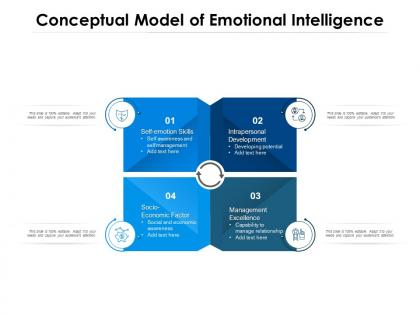
Conceptual model of emotional intelligence




Try Before you Buy Download Free Sample Product
 Impress Your
 Audience
 100%
100% Editable
 Save Hours
 of Time


Our Conceptual Model Of Emotional Intelligence are an affordable choice. It helps in cutting down costs.
People who downloaded this PowerPoint presentation also viewed the following :
Conceptual model of emotional intelligence with all 2 slides:
Our Conceptual Model Of Emotional Intelligence assist in cutting down costs. It is an affordable choice.

FAQs for Conceptual model
The Emotional Intelligence Model comprises five core components: self-awareness, self-regulation, motivation, empathy, and social skills, which collectively enhance interpersonal effectiveness and decision-making capabilities. These components enable organizations to streamline leadership development, improve team collaboration, and reduce workplace conflicts, with many companies finding that emotionally intelligent managers deliver significantly better employee engagement and organizational performance.
Emotional intelligence focuses on understanding, managing, and leveraging emotions in interpersonal interactions, while traditional intelligence measures cognitive abilities like logical reasoning, mathematical skills, and analytical problem-solving. While IQ assessments evaluate technical competencies, emotional intelligence encompasses self-awareness, empathy, and social skills that drive leadership effectiveness, team collaboration, and customer relationships, with many organizations finding that emotionally intelligent employees deliver superior performance in client-facing roles and management positions.
Emotional intelligence significantly enhances workplace productivity by improving communication, reducing conflicts, fostering better teamwork, and enabling more effective leadership decision-making. Through enhanced self-awareness and interpersonal skills, organizations experience streamlined collaboration, faster problem resolution, and reduced employee turnover, with many companies finding that emotionally intelligent teams deliver higher performance and innovation outcomes.
Emotional intelligence can be significantly developed through targeted practice, self-reflection, feedback, and skill-building exercises, while certain foundational elements may be naturally influenced by personality and early experiences. Organizations increasingly invest in emotional intelligence training programs, finding that employees enhance their self-awareness, empathy, and interpersonal effectiveness, ultimately delivering improved team dynamics and leadership capabilities.
Cultural factors significantly influence emotional intelligence perception through varying communication styles, emotional expression norms, relationship priorities, and leadership expectations across different societies. While Western cultures often emphasize individual emotional awareness and direct expression, many Eastern cultures prioritize collective harmony and subtle emotional cues, with organizations finding that culturally adapted EI training delivers better engagement and cross-cultural collaboration outcomes.
Empathy serves as a cornerstone of emotional intelligence, enabling individuals to understand, recognize, and respond appropriately to others' emotions and perspectives. This critical component enhances interpersonal relationships, communication effectiveness, and collaborative decision-making across organizations, with many leaders finding that empathetic approaches ultimately deliver stronger team performance and customer satisfaction.
Leaders utilize emotional intelligence to enhance team performance by developing self-awareness, practicing empathy, managing their emotional responses, and creating psychologically safe environments that encourage open communication. Through active listening, recognizing team members' emotional states, and adapting their leadership style accordingly, leaders can build stronger relationships, reduce workplace conflicts, and foster collaboration, ultimately delivering higher productivity and employee engagement across diverse organizational settings.
Effective strategies for improving emotional intelligence include practicing self-awareness through reflection, developing empathy by actively listening to others, managing stress through mindfulness techniques, seeking feedback on interpersonal interactions, and observing emotional patterns in workplace dynamics. These approaches enhance leadership capabilities, strengthen team collaboration, and improve decision-making processes, with many organizations finding that emotionally intelligent employees deliver better customer experiences and drive higher performance outcomes.
Emotional intelligence enhances conflict resolution by enabling individuals to recognize emotions, manage reactions, and empathize with opposing perspectives during disputes. Through improved self-awareness and social skills, managers and team leaders can de-escalate tensions, facilitate productive dialogue, and find mutually beneficial solutions, ultimately transforming workplace conflicts into opportunities for stronger collaboration and understanding.
Organizations assess employee emotional intelligence through comprehensive evaluation methods including 360-degree feedback, behavioral interviews, EQ assessment tools like EQ-i 2.0, situational judgment tests, and peer evaluations. These approaches enable HR teams to identify leadership potential, improve team dynamics, and enhance customer service capabilities, with many companies finding that strategic EQ assessment ultimately delivers stronger workplace relationships and improved organizational performance.
Emotional intelligence significantly enhances mental well-being by enabling better stress management, self-regulation, and interpersonal relationships through improved emotional awareness and coping strategies. Organizations implementing EI training programs find that employees demonstrate greater resilience, reduced burnout rates, and enhanced psychological safety, ultimately delivering improved workplace satisfaction and sustained performance across teams.
Emotional intelligence influences decision-making by enhancing self-awareness of biases, improving evaluation of social dynamics, and enabling better stress management during critical choices. Through heightened empathy and emotional regulation, leaders in healthcare, finance, and retail make more balanced decisions, considering both analytical data and human factors, ultimately delivering improved team outcomes and strategic advantage.
Self-regulation enables individuals to manage their emotional responses, control impulses, and adapt behavior appropriately in various situations, forming a crucial foundation for effective leadership and interpersonal relationships. Through enhanced self-control and emotional management, professionals in healthcare, finance, and customer service demonstrate improved decision-making, reduced workplace conflicts, and stronger team dynamics, ultimately delivering better organizational outcomes and competitive advantage.
Emotional intelligence enhances customer relationship management by enabling personalized interactions, accurate emotion recognition during communications, and proactive conflict resolution before issues escalate. Through emotional awareness training and empathetic response strategies, sales teams and customer service representatives build stronger rapport, increase customer satisfaction scores, and ultimately drive higher retention rates and lifetime value.
Educators can incorporate emotional intelligence training through interactive workshops, role-playing exercises, mindfulness practices, peer collaboration activities, and reflective journaling assignments. These approaches enhance classroom engagement, improve student relationships, and develop critical life skills, with many schools finding that structured EI programs ultimately deliver better academic outcomes and more supportive learning environments.
No Reviews