


Construction and demolition waste management technology ppt rules




Try Before you Buy Download Free Sample Product
 Impress Your
 Audience
 100%
100% Editable
 Save Hours
 of Time


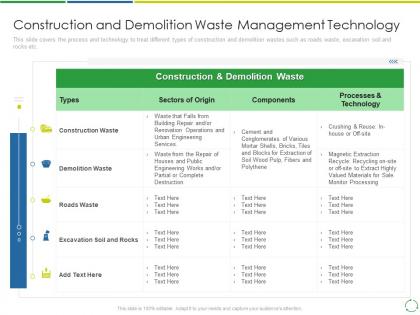
This slide covers the process and technology to treat different types of construction and demolition wastes such as roads waste, excavation soil and rocks etc.
People who downloaded this PowerPoint presentation also viewed the following :
Construction and demolition waste management technology ppt rules with all 2 slides:
Use our Construction And Demolition Waste Management Technology Ppt Rules to effectively help you save your valuable time. They are readymade to fit into any presentation structure.

FAQs for Construction and demolition waste management
Regulations are all over the place depending where you are. EU's got that Waste Framework Directive - they wanted 70% recycling by 2020 (spoiler: didn't quite work out). US is way more scattered though. California makes you report everything and they're hardcore about it, but other states barely care. Most places will make you sort stuff on-site and track where it all ends up. There's usually waste characterization rules and landfill diversion targets you'll need to hit. Honestly, just call your local environmental agency first - they're the ones who'll show up and fine you if you mess up, so might as well get the real story from them.
Design phase is where you'll make the biggest difference - plan waste reduction from day one. Digital takeoffs help you order way more precisely, and coordinate deliveries so you're not sitting on excess materials. Seriously, the waste I see on sites drives me nuts. Set up sorting areas for different materials and train crews on proper separation. Modular construction cuts waste big time if you can swing it. Build relationships with local recycling places too. Oh, and make waste tracking part of your daily check-ins. Can't be an afterthought if you want real results.
Dude, the tech happening in C&D recycling right now is actually crazy. AI sorting systems can pick out different materials faster than any crew - honestly didn't think we'd see that level of accuracy this soon. Mobile crushers are huge too since you can process concrete and asphalt right on-site instead of hauling everything. Oh, and the automated rebar separation stuff makes steel recovery way more efficient. Some places are using robots for hazardous materials now, which is probably smart. You should definitely look into mobile processing gear for your jobs - the payback period isn't nearly as long as you'd expect.
Your architect is honestly where the magic happens - they can prevent way more waste than you'll ever clean up later. Get them thinking modular designs and standard dimensions that actually match what materials come in. I learned this the hard way on my last project. Choose stuff with recycled content or things you can take apart down the road. Having them create precise material lists means you're not ordering random extra lumber "just in case." Trust me, it's so much better than staring at a dumpster full of expensive scraps. Bring up waste reduction during design meetings - future you will thank you.
Honestly, just follow the basic waste hierarchy - reduce, reuse, recycle. Design your projects to create less waste upfront. Salvage anything decent like timber and fixtures for other jobs. The disposal fee savings are actually insane! Sort materials on-site instead of dumping everything together. Partner with local recycling places - they're usually pretty helpful once you build a relationship. Track how much you're diverting from landfills to see if you're improving. Oh, and plan this stuff from day one. Don't make it an afterthought or you'll hate yourself later.
Honestly, bad C&D disposal is a nightmare for the environment. Concrete and asphalt leak nasty chemicals into groundwater when they hit regular landfills. Plus you're wasting space like crazy. What kills me is people miss out on recycling - concrete becomes aggregate, wood gets reused, metals are worth actual money. Illegal dumping happens way too often and destroys habitats. Then communities get stuck with cleanup costs. My advice? Find certified haulers who'll separate everything properly. They focus on recycling instead of just tossing it all in landfills.
Honestly, concrete's the easiest - just crush it up for new projects. Metal parts are where you'll make money though, super valuable and simple to pull out. Wood's annoying because treated lumber usually can't get recycled (chemicals and whatnot), plus you're stuck picking out every nail by hand. Different grades need sorting too which takes forever. My advice? Do the separation work during demo instead of dealing with a giant mixed pile later. Trust me, future you will thank present you for that extra planning.
Dude, waste management is actually a goldmine if you do it right. Separate dumpsters for different materials - that's your starting point. Track what you're spending on disposal now so you can see the difference later. Steel, concrete, lumber? You can resell that stuff or reuse it instead of buying new materials. The savings add up fast, trust me. Yeah, you'll need some sorting equipment upfront, but it pays for itself pretty quick. Oh, and clients eat up the sustainability angle these days - gives you an edge when bidding. Plus you won't get hit with those brutal regulatory fines that can really mess up a project budget.
Dude, you'd be shocked how much waste data can help your construction sites. Most contractors have no clue what they're actually throwing away - like, zero tracking whatsoever. Start by measuring waste volumes by material type for just one month. You'll spot patterns fast: which crews waste the most, what materials get tossed constantly, timing issues. The numbers help you order smarter, cut disposal fees, maybe even sell leftover stuff instead of junking it. Honestly, the data's pretty eye-opening once you dig in. Way better than guessing.
Honestly, the biggest pain is gonna be cost and logistics upfront. Your crews need training because - let's be real - construction guys hate changing how they do things. Separating materials on-site eats up time and labor. Finding decent recycling partners? Good luck with that headache. You'll also need to map out waste streams before you even start building, which means coordinating with subs becomes way more complicated. My advice? Start small - pick one thing like metal or concrete, show the higher-ups it actually saves money, then expand from there.
Getting residents involved is honestly a game-changer for C&D recycling. People start reporting illegal dumping when they feel invested. They'll pressure contractors to do the right thing too. Try organizing clean-up events or workshops - doesn't have to be fancy. Incentive programs work great for getting folks to sort materials properly. The trick is making participation super easy and showing real results in their neighborhood. I'd start with just one small pilot program and see how it goes. People genuinely want to help once they understand the impact.
Basically, deconstruction takes way longer but you can salvage like 50-90% of materials versus only 10-30% with regular demo. You're carefully taking apart the building to save lumber, fixtures, all that good stuff. Traditional demolition? Super fast, cheaper upfront, but most everything goes straight to the landfill - which honestly feels wasteful these days. Deconstruction means more labor costs initially, though you might make some money back selling the materials you pull out. Really depends on your timeline and how much you care about sustainability. Oh, and definitely do a pre-demo audit first to figure out what's actually worth saving before you start tearing anything down.
So instead of the usual "build it, tear it down, dump it" cycle, you're basically keeping materials moving through different projects. Plan your design upfront so stuff can actually be taken apart later - not just demolished with a wrecking ball (which is honestly kind of wasteful when you think about it). Modular construction works great for this since you can disconnect pieces cleanly. Salvage doors, windows, fixtures. Crush up that concrete for your next foundation. Steel beams? Perfect for another building. It's all about designing for disassembly from day one, not figuring it out when demolition day rolls around.
Definitely get your crew trained on sorting waste and identifying hazmat stuff - that's crucial. OSHA training isn't optional either. Online courses work for the basics, but honestly your people need to practice with real waste to get good at spotting what's recyclable. Local regulations are all over the place, so make sure you're covering what applies to your area. Oh, and reach out to your waste haulers - a lot of them do free training sessions which is pretty cool. I'd say do refreshers every few months because rules change and people forget things. Nothing worse than failing an inspection over something preventable.
C&D waste rules are all over the place internationally. The EU's got these crazy strict recycling targets and classification systems. Meanwhile, the US is a total mess - every state just wings it differently. Japan and South Korea though? They're absolutely nuts about sorting (in a good way - their recycling rates are insane). Most developing countries barely have any rules at all, let alone enforcement. Honestly, if you're doing cross-border projects, check the local requirements first thing. What's totally fine in one place could land you a hefty fine somewhere else.
-
Attractive design and informative presentation.