


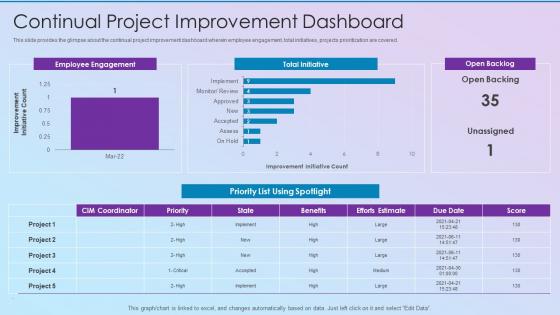
Continual Project Improvement Dashboard Process Improvement Planning




Try Before you Buy Download Free Sample Product
 Impress Your
 Audience
 100%
100% Editable
 Save Hours
 of Time


This slide provides the glimpse about the continual project improvement dashboard wherein employee engagement, total initiatives, projects prioritization are covered.
People who downloaded this PowerPoint presentation also viewed the following :
Continual Project Improvement Dashboard Process Improvement Planning with all 7 slides:
Use our Continual Project Improvement Dashboard Process Improvement Planning to effectively help you save your valuable time. They are readymade to fit into any presentation structure.





FAQs for Continual Project Improvement Dashboard
Okay so the big three are Lean, Six Sigma, and Kaizen - definitely your best bets. Lean's about cutting waste, Six Sigma uses data to fix quality problems, and Kaizen does tiny improvements constantly. Agile works well if things move fast at your place. Here's the thing though - don't stress about finding the "right" methodology from the start. Map your current process first. Find what's really broken. Then pick whatever actually fixes those problems. I learned this the hard way lol. You can mix and match later once you figure out what works.
Look at three things: customer impact, cost, and how often stuff breaks. Start with whatever's making customers mad or bail on you - that's priority one. Money bleeding comes next. Map out the biggest pain points first (honestly, your team already knows what these are, they complain about them daily). Skip the fancy analysis charts for now - just ask what's losing customers, burning cash, and happening constantly. Those quick wins will give you momentum. Short sentences work. Then tackle the messier stuff once people see results and actually want to keep going.
Your employees see everything management misses - they're in the trenches dealing with broken processes daily. Those casual complaints about workflow bottlenecks? Pure gold. I've watched companies ignore frontline insights for months, then finally listen and solve issues in weeks. The trick is making people comfortable sharing without getting blamed for "whining." Anonymous suggestion boxes work great. So do regular feedback sessions where you actually act on what you hear. Your staff already knows what's broken and probably how to fix it. You just need to ask and then actually listen to their answers.
Honestly, automation just gets rid of all that boring repetitive crap that slows everything down. Data entry, approvals, sending out notifications - you can automate most of it. Way fewer mistakes that way, and things actually get done fast for once. Your team will love you because they won't be stuck doing mindless tasks all day (seriously, nobody misses copying data around). The cool part is when you connect different systems so info just flows between departments automatically. Oh, and don't try to automate everything at once - just pick whatever process pisses everyone off the most and start there.
Definitely track both speed and quality stuff - cycle time, error rates, customer satisfaction, cost per unit. Those really matter. Also don't forget employee satisfaction because miserable workers will tank any improvement you make, trust me on that one. Get your baseline numbers first before changing anything, then stay consistent with tracking afterward. Oh and seriously, don't go metric-crazy. Pick like 4-5 that actually connect to what you're trying to fix and review them regularly. I've seen teams drown in data they never use.
Honestly, the trick is making improvement feel rewarding instead of like more work piled on. Celebrate when people suggest changes - even failed experiments deserve props. Hold retrospectives where folks can vent without getting blamed for stuff. The frontline workers usually have the best ideas anyway since they deal with the mess daily. Actually follow through on their suggestions when you can, because nothing kills morale faster than ignored feedback. Oh, and give them real work time to test process tweaks, not just "figure it out in your spare time."
Oh man, biggest mistake? Companies try fixing everything simultaneously instead of picking one process. Drives me nuts. People will fight you hard on changing "how we've always done things" - change management is seriously half your job. Also, measure where you're starting from or you can't prove anything improved later. Don't skip asking stakeholders what they actually need. And here's the worst part: leadership gets bored when results take time. Quick wins help, but make sure your executives won't bail for the next trendy project.
Honestly, cross-functional teams are total game-changers for fixing processes. When you pull in people from sales, ops, IT, customer service - basically everyone who actually touches the workflow - you avoid those awful blind spots. I've watched so many "improvements" crash and burn because only one department designed them (usually in some conference room nowhere near the actual work). Having everyone involved from the start means you're designing stuff that actually works across the whole process. Oh, and people don't fight changes they helped build. Start by figuring out who touches your process, then get them all in the room day one.
Yeah totally! Lean and Six Sigma work great together - honestly wish more people realized this. Start with Lean tools like value stream mapping to quickly spot your bottlenecks and waste. Gets you those fast wins everyone loves. Then when you hit the really gnarly problems that need serious data digging, that's where Six Sigma's DMAIC comes in handy. I've watched teams spin their wheels for months because they jumped straight into heavy analysis on the wrong issues. Use Lean for speed and flow stuff. Save Six Sigma for when you need statistical muscle on complex root causes.
Oh man, you HAVE to get stakeholders involved early. These people deal with your processes every single day - they know exactly what's broken and why. If you try to force changes on them without asking first, good luck getting anyone to actually use what you build. Here's the thing though: don't just ask for feedback after you've already decided everything. That's pointless. Get them in there when you're still figuring out the problems and brainstorming fixes. They've probably got workarounds you'd never think of, or they'll point out something super obvious that you completely missed. Makes the whole thing way smoother.
Okay so process mapping is basically like putting your workflow under a microscope - suddenly all the messy stuff becomes super obvious. Bottlenecks literally jump out at you. You'll catch things like emails sitting in someone's inbox for days, or three different people doing the same task (which happens way more than you'd think). The visual part is key because it gets everyone looking at the same picture instead of arguing about what they think happens. I always tell people to start with whatever process is driving them the most crazy. Trust me, you'll have one of those "oh wow we're actually terrible at this" moments.
Dude, Toyota's lean manufacturing completely changed the game - workers can literally stop the entire production line if they catch a problem. Amazon cut their warehouse picking times by 25% just through smart data analysis. Six Sigma at GE? That saved them billions by fixing defects. Honestly, the coolest part is you don't need to be a massive company to use this stuff. Start small with your team, track what matters, and actually listen to the people doing the work every day. They'll know where the real problems are.
Oh man, I've watched so many good ideas just die on the vine! First thing - pick someone to actually own this stuff. Can't tell you how many times everyone thinks someone else is handling it. Set up regular check-ins to see if it's actually working (not just collecting dust). Document everything and train people properly so when Sarah leaves for that new job, the knowledge doesn't walk out with her. Leadership support is huge too - without it, you're basically fighting uphill. And honestly? Celebrate the small wins along the way. People need to see it's worth the effort.
Honestly, Tableau and Power BI are your best bets for dashboards - they make data actually look good. Celonis is amazing for process mining but costs a fortune, so maybe skip that unless you've got serious budget. Excel works too if you're just starting out, though it gets annoying fast with big datasets. Minitab's decent for the stats side if you're doing Six Sigma stuff. Oh, and figure out which metrics you actually care about first - there's no point tracking everything under the sun. Pick whatever shows your KPIs in real-time without making your brain hurt.
Honestly, fixing your processes is like magic for customer happiness. People immediately feel the difference when you cut wait times or make things less confusing. I've seen companies transform their reputation just by identifying where customers get stuck - like during checkout or support calls - and smoothing those rough spots out. Fewer mistakes happen automatically when your workflow actually makes sense. Your customers don't care about your internal dashboards anyway, they just want fast, reliable service. Map out their whole journey and find the annoying parts first. That's where you'll get the biggest wins.
-
Very unique, user-friendly presentation interface.
-
What an exhaustive collection of templates you guys have there in slideteam. Impressive!!!