


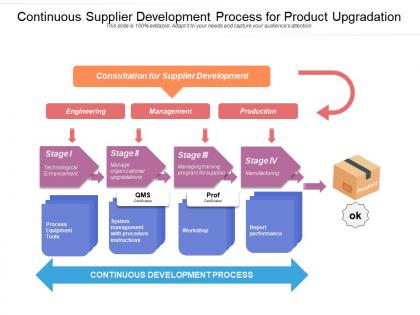
Continuous supplier development process for product upgradation




Try Before you Buy Download Free Sample Product
 Impress Your
 Audience
 100%
100% Editable
 Save Hours
 of Time


Our Continuous Supplier Development Process For Product Upgradation are topically designed to provide an attractive backdrop to any subject. Use them to look like a presentation pro.
People who downloaded this PowerPoint presentation also viewed the following :
Continuous supplier development process for product upgradation with all 2 slides:
Use our Continuous Supplier Development Process For Product Upgradation to effectively help you save your valuable time. They are readymade to fit into any presentation structure.
FAQs for Continuous supplier development process
**INPUT**: What are the key principles of effective supplier development? **OUTPUT**: Effective supplier development principles include collaborative partnership building, performance measurement and feedback, capability enhancement through training, strategic alignment with business objectives, and continuous improvement processes. These approaches streamline procurement operations by fostering transparency, reducing supply chain risks, and enhancing quality standards, with many organizations finding that strategic supplier relationships ultimately deliver cost efficiencies and competitive advantage. **Word count: 58 words**
Organizations measure supplier development success through key performance indicators like quality metrics, delivery performance, cost reductions, compliance scores, and innovation contributions from suppliers. These measurements enable companies to track improvements in operational efficiency, risk mitigation, and strategic partnerships, with many finding that regular supplier scorecards and milestone assessments ultimately deliver enhanced supply chain resilience and competitive advantage.
Communication serves as the foundation for building trust, aligning expectations, setting clear performance standards, and facilitating collaborative problem-solving in supplier relationships. Through regular dialogue, feedback sessions, and transparent information sharing, organizations can enhance supplier performance, reduce misunderstandings, and foster long-term partnerships, ultimately delivering improved quality, innovation, and supply chain resilience.
Cultural differences significantly impact supplier development through varying communication styles, business practices, relationship-building approaches, decision-making processes, and quality standards across regions. While these differences present challenges, they also create opportunities for enhanced innovation and market understanding, with many multinational organizations finding that culturally-adaptive supplier development strategies ultimately deliver stronger partnerships and competitive advantages in diverse global markets.
Supply chain training best practices include comprehensive supplier assessment programs, skills-based development workshops, technology integration training, performance monitoring systems, and collaborative knowledge sharing platforms. These approaches streamline operations by enhancing supplier capabilities, reducing quality issues, and building stronger partnerships, with many manufacturing and retail organizations finding that strategic capacity building ultimately delivers improved efficiency, cost reduction, and competitive advantage.
Companies should assess supplier development risks through comprehensive financial evaluations, operational audits, compliance reviews, market stability analysis, and dependency assessments. These evaluations help organizations identify potential supply chain vulnerabilities, with many manufacturing and retail companies finding that diversified supplier portfolios and regular risk monitoring ultimately deliver greater resilience and competitive advantage.
Technologies transforming supplier development include artificial intelligence, blockchain, IoT sensors, cloud-based platforms, and predictive analytics. These technologies streamline supplier onboarding, enhance performance monitoring, and automate compliance tracking, with manufacturing and retail organizations finding that digital supplier portals reduce evaluation timeframes by 40% while improving transparency and collaboration throughout the supply chain.
Collaboration between suppliers and buyers drives innovation by fostering shared knowledge exchange, joint problem-solving initiatives, and co-development of new technologies or processes. Through strategic partnerships, companies like automotive manufacturers and tech firms streamline product development cycles, reduce costs, and accelerate time-to-market, ultimately delivering competitive advantages and enhanced customer experiences in increasingly dynamic markets.
**INPUT**: What metrics are most effective for evaluating supplier performance post-development? **OUTPUT**: Effective supplier performance metrics include quality ratings, delivery timeliness, cost efficiency, compliance scores, and innovation contributions. These measurements enable organizations to assess development ROI by tracking defect rates, on-time delivery percentages, and cost reductions, with many companies finding that balanced scorecards ultimately deliver enhanced supplier relationships and sustained competitive advantage. **Word count: 54 words**
Neglecting supplier development can result in quality inconsistencies, supply chain disruptions, missed innovation opportunities, and weakened competitive positioning in increasingly complex markets. Organizations often face higher costs, delayed product launches, and compromised customer satisfaction, with many finding that underdeveloped supplier relationships ultimately limit scalability and strategic growth potential.
Supplier development contributes to sustainability goals by implementing green procurement standards, environmental compliance requirements, and sustainable manufacturing practices throughout the supply chain. Through collaborative partnerships, organizations enhance resource efficiency, reduce carbon footprints, and minimize waste generation, while many companies finding that strategic supplier sustainability programs ultimately deliver cost savings and stronger brand reputation.
Small businesses can employ supplier development strategies including regular performance reviews, collaborative planning sessions, joint training programs, shared technology platforms, and strategic partnership agreements. These approaches enhance operational efficiency by streamlining communication, reducing costs, and improving quality standards, with many small retailers and manufacturers finding that close supplier relationships ultimately deliver competitive advantages and faster market responsiveness.
Regulatory changes significantly reshape supplier development practices by requiring enhanced compliance monitoring, updated qualification standards, and revised contract terms to meet new legal requirements. Organizations must implement more rigorous auditing processes, provide compliance training to suppliers, and establish stronger documentation systems, with many companies in healthcare, finance, and manufacturing finding that proactive regulatory alignment ultimately delivers competitive advantage and reduced risk exposure.
Supplier development enhances supply chain resilience by diversifying supplier bases, strengthening partnerships through capacity building, implementing risk assessment protocols, and establishing collaborative contingency planning. These strategic initiatives enable organizations to reduce single-source dependencies, improve supplier financial stability, and create adaptive networks that quickly respond to disruptions, ultimately delivering greater operational continuity and competitive advantage.
The future of supplier development centers on digital integration, data-driven partnerships, AI-powered performance analytics, blockchain transparency, and collaborative innovation platforms. These technologies streamline vendor relationships by enabling real-time monitoring, predictive risk management, and seamless communication, with many organizations finding that digital-first supplier ecosystems deliver enhanced agility, cost efficiency, and competitive advantage in rapidly evolving markets.
No Reviews