

Core values and beliefs example ppt presentation




Try Before you Buy Download Free Sample Product
 Impress Your
 Audience
 100%
100% Editable
 Save Hours
 of Time


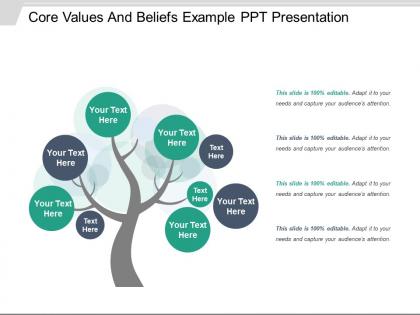
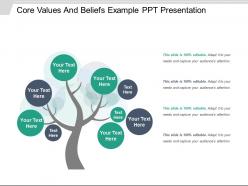
Core values and beliefs example PPT presentation is a slide presenting the core values developed by the company to inspire the staff members, customers, and stakeholders. Tree with multiple branches PowerPoint template is an ideal template to show the company core values because over here tree refers to the company as a whole and branches represent the values and beliefs as related to this tree and attached to the various departments/ branches of this tree. Sufficient text space has also been provided alongside the tree diagram where the presenter can easily mention the details of the concept he is talking about. The users can make use of this main principle of company PowerPoint presentation diagram to depict the core values of the company and their beliefs. The proper and detailed presentation of the core values and beliefs PPT slide graphic to the new entrants in the company help them to behave and act accordingly in the organization. The beliefs of the organization PowerPoint presentation slide model with its subtle color scheme helps to categorize the context of core values and beliefs exclusively. Find inspiration in our Core Values And Beliefs Example Ppt Presentation. Get inputs that fire your imagination.
People who downloaded this PowerPoint presentation also viewed the following :
Core values and beliefs example ppt presentation with all 5 slides:
Get aware of current favorites with our Core Values And Beliefs Example Ppt Presentation. They have their ear to the grapevine.
FAQs for Core values and beliefs
Honestly, three things will save your ass: be authentic, know your audience, and keep it simple. Fake enthusiasm? People can smell that from a mile away. Instead of just talking about what you want to cover, think about what they actually need to hear. Most presentations bomb because they're way too complicated - I've sat through so many where I had no clue what the main point was supposed to be. Pick one clear message and build everything around that. Oh, and don't try to sound like a corporate robot. Just be yourself up there. Master those basics and you'll crush most other presenters without breaking a sweat.
Dude, figure out what you actually believe about your topic first. Like, write down 3-4 core things you stand for - takes maybe 10 minutes but it's a game changer. Your whole presentation will have this solid backbone that makes everything else fall into place naturally. I've sat through way too many talks that felt totally scattered, and it's usually because the person skipped this step. When you're clear on your beliefs, your points aren't just random ideas anymore - they actually support each other. Plus your audience can tell when you're being real vs. just going through the motions. Trust me on this one.
Okay so here's the thing - your values are like a magnet with your audience. When they match up, people actually listen and stay hooked. But if they clash? You've lost them. Picture trying to talk about work-life balance to a room of hardcore workaholics... yeah, that's not happening. When your values align though, magic happens. They trust you more, your examples hit different, and they genuinely care about what you're saying. You'll see them nodding, asking real questions, actually remembering your points later. Honestly, just spend like five minutes before presenting to figure out what your audience values most, then connect your content to that. It's such a simple thing but makes all the difference.
Don't just throw your values on a title slide and walk away. Actually weave them into your content with real stories - like if integrity's your thing, tell people about that time you chose the harder path. Your fonts and colors should match too (but please, no rainbow explosion slides). Talk like yourself, not some corporate robot. Make sure your call-to-action reflects what you genuinely want people to do. Here's the thing though - if someone can't figure out your values just from listening to your content, you're probably being way too subtle about it. Be more obvious than you think you need to be.
Your beliefs are like a filter for what stories you pick and how you tell them. Value authenticity? You'll share messy, real moments instead of highlight reels. Innovation person? You're probably talking about those "aha!" breakthrough times. But here's what I've noticed - people can tell when you're faking it. Like, immediately. Your values show up in everything from your word choice to what parts you get emotional about. Oh, and don't try forcing stories that aren't really "you" - it's awkward for everyone. Just go with stuff that actually matters to you.
Okay so here's the thing - you don't change your actual values, just how you talk about them. Like if I'm pitching to executives, I might say "innovation" but with my team it's more "let's figure out creative solutions." Same idea, different words. People tune out when they don't connect with your language, which is honestly super frustrating when you know your idea's solid. Before you present anything, jot down what you actually believe in. Then think about how each group would naturally describe those same concepts. It's kinda like code-switching but for work stuff. Way more effective than using the same script everywhere.
Honestly, I'd start by thinking about times you felt genuinely proud of something - what was driving those feelings? Make a list of what actually matters to you, then cut it down to like 5-7 things max. Don't just throw around words like "integrity" unless you've got a real story to back it up (corporate speak is so transparent). Each value needs a personal example or moment that shows it in action. Actually explain how these things influence the choices you make day-to-day. The whole point is being real about what drives you, not whatever sounds most impressive on paper.
Oh man, this is huge - your audience's culture totally changes how they hear your message. I bombed a presentation in Tokyo last year talking about "individual achievement" because it sounded super selfish there. In the US? People eat that stuff up. But in Japan or Korea, not so much. Honestly, what feels inspiring here can sound aggressive or just naive somewhere else. Hierarchy, risk-taking, work-life balance - it all hits different depending on where you are. Do some homework on your audience's cultural background first. Keep your main message but switch up the examples and tone so it actually lands. Makes all the difference.
Honestly, just grab your company's mission statement first - I know it sounds boring but trust me on this. Go through your presentation and connect each main point back to those values. Ask yourself "does this actually fit what we stand for?" Use the same language your company uses, not just on one slide but throughout the whole thing. If you're not sure, bounce your ideas off someone who really gets the culture there. Here's the thing though - cut anything that doesn't align. I'd rather see a tight presentation that actually reflects your values than something all over the place.
Honestly, you've gotta focus on the universal stuff everyone feels - fairness, wanting to grow, needing connection. Don't get stuck in your own bubble (I see this happen way too much). Research who you're talking to first, then ditch language that assumes everyone's had your experiences. Tell stories people can relate to even if their details are different. And actually listen when people give feedback - be ready to tweak things. Quick test: ask yourself if someone totally unlike you would still get something meaningful from what you're saying. That'll tell you everything.
Honestly, the hardest part is not being fake - people see right through corporate BS. Generic buzzwords make you sound like everyone else. There's this temptation to paint some perfect picture instead of showing your actual messy values. Growing fast or changing leadership makes consistency even trickier (been there). My take? Be brutally honest with yourself first about what you really stand for. Then find concrete examples where those values played out. Skip the boring list format - tell actual stories that prove your point. Way more believable.
Your visual choices need to match what you actually believe in. Bold colors and sleek fonts work great if you're all about innovation. But if trust is your thing? Stick with blues and clean, professional layouts. I swear, half the websites I see look pretty but totally miss the mark on messaging. Your color scheme, fonts, how you use white space - it all needs to echo your values. Short sentences hit different than long flowing ones, you know? Just make sure whoever's designing for you gets your core beliefs from day one, otherwise you'll end up with something that looks good but feels completely off-brand.
Honestly, feedback is like having a mirror held up to your presentation. You think you're nailing authenticity, but audiences catch stuff you totally miss - like when your actions don't actually match what you're saying. It's wild how we can contradict ourselves without realizing. Other people spot those blind spots way better than we do. Don't just ask about your delivery though - that's not the point. Ask colleagues you trust: "Did this feel genuine to who we are as a company?" That specific question hits different than generic feedback. That's where you'll actually improve.
Look, people can tell when you're being real about what matters to you. Share why you actually care about your topic - not just the facts, but the personal stuff. Then back it up with how you act. Say integrity's your thing? Just admit when you don't know something instead of making stuff up. Way better than pretending to be an expert. I've seen too many presentations where someone talks about their values but then contradicts themselves five minutes later. Be consistent. Oh, and start your next one by telling people why this topic hits different for you personally. That's where the trust happens.
Okay so here's what works - find 2-3 real stories from your company where each value actually happened. Like when "integrity" meant your team told a client the truth even though it was messy. Then break down what that looks like day-to-day: "collaboration" = we actually ask other teams before making big calls. Stories beat bullet points every single time, trust me on this. I learned this the hard way after boring people to death with value lists on slides. End each one with "this means we..." so everyone knows what you're actually asking them to do. Makes it way less abstract and more like, oh okay I get it now.
-
Amazing product with appealing content and design.
-
Informative design.