


Core values communication good ppt example




Try Before you Buy Download Free Sample Product
 Impress Your
 Audience
 100%
100% Editable
 Save Hours
 of Time


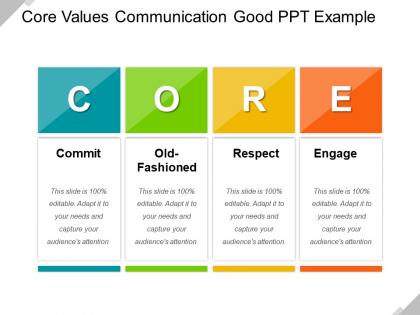
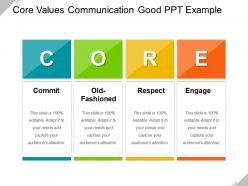
Provide a direction to our business and to your team by means of this core values communication good PPT example. You can make use of this presentation tiles communicate the CORE values PPT slide graphic during company tie-ups or merger meetings or while building company brand image. Thus, we have brought to you business core values PowerPoint template pertaining to the crucial corporate statements. Our professionally organizational values PPT slide infographic will give you complete usage ease. The visuals as used in the slide are breathtakingly impressive. Make use of this slide to illustrate what you aim at, what keeps you driven, and what are the ideas on which your entire enterprise is based on. Over here C stands for a commitment to the goals and objective, following the old fashioned belief of delivering the values, respecting our age-old relationships and engagement to the job. Our expertly designed graphics prove to be instrumental in everything that you communicate. So transform yourself from a dynamic manager to the most vivacious presenter and create an everlasting memory in the mind of the audience. Our Core Values Communication Good Ppt Example excel at giving good cues. Ensure you don't forget important elements.
People who downloaded this PowerPoint presentation also viewed the following :
Core values communication good ppt example with all 5 slides:
Your ideas have been built on firm foundations. Progress your case with our Core Values Communication Good Ppt Example.


FAQs for Core values communication
Honestly, it all comes down to three things: be consistent, tell actual stories, and make it personal for your team. Don't just slap motivational posters everywhere (though let's be real, they'll probably end up there anyway). Leadership has to walk the walk - people notice actions way more than fancy speeches. Connect your values to everyday decisions and call out team members when they're crushing it. The game-changer though? Give people natural language to talk about this stuff. I'd start with finding one killer story that shows each value in action. Makes it way less corporate-y and more real.
Your team's core values? They're literally the playbook for everything - decisions, how people treat each other, conflict resolution, you name it. But here's the thing: I've worked places where values were just fancy posters versus actually living them, and wow, what a difference. Leadership has to walk the walk first though. People don't listen to what you say nearly as much as they watch what you do in meetings and tough calls. When your team genuinely connects with the mission, engagement goes through the roof. It's honestly that simple - but most companies still get it backwards.
Honestly, forget just handing people a laminated values card - that's so cringe! You want new hires actually seeing your values play out through real stories from current employees. Interactive stuff works way better. Role-playing scenarios, case studies, whatever gets them engaged. The goal isn't just knowing what your values are, but understanding how they actually look in day-to-day work decisions. Have team members share specific examples of when they've used the values. That way new people have concrete stuff to reference later when they're figuring things out on their own.
Honestly, you need to hit this from a few angles. Start with surveys - can people actually name your values and spot them in everyday decisions? Exit interviews are pure gold for this stuff. Watch how managers make choices too. Do their actions match what's on the wall posters? Performance reviews and team meetings should naturally reflect your values if they're real. Oh, and check across departments because different teams can interpret the same values totally differently. The tricky part isn't just whether people know them - it's whether they're actually living them day-to-day.
Look, you can't just slap values on the wall and expect magic. Leaders have to actually talk about this stuff - in meetings, when making decisions, all that. Tell stories about times when values helped with tough calls. Celebrate people who live them out. I've watched so many places where bosses just give it lip service and wonder why nothing changes. Pretty obvious why, honestly. When your leaders reference values while explaining decisions and actually walk the walk? That's when people realize they're not just corporate fluff. Short version: make values part of how you communicate everything.
Honestly, stories work way better than just posting "integrity" on a wall somewhere. Find real examples from your team - like when Sarah stayed late to help that customer even though her shift was over. Our brains are wired to remember stories, not bullet points. Share these during meetings, on social media, wherever. Just make sure they're actual human moments, not corporate BS that makes people roll their eyes. I'd start asking around for these stories now. People have them, they just don't think to share. Way more powerful than any mission statement.
Honestly, it's that whole saying vs. doing thing. Companies slap "integrity" on their website but then when money gets tight? Different story. Leaders think they're walking the walk, but they'll make decisions that totally go against what they preach - and half the time they don't even see it. Each department ends up doing their own interpretation of the values anyway. Then managers send mixed messages, employees get cynical about the whole thing... it's a mess. You really need systems that track whether people are actually behaving according to those values, not just hitting revenue targets.
Honestly, visuals beat boring text every time. People actually remember infographics and videos way better than some mission statement poster. Like, when you show "integrity" through real workplace examples instead of just the word itself? That actually means something. We're visual creatures - I swear most of us need to *see* concepts to really get them. A simple diagram showing your values in action will stick around in people's heads. Plus it gets conversations going. Way better than another corporate email that everyone deletes.
Honestly, anonymous surveys are your friend here - people actually tell the truth when they know it won't come back to bite them. Exit interviews are pure gold too since folks leaving have zero reason to sugarcoat things. You could try focus groups or manager check-ins, but those feel more formal. Oh, and those pulse surveys throughout the year work well if you don't want to wait for annual feedback. Maybe set up a digital suggestion box or use Slack for ongoing chats about how values play out day-to-day. I'd start with the anonymous route first - easy win.
Slack channels for value recognition work pretty well. Also weave your values into video meetings by calling out good examples from the team. Simple visual stuff helps too - email signatures, virtual backgrounds, whatever. Honestly, storytelling beats just dumping value statements on the intranet every time. People actually remember real stories. Virtual town halls where you spotlight team members living the values? That really hits different. Don't go crazy trying to do everything at once though - pick one platform and build from there. Your team will thank you for not overwhelming them.
Look, sharing your values upfront lets customers figure out if you're their kind of company - that's how real loyalty happens. People genuinely want to back brands that match their beliefs. Your values become what sets you apart from competitors, not just your features or prices. BUT (and this is huge) - you can't fake it. Actually live those values every day. I've seen too many companies get destroyed on social media for saying one thing and doing another. Customers will absolutely roast you for being fake. First step? Check if you're actually walking the walk with what you preach.
Just build it right into your regular performance reviews - way easier than starting from scratch. Create specific behavioral examples for each value instead of vague questions. Like instead of "shows integrity," use "admits mistakes openly" or "speaks up about process issues." Rate these behaviors exactly like other skills. Honestly, this is the only way I've seen values actually stick rather than becoming meaningless wall art. Your managers need real examples to point to during reviews though. Makes everything way more concrete and actually useful.
Oh man, misaligned values communication is a recipe for disaster. Your people get totally confused about what actually matters and start making decisions that contradict each other. Trust in leadership? Gone. It's honestly like everyone's following different maps to the same destination - complete mess. You'll notice higher turnover pretty quick, plus customers get inconsistent experiences. Teams end up working against each other instead of together, which is so frustrating to watch. The worst part? When employees see a gap between what you preach and what gets rewarded, they become cynical fast. I'd start by checking all your communication channels for mixed messages.
Honestly, this is when you really need to hammer home your core values - like, more than you think you do. People get anxious during change and start looking for something solid to hold onto. Your values should be that anchor. I always tell leaders: don't assume everyone remembers what you stand for when everything's chaotic. Work those values into every email, every meeting about the change. Explain decisions through that lens. And here's the thing - your team will be watching your every move, so you better actually live those values too. Pick whichever one connects most to what you're changing and start there.
Honestly, just print out a simple values checklist and tape it to your monitor - sounds dumb but it works. First thing though, look at what you're already sending out to see where you're missing the mark. Train your team to naturally work your values into emails and social stuff without being preachy about it. I've watched companies totally overdo this and sound fake as hell. Maybe get someone in each department to be the "values person" who can give feedback on messaging? Oh and definitely set up some kind of approval process for the bigger communications. The whole point is making it automatic, not something you remember last minute.
-
Editable templates with innovative design and color combination.
-
Great product with effective design. Helped a lot in our corporate presentations. Easy to edit and stunning visuals.