


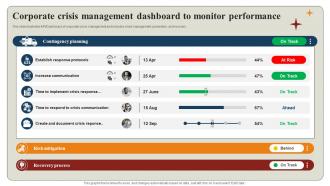
Corporate Crisis Management Dashboard To Monitor Performance





Try Before you Buy Download Free Sample Product
 Impress Your
 Audience
 100%
100% Editable
 Save Hours
 of Time


This slide illustrates KPI Dashboard of corporate crisis management and includes crisis management, prevention, and recovery.
People who downloaded this PowerPoint presentation also viewed the following :
Corporate Crisis Management Dashboard To Monitor Performance with all 9 slides:
Use our Corporate Crisis Management Dashboard To Monitor Performance to effectively help you save your valuable time. They are readymade to fit into any presentation structure.








FAQs for Corporate Crisis Management Dashboard
Key components include crisis response teams, communication protocols, stakeholder mapping, risk assessment frameworks, and recovery procedures. These elements work together by establishing clear leadership structures, enabling rapid decision-making, and maintaining transparent communication channels, with many organizations finding that comprehensive planning significantly reduces response time and protects brand reputation during critical incidents.
Organizations can anticipate potential crises through comprehensive risk assessments, scenario planning exercises, stakeholder feedback monitoring, early warning systems, and regular vulnerability audits. These proactive approaches enable companies to identify emerging threats across operations, reputation, and market conditions, while implementing preventive measures and response protocols, ultimately delivering enhanced resilience and competitive advantage in an increasingly volatile business environment.
Communication serves as the foundation of effective crisis management, enabling transparency, stakeholder alignment, and reputation protection through clear messaging, timely updates, and consistent information flow across all channels. Strategic communication helps organizations maintain trust, minimize speculation, and coordinate response efforts, with companies like Johnson & Johnson and Southwest Airlines demonstrating how proactive, honest communication ultimately preserves brand credibility and accelerates recovery.
Leadership significantly influences crisis management effectiveness through clear communication, decisive decision-making, resource allocation, and stakeholder coordination during critical situations. Strong leaders enhance organizational resilience by establishing transparent protocols, maintaining team morale, and adapting strategies in real-time, with many corporations finding that executive visibility and authentic communication ultimately deliver faster recovery and stronger stakeholder confidence.
**INPUT**: What are the best practices for training employees on crisis response? **OUTPUT**: Best practices for training employees on crisis response include regular scenario-based simulations, clear role assignments, communication protocols, decision-making frameworks, and cross-departmental coordination exercises. These approaches enhance preparedness by building muscle memory, streamlining response times, and ensuring consistent messaging, with many organizations finding that comprehensive training programs ultimately deliver faster recovery, reduced operational disruption, and stronger stakeholder confidence during actual crisis situations. **Word count: 60 words**
Social media significantly impacts corporate crisis management by accelerating information spread, enabling real-time stakeholder communication, and providing direct response channels to address concerns immediately. However, it also presents challenges through rapid misinformation propagation and amplified negative sentiment, with many organizations finding that proactive social media strategies ultimately deliver faster crisis resolution and enhanced transparency.
Key metrics include response time, stakeholder sentiment analysis, media coverage tone, operational continuity rates, financial impact assessment, and recovery timeline benchmarks. These measurements enable organizations to evaluate their crisis handling across communications, operations, and reputation management, with many companies finding that comprehensive tracking ultimately delivers improved preparedness, faster recovery, and enhanced stakeholder confidence for future incidents.
Companies should prioritize stakeholders during a crisis by focusing first on employee safety and customer well-being, followed by regulatory compliance, investor communications, and community impact. This strategic approach enables organizations to maintain operational continuity while preserving trust, with many businesses finding that transparent, tiered communication ultimately delivers stronger stakeholder relationships and competitive advantage.
Corporations should prioritize regulatory compliance, stakeholder communication transparency, documentation preservation, liability mitigation, and legal counsel engagement during crises. These considerations help organizations navigate complex regulatory requirements, protect against litigation exposure, and maintain operational continuity, with many companies finding that proactive legal frameworks ultimately deliver faster crisis resolution and stronger stakeholder confidence.
Companies can leverage AI-powered monitoring systems, automated communication platforms, predictive analytics, real-time collaboration tools, and cloud-based backup solutions to enhance crisis management efforts. These technologies streamline response coordination by enabling faster threat detection, seamless stakeholder communication, and data-driven decision making, with many organizations finding that integrated digital approaches significantly reduce response times and minimize operational disruptions.
Common pitfalls include delayed response times, inconsistent messaging across channels, lack of stakeholder communication, inadequate preparation planning, and poor media management. These missteps often escalate situations unnecessarily, with many organizations finding that delayed acknowledgment and fragmented communication ultimately damage brand reputation, erode customer trust, and create lasting competitive disadvantages in crisis recovery.
Rebuilding brand reputation requires transparent communication, swift corrective action, stakeholder engagement, consistent messaging across channels, and long-term commitment to change. Companies like Johnson & Johnson and Starbucks have successfully restored trust by acknowledging mistakes, implementing systematic improvements, and demonstrating authentic accountability, ultimately strengthening customer loyalty and competitive positioning.
Case studies of past corporate crises provide invaluable insights into effective response strategies, communication approaches, stakeholder management techniques, and recovery methodologies that organizations can adapt for future challenges. By analyzing how companies like Johnson & Johnson handled the Tylenol crisis or how airlines managed safety incidents, businesses develop comprehensive crisis protocols, enhance decision-making frameworks, and build organizational resilience, ultimately delivering faster response times and stronger stakeholder confidence.
Corporate culture significantly influences crisis readiness through established communication patterns, decision-making processes, employee trust levels, leadership accountability, and organizational adaptability. Companies with transparent, collaborative cultures typically respond more effectively during crises, with employees demonstrating greater resilience and alignment, while rigid hierarchical structures often struggle with rapid response coordination, ultimately determining whether organizations emerge stronger or weakened from challenging situations.
Companies should evaluate crisis management plans quarterly through scenario testing, stakeholder feedback analysis, regulatory compliance reviews, and post-incident assessments. This systematic approach enables organizations to identify vulnerabilities, update communication protocols, and refine response procedures, with many finding that regular simulations and cross-departmental reviews ultimately deliver faster recovery times and enhanced organizational resilience.
-
Based on my personal experience, I would recommend other people to subscribe to SlideTeam. No one can be disappointed here!
-
I am extremely pleased with these PPT slides that we used for our event. They were easy to modify and came out great in all aspects!