


Corporate Risk KPI And Control Dashboard Snapshot With Expenditure





Try Before you Buy Download Free Sample Product
 Impress Your
 Audience
 100%
100% Editable
 Save Hours
 of Time


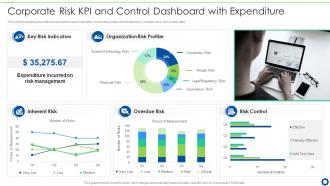
This slide illustrates corporate risk key performance indicators. It includes graphs of inherent risks, overdue risks, risk control data.
People who downloaded this PowerPoint presentation also viewed the following :
Corporate Risk KPI And Control Dashboard Snapshot With Expenditure with all 7 slides:
Use our Corporate Risk KPI And Control Dashboard Snapshot With Expenditure to effectively help you save your valuable time. They are readymade to fit into any presentation structure.





FAQs for Corporate Risk KPI And Control Dashboard
Primary components of an effective corporate risk management framework include risk identification processes, assessment methodologies, mitigation strategies, monitoring systems, and governance structures. These elements work together by establishing clear accountability, enabling proactive threat detection, and streamlining response protocols, with many organizations finding that integrated frameworks significantly enhance operational resilience and strategic decision-making capabilities.
Organizations identify and assess potential risks through comprehensive risk audits, stakeholder interviews, process mapping, data analysis, and scenario planning exercises. These systematic approaches enable companies to evaluate likelihood and impact across operational, financial, and strategic areas, with many institutions finding that regular risk assessments streamline decision-making, enhance regulatory compliance, and ultimately deliver competitive advantage through proactive risk mitigation.
Technology revolutionizes corporate risk management through predictive analytics, automated monitoring systems, real-time data integration, artificial intelligence algorithms, and comprehensive reporting dashboards. These solutions enable organizations to identify potential threats faster, streamline compliance processes, and enhance decision-making accuracy, with many financial institutions and healthcare organizations finding that automated risk assessment delivers significant operational efficiency and competitive advantage.
Stakeholder perceptions significantly shape risk management decisions by influencing funding priorities, strategic direction, and regulatory compliance approaches through investor expectations, customer concerns, and employee feedback. These perceptions drive corporations to balance financial prudence with operational transparency, with many organizations finding that proactive stakeholder communication enhances risk mitigation strategies while maintaining competitive market positioning.
Operational risks involve day-to-day business disruptions like system failures, supply chain issues, and compliance violations, while financial risks encompass market volatility, credit defaults, and liquidity challenges. Strategic risks present both challenges and opportunities, including competitive threats, technology shifts, and market changes, with many organizations finding that integrated risk management across these categories delivers enhanced decision-making and sustained competitive advantage.
Companies quantify risk impact through financial modeling techniques, scenario analysis, value-at-risk calculations, Monte Carlo simulations, and sensitivity testing. These methodologies enable organizations to assign monetary values to potential losses, assess probability-weighted outcomes across different risk scenarios, and ultimately make informed decisions about risk tolerance, capital allocation, and insurance coverage strategies.
Businesses can prioritize risks using quantitative assessments, risk matrices, impact-probability scoring, scenario planning, and stakeholder input analysis. These methods enable organizations to allocate resources strategically by focusing on high-impact vulnerabilities first, with many financial services and manufacturing companies finding that systematic prioritization reduces operational costs while enhancing regulatory compliance and competitive resilience.
Organizational culture and leadership significantly influence risk management implementation by establishing risk tolerance levels, communication protocols, and accountability structures throughout the organization. Strong leadership fosters risk-aware cultures where employees proactively identify threats, while poor leadership creates environments where risks are hidden or ignored, with many financial institutions finding that executive commitment determines whether risk frameworks deliver meaningful protection or remain purely compliance exercises.
Common pitfalls include inadequate risk identification, lack of senior leadership commitment, poor communication across departments, insufficient resource allocation, and failure to regularly update assessments. These challenges often arise when organizations treat risk management as a compliance exercise rather than strategic priority, with many companies finding that siloed approaches and reactive rather than proactive planning ultimately compromise their operational resilience and competitive positioning.
Companies can ensure regulatory compliance by implementing comprehensive governance frameworks, conducting regular compliance audits, maintaining detailed documentation, establishing clear reporting protocols, and providing ongoing staff training on regulatory requirements. Through automated monitoring systems and cross-functional compliance teams, organizations streamline adherence to evolving regulations while minimizing operational disruptions, ultimately delivering enhanced transparency and reduced regulatory penalties.
Global diversification significantly reduces a company's risk profile by spreading exposure across different markets, currencies, economic cycles, and regulatory environments. This strategic approach minimizes dependence on single markets, with many multinational corporations finding that geographic spread helps weather regional downturns, currency fluctuations, and local disruptions, ultimately delivering more stable revenue streams and enhanced resilience.
Scenario analysis enables organizations to model potential risk situations through systematic evaluation of various "what-if" conditions, stress testing different variables, and identifying potential vulnerabilities before they materialize. By simulating economic downturns, supply chain disruptions, or regulatory changes, companies can develop contingency plans, allocate resources strategically, and build organizational resilience, ultimately strengthening their competitive position in uncertain markets.
Best practices for communicating risks to external stakeholders include transparent reporting, regular updates, standardized frameworks like COSO or ISO 31000, tailored messaging for different audiences, and proactive disclosure of material risks. Through structured risk dashboards and quarterly communications, organizations enhance stakeholder confidence, meet regulatory requirements, and maintain trust, with many publicly traded companies finding that consistent transparency ultimately strengthens investor relations and market credibility.
Companies should revisit and update their risk management strategies at least annually, with quarterly reviews recommended for rapidly evolving industries like technology, financial services, and healthcare. Many organizations are increasingly adopting continuous monitoring approaches that trigger strategy updates whenever significant market changes, regulatory shifts, or operational developments occur, ultimately ensuring their risk frameworks remain relevant and effective in an increasingly dynamic business environment.
Employee training enhances risk awareness by educating staff on identifying potential threats, understanding compliance requirements, implementing proper protocols, and responding effectively to incidents. Through comprehensive programs, organizations develop a risk-conscious culture where employees proactively recognize vulnerabilities, report concerns promptly, and follow established procedures, ultimately reducing operational risks and strengthening overall organizational resilience.
-
“Thank you to the SlideTeam. Your presentations look really skillful and have made my life so much easier.”
-
“I required a slide for a board meeting and was so satisfied with the final result !! So much went into designing the slide and the communication was amazing! Can’t wait to have my next slide!”