


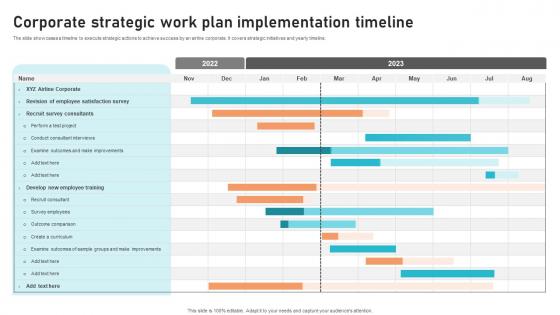
Corporate Strategic Work Plan Implementation Timeline




Try Before you Buy Download Free Sample Product
 Impress Your
 Audience
 100%
100% Editable
 Save Hours
 of Time


The slide showcases a timeline to execute strategic actions to achieve success by an airline corporate. It covers strategic initiatives and yearly timeline.
People who downloaded this PowerPoint presentation also viewed the following :
Corporate Strategic Work Plan Implementation Timeline with all 6 slides:
Use our Corporate Strategic Work Plan Implementation Timeline to effectively help you save your valuable time. They are readymade to fit into any presentation structure.





FAQs for Corporate Strategic Work
Okay so first you'll want to map out the big stuff - strategic planning kickoff, market analysis, competitive assessment, goal-setting workshops, and resource allocation. Stakeholder buy-in sessions are super critical too (learned that the hard way). Then mark your implementation phases and quarterly reviews. Honestly, the spacing matters way more than people think - your team will hate you if deadlines are crazy tight. Build in buffer time, especially for analysis work because that stuff always drags on. Oh and don't forget performance measurement dates at the end.
So basically, everyone needs to see the same roadmap or your teams end up pulling in totally different directions. Your Q2 stuff should connect to what's happening later in Q4, right? Think of it like GPS for your whole company - though honestly most places are terrible at actually using these things. It helps you catch conflicts before they blow up and coordinate resources way better. Oh, and make sure people can actually see it and you update it regularly. Otherwise it just sits there collecting dust like every other corporate document nobody reads.
For mapping out strategic stuff, Gantt charts in Asana or Monday.com work great. Google Sheets is totally fine too if you want simple. Lucidchart and Miro are solid for more visual timeline work - actually love Miro for team brainstorming sessions. Don't sleep on PowerPoint either, honestly some of the best project timelines I've seen were just made there. My advice? Start with whatever tool your team already uses daily. No point switching to something fancy if half your people won't touch it. You can always upgrade later once everyone's on board.
Honestly, quarterly reviews are what you should aim for, but let's be real - who has time for that when you're drowning in daily fires? Markets move crazy fast though. What made sense in January could be totally irrelevant by July. Quick quarterly check-ins work better for adjusting timelines and milestones. Save the heavy lifting for annual reviews where you actually dig into priorities and budgets. Don't be so rigid that you can't pivot, but also don't change course every five minutes or your team will lose their minds. Set those calendar reminders right now or it'll never happen.
Dude, the worst thing you can do? Being way too optimistic about timing. I swear every timeline I've ever made needed major tweaks later. People always forget how long getting everyone on board actually takes - like, stakeholders move at the speed of molasses. Plus you've got all these dependencies between different projects that'll bite you. Market stuff changes constantly too, so don't make your timeline super rigid. Here's what works: tack on 25% extra time to each phase, figure out what relies on what first, and build in regular reality checks. Trust me on this one.
Dude, visuals are a game-changer for strategy timelines. Color-code your initiatives so people can actually follow what's happening. Icons work great too - different ones for each department or project type. Progress bars show completion status instantly, which honestly saves so much explanation time. I always throw in charts for metrics alongside the milestones. Here's the thing - giant walls of text just make people's brains shut off. But mix up your fonts, add some shapes, give everything proper spacing? Suddenly it clicks for everyone. Even something basic like consistent colors per quarter makes a massive difference. Start there.
Think of stakeholder feedback as your strategy GPS - it stops you from driving off a cliff. Build in check-ins at major points: after planning, during pilots, before big launches. I can't tell you how many brilliant strategies I've watched implode because someone ignored what employees were screaming about early on. The feedback catches stuff you missed - bad timelines, not enough resources, market changes. Don't go crazy surveying everyone though, that's just noise. Pick the right people for each phase and actually listen when they tell you something's broken.
Look at your company's speed first - that's what really matters. Startups can do 6-12 month cycles since you're nimble, but big corporations? You're looking at 3-5 years minimum with all the approvals needed. Tech moves fast, manufacturing doesn't because of regulations and equipment costs. I swear half the failures I see are from companies just copying what worked somewhere else. Your industry's totally different! Check how fast your market changes and how quickly leadership makes decisions. Oh, and don't overthink the first version - start simple and tweak it once you see what clicks with your team.
Pick 5-7 metrics max that actually matter for your strategy - revenue growth, market share, customer acquisition costs, that stuff. More than that and you'll drown in data (learned this the hard way). Each metric needs someone who owns it. Monthly dashboards work great for day-to-day operations, but save the big strategic reviews for quarterly. Oh, and focus on getting some early warning indicators in there - the kind that'll tell you you're screwing up before it's too late. Mix leading indicators with lagging ones so you're not just looking backwards all the time.
Look, the market will mess with your timeline no matter what you plan. Competitors drop something crazy and suddenly you're rushing decisions that should've taken months. Economic stuff hits and boom - expansion plans get shelved, or you're pressured to move way faster than feels right. I watched one team go from an 18-month rollout to 6 months because their window was basically slamming shut. Honestly? Just build in extra time from day one. Assume something external will screw things up and give yourself that cushion.
You need the quick wins to keep everyone sane and motivated - nothing kills team morale faster than only working toward some distant goal. But here's the thing: those short-term victories have to actually connect to where you're trying to go long-term, otherwise you're just checking boxes. I've seen so many teams get caught up in quarterly sprints that don't ladder up to anything meaningful. Your long-term vision is basically your compass, keeps you from wandering into random projects that feel productive but aren't really moving you forward. Map out how each milestone gets you closer to that bigger picture.
Break your tech integration into clear phases on the timeline - start with "Legacy System Assessment" in Q1, then "Platform Migration" for Q2-Q3, finishing with "Full Implementation" by Q4. Milestone markers are clutch for tracking stuff like go-live dates and training completions. Honestly, I'd add buffer time because these projects *always* run long. If you're juggling multiple integrations, color-code each stream so you don't lose your mind. The trick is being super specific about what "integration complete" actually means for each phase - otherwise you'll be arguing about it later.
Honestly, the biggest mistake I see is being vague about timing from the start. Map out your milestones this week and be brutally honest about delays upfront - way better than moving deadlines later (learned that the hard way). Hit people from multiple angles: all-hands, email updates, those visual roadmaps everyone loves. Quick wins matter too. Don't just tell them when things happen, explain why the timeline makes sense for the business. Oh, and pick a communication rhythm you can actually stick to.
Here's what I've learned about scenario planning - it's kinda paradoxical. Takes forever upfront (like, weeks of modeling different futures), but then you're way faster when stuff actually hits the fan. You've already thought through Plan B and C, so no panic mode. My advice? Don't overthink it with like 10 scenarios. Start with maybe 2-3 max. The whole point is building flexibility into your timeline rather than sticking to some rigid plan that falls apart the second reality kicks in. It's honestly more about being ready to pivot than predicting the future perfectly.
Amazon spent like 20 years going from just books to selling literally everything. Apple's transformation was crazy fast though - about 10 years from iPod to iPhone to iPad under Jobs. Netflix ditched DVDs for streaming in around 7 years, which was smart timing. Microsoft's cloud pivot under Nadella took maybe 5 years but totally turned things around. The key thing? They all stuck to realistic timelines even when investors were freaking out. Oh, and they were super clear about hitting milestones along the way - that's probably what kept everyone on board.
-
One-stop solution for all presentation needs. Great products with easy customization.
-
Kudos to SlideTeam for achieving the high success rate in delivering the top-notch slides.