


Critical success factors example ppt sample file





Try Before you Buy Download Free Sample Product
 Impress Your
 Audience
 100%
100% Editable
 Save Hours
 of Time


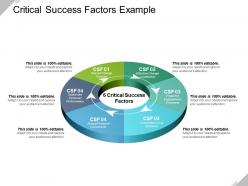
Critical success factors example PPT file is an outstanding presentation of graphics for stating the concept of success factors. This template casts a significant impact on the audience while explaining the upcoming development and rate of success. Its way of presentation gives an idea of strength to the presenter’s message. The key success factors KSF PowerPoint model is designed for the entrepreneur and startups to help them illustrate their innovative product or service to the investors and potential clients. The key performance areas PPT graphic is a step by step circular diagram to describe the achievements from beginning to end. The professional speakers of success line make use of this presentation to explain the topic related to success and achievement. The key success result areas PPT presentation infographic is ideal for the business success presentation and for individual success building programs. The key success factors of the business can be illustrated using the colorful PowerPoint. The visuals of the template ensure to grab the attention of the audience and make your presentation a thrilling success. Ideas begin to jell due to our Critical Success Factors Example Ppt Sample File. A definite form is bound to emerge.
People who downloaded this PowerPoint presentation also viewed the following :
Critical success factors example ppt sample file with all 5 slides:
Avoid alienating a few colleagues with our Critical Success Factors Example Ppt Sample File. They ensure everyone gets equal attention.




FAQs for Critical success factors example
Essential critical success factors for tech startups include strong product-market fit, scalable technology infrastructure, experienced founding team, sufficient funding runway, and rapid customer acquisition strategies. These factors work synergistically, with many successful startups finding that combining technical innovation with strategic market positioning, lean operational practices, and adaptable business models ultimately delivers sustainable competitive advantage in an increasingly crowded marketplace.
Critical success factors vary significantly across industries, with healthcare prioritizing patient safety, regulatory compliance, and clinical outcomes, while education focuses on student engagement, learning effectiveness, and institutional accreditation. Financial services emphasize risk management, regulatory adherence, and customer trust, with many organizations finding that industry-specific factors like technological integration and stakeholder satisfaction remain universally important for competitive advantage.
Leadership plays a pivotal role in identifying critical success factors through strategic vision, stakeholder engagement, and market analysis, while implementing them through resource allocation, team alignment, and performance monitoring. Effective leaders in organizations across industries, from healthcare to manufacturing, create accountability frameworks and foster collaboration, ultimately delivering sustained competitive advantage and operational excellence through consistent execution.
Organizations can effectively measure their critical success factors through key performance indicators, regular dashboard monitoring, data analytics platforms, and quarterly review cycles. These measurement systems streamline tracking by automating data collection, providing real-time visibility, and enabling trend analysis, with many companies finding that consistent CSF monitoring ultimately delivers improved strategic alignment and competitive advantage.
Cultural and organizational values significantly shape critical success factors by influencing strategic priorities, performance metrics, and stakeholder expectations across all business operations. Companies with innovation-focused cultures prioritize agility and R&D investment, while customer-centric organizations emphasize service quality and satisfaction scores, ultimately ensuring that success measures align with core values and drive sustainable competitive advantage.
Critical success factors help in risk management by identifying key performance indicators, establishing early warning systems, creating contingency planning frameworks, and enabling proactive monitoring of business-critical areas. Through strategic risk assessment and performance tracking, organizations in sectors like banking, healthcare, and manufacturing can anticipate potential disruptions, allocate resources more effectively, and implement mitigation strategies before issues escalate, ultimately delivering enhanced operational resilience and competitive advantage.
Critical success factors influence decision-making by prioritizing resource allocation, guiding strategic initiatives, and establishing performance benchmarks that align with organizational objectives. These factors enable leaders to evaluate opportunities against core business priorities, streamline complex choices, and focus investments on high-impact areas, ultimately delivering faster execution and competitive advantage in increasingly dynamic markets.
Teams can prioritize critical success factors using impact-versus-effort matrices, stakeholder weighting systems, customer journey mapping, and SMART criteria evaluation. Through strategic assessment workshops, organizations systematically rank factors by business value, resource requirements, and implementation timelines, with many companies finding that focusing on high-impact, low-effort initiatives first creates momentum while building organizational capability for more complex transformations.
Small businesses can leverage critical success factors by focusing on agility, personalized customer service, niche market expertise, lean operations, and rapid decision-making capabilities that larger enterprises often struggle to match. These advantages enable smaller companies to respond quickly to market changes, deliver highly customized solutions, and build stronger customer relationships, ultimately creating competitive differentiation through flexibility and specialized focus rather than scale.
Organizations face challenges including unclear strategic priorities, insufficient stakeholder buy-in, resource constraints, poor communication across departments, and lack of measurable metrics when aligning goals with critical success factors. These alignment issues often result in conflicting objectives, wasted resources, and missed performance targets, with many companies finding that regular cross-functional reviews and data-driven adjustments ultimately streamline goal alignment and enhance operational efficiency.
Technology enhances critical success factor identification and tracking through advanced analytics, real-time dashboards, automated data collection, predictive modeling, and integrated performance management systems. These tools streamline monitoring by consolidating multiple data sources, providing instant visibility into key metrics, and enabling proactive adjustments, with many organizations finding that automated tracking delivers faster decision-making and improved strategic alignment.
Employee engagement directly influences critical success factor execution through enhanced productivity, stronger commitment to organizational objectives, and improved collaboration across departments. Engaged employees demonstrate greater ownership of strategic initiatives, contribute innovative solutions more frequently, and maintain consistent performance during challenging implementation phases, with many organizations finding that high engagement levels accelerate goal achievement and sustainable competitive advantage.
Market trends significantly influence critical success factors by reshaping customer expectations, competitive landscapes, regulatory requirements, technological capabilities, and operational priorities that companies must master to succeed. For instance, digital transformation trends compel retail and banking organizations to prioritize e-commerce platforms, mobile optimization, and data analytics capabilities, while sustainability trends increasingly require manufacturing and energy companies to focus on environmental compliance and resource efficiency as core competitive advantages.
Organizations ensure critical success factors remain relevant by regularly reviewing and updating them through continuous market analysis, stakeholder feedback, and performance monitoring against evolving industry benchmarks. This dynamic approach enables companies to pivot strategically when disruptions occur, with many businesses finding that quarterly CSF assessments and cross-functional alignment sessions deliver enhanced agility and sustained competitive advantage.
Customer feedback and market research serve as foundational inputs for identifying and refining critical success factors, providing real-world validation of what truly drives business performance and customer satisfaction. These insights enable organizations to align their strategic priorities with actual market demands and customer expectations, while helping companies across sectors like retail, healthcare, and financial services adjust their success metrics based on evolving preferences, ultimately delivering more targeted solutions and sustained competitive advantage.
-
Nice and innovative design.
-
Easily Editable.