


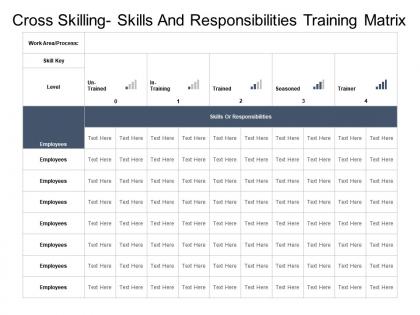
Cross skilling skills and responsibilities training matrix




Try Before you Buy Download Free Sample Product
 Impress Your
 Audience
 100%
100% Editable
 Save Hours
 of Time


Instigate the inactive with our Cross Skilling Skills And Responsibilities Training Matrix. Get them to join in the action.
People who downloaded this PowerPoint presentation also viewed the following :
Cross skilling skills and responsibilities training matrix with all 5 slides:
Ensure all gatherings are enjoyable with our Cross Skilling Skills And Responsibilities Training Matrix. It encourages congenial conduct.



FAQs for Cross skilling skills and
Cross-skilling involves training employees in skills outside their primary expertise areas, while upskilling enhances existing competencies within their current role. Cross-skilling creates versatile teams capable of handling diverse functions, with many organizations finding that employees trained across departments, technologies, and processes deliver greater operational flexibility, reduced dependency risks, and enhanced collaborative problem-solving capabilities.
Cross-skilling improves team collaboration by enabling seamless knowledge sharing, reducing dependency bottlenecks, and fostering mutual understanding across different roles and departments. Organizations implementing cross-skilling programs find enhanced project flexibility, faster problem-solving capabilities, and improved resource allocation, with teams ultimately delivering higher productivity and stronger workplace cohesion.
Healthcare, technology, manufacturing, retail, and financial services have benefited significantly from cross-skilling implementation, with each sector addressing unique operational challenges. These industries leverage cross-skilling to enhance workforce flexibility, reduce recruitment costs, and improve service delivery, while hospitals streamline patient care through multi-skilled staff and tech companies accelerate project timelines, ultimately delivering greater operational efficiency and competitive advantage.
Key challenges include employee resistance to change, increased training costs, potential skill dilution, scheduling complexities, and measuring effectiveness across diverse competencies. While cross-skilling presents initial resource allocation hurdles, many organizations find that strategic implementation through phased approaches and targeted development programs ultimately delivers enhanced workforce flexibility, reduced dependency risks, and improved operational resilience.
Cross-skilling enhances employee retention by creating diverse career pathways, reducing monotony, and increasing perceived value within organizations, while boosting job satisfaction through continuous learning opportunities and professional growth. Many companies in technology, healthcare, and manufacturing find that cross-skilled employees demonstrate higher engagement, improved adaptability, and stronger loyalty, ultimately delivering reduced turnover costs and enhanced workforce stability.
Technology streamlines cross-skilling through learning management systems, virtual reality training, AI-powered skill assessments, collaborative platforms, and microlearning apps. These digital tools enable personalized learning paths, real-time knowledge sharing, and skills gap analysis, with many organizations finding that technology-enhanced cross-skilling reduces training costs while accelerating team adaptability and operational efficiency.
Organizations measure cross-skilling effectiveness through performance metrics, skill assessment scores, employee engagement surveys, internal mobility rates, and project completion timelines. These measurement approaches enable companies to track knowledge transfer success, identify skill gaps, and quantify productivity improvements, with many finding that regular evaluation helps optimize training investments while delivering enhanced workforce flexibility and operational resilience.
Effective cross-skilling training methods include job shadowing, mentorship programs, cross-departmental rotations, online learning platforms, and collaborative project assignments. These approaches enhance workforce flexibility by exposing employees to diverse skill sets, fostering knowledge transfer across teams, and building organizational resilience, with many companies finding that strategic cross-skilling ultimately delivers improved adaptability and competitive advantage.
Managers can identify relevant cross-skilling opportunities by analyzing upcoming project requirements, assessing current skill gaps, reviewing industry trends, conducting team capability audits, and mapping strategic business objectives. Through regular one-on-ones and performance reviews, managers in sectors like technology and healthcare increasingly discover overlapping competencies, ultimately enabling more agile resource allocation and enhanced team versatility across multiple functions.
Cross-skilling significantly enhances organizational agility by enabling rapid resource reallocation, reducing dependency on specialized roles, and accelerating response times to market changes. Through strategic skill diversification, companies streamline operations, minimize bottlenecks, and maintain continuity during disruptions, with many organizations finding that cross-trained teams deliver faster project completion and improved competitive positioning.
Cross-skilling enables businesses to respond to market changes by creating flexible workforces, reducing hiring dependencies, accelerating project timelines, and maintaining operational continuity during transitions. Organizations across retail, technology, and manufacturing find that employees with diverse skill sets can pivot between roles seamlessly, ultimately delivering faster adaptation and sustained competitive advantage in volatile markets.
Cross-skilling culture delivers enhanced organizational resilience, improved employee retention, increased operational flexibility, reduced knowledge silos, and accelerated innovation through diverse skill combinations. Organizations with strategic cross-skilling programs find stronger succession planning, faster project delivery, and more adaptable teams, ultimately creating competitive advantage in increasingly dynamic business environments.
Cross-skilling prepares future leaders by developing diverse competencies, strategic thinking, adaptability, and comprehensive business understanding across multiple functions. Through exposure to different departments like finance, operations, and customer service, employees gain holistic perspectives, enhanced problem-solving abilities, and collaborative skills, ultimately enabling them to make informed decisions and lead cross-functional teams effectively.
Companies should establish clear learning pathways, identify skill gaps through comprehensive assessments, create mentorship programs, and provide dedicated time for skill development activities. Successful programs pair employees across departments, utilize hands-on projects rather than theoretical training, and track progress through measurable outcomes, with many organizations finding that structured peer-to-peer learning accelerates adoption while building stronger interdepartmental collaboration.
Cross-skilling opportunities differ significantly by professional level, with entry-level employees typically accessing structured training programs, mentorship, and rotational assignments, while executives pursue strategic leadership development, board positions, and industry partnerships. Entry-level professionals often focus on foundational skills across departments like marketing, operations, and finance, whereas executives emphasize cross-functional leadership, mergers and acquisitions expertise, and strategic decision-making capabilities that ultimately enhance organizational agility and competitive positioning.
-
Great quality slides in rapid time.
-
Great designs, Easily Editable.