


Cultural mergers and acquisitions powerpoint presentation slides





Try Before you Buy Download Free Sample Product
 Impress Your
 Audience
 100%
100% Editable
 Save Hours
 of Time


Introducing Cultural Mergers And Acquisitions PowerPoint Presentation Slides. The agenda of this presentation is to introduce better cultural beliefs, and behaviors in the company after the merger. The slide allows you to analyze the current situation of the company. Take the assistance of company culture PPT slideshow, and showcase the company’s productivity and revenue for four years. Our readily available slideshow describes the assimilation strategy and its features. Provide information on integration strategies and the top-down approach of the company by using this visually-appealing PowerPoint slide deck. Take the assistance of our ready-to-use PowerPoint infographics, and discuss cultural issues in the company due to mergers and acquisitions. Analyze the current flaws in the company’s culture by taking the assistance of the organization environment PPT layouts. The presentation allows you to develop a culture change plan and roadmap for the cultural integration strategy. Showcase the impact of developing a new culture plan by downloading our visually-attention-grabbing working culture PPT presentation.
People who downloaded this PowerPoint presentation also viewed the following :
Content of this Powerpoint Presentation
Slide 1: This title slide introduces Cultural Mergers and Acquisitions. Add the name of your company here.
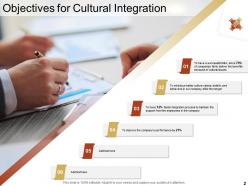
Slide 2: This slide presents the Objectives for Cultural Integration. This includes To have a successful M&A, since 70% of companies fail to deliver the benefits because of cultural issues, Introducing better cultural values, beliefs, and behaviors in our company after the merger, To have 12% faster integration process to maintain the support from the employees in the company, To improve the company’s performance by 21% and more.
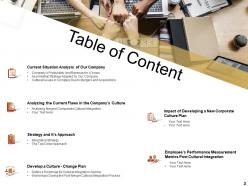
Slide 3: This slide contains the Table of Content. It includes Analyzing the Current Flaws in the Company’s Culture, Strategy, and Approach, Develop a Culture - Change Plan, the Impact of Developing a New Corporate Culture Plan, and Employee Performance Measurement Metrics Post Cultural Integration.
Slide 4: This is a table of content slide showing the Current Situation Analysis of Our Company. It includes Company’s Productivity and Revenue for 4 Years, Assimilation Strategy Adapted by Our Company, and Cultural Issues in Company Due to Mergers and Acquisitions.
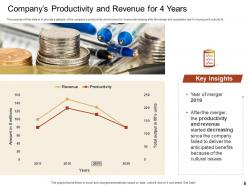
Slide 5: This slide presents the Company’s Productivity and Revenue for 4 Years. It provides a glimpse of the company’s productivity and revenue for 4 years decreasing after the merger and acquisition due to incongruent cultural fit.
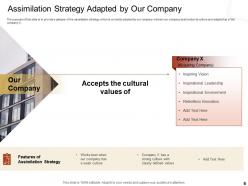
Slide 6: This slide presents the Assimilation Strategy Adapted by Our Company. It provides a glimpse of the assimilation strategy which is currently adopted by our company wherein our company dysfunction its culture and adapts that of the company X.
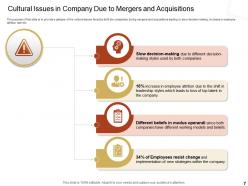
Slide 7: This slide presents Cultural Issues in Company Due to Mergers and Acquisitions. It provides a glimpse of the cultural issues faced by both the companies during mergers and acquisitions leading to slow decision making, increase in employee attrition rate, etc.
Slide 8: This is a table of content slide showing Analyzing the Current Flaws in the Company’s Culture. This includes Analyzing Merged Companies Cultural Integration and more.
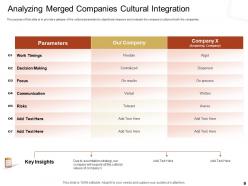
Slide 9: This slide presents Analyzing Merged Companies Cultural Integration. It provides a glimpse of the cultural parameters to objectively measure and evaluate the company’s culture at both companies.
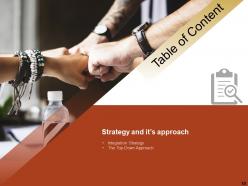
Slide 10: This is a table of content slide showing Strategy and its approach. This includes Integration Strategy and The Top-Down Approach.
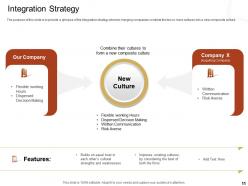
Slide 11: This slide presents the Integration Strategy. It provides a glimpse of the integration strategy wherein merging companies combine the two or more cultures into a new composite culture.
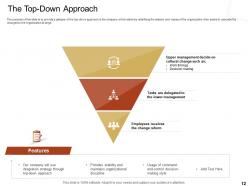
Slide 12: This slide presents The Top-Down Approach. It provides a glimpse of the top-down approach in the company which starts by redefining the mission and values of the organization, then seeks to cascade the changes to the organization at large.
Slide 13: This is a table of content slide showing Develop a Culture-Change Plan. This includes Define a Roadmap for Cultural Integration Journey and Workshops During the Post-Merger Cultural Integration Process.
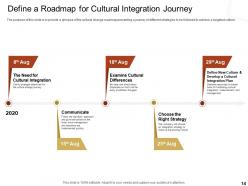
Slide 14: This slide defines a Roadmap for the Cultural Integration Journey. It provides a glimpse of the cultural change roadmap presenting a journey of different strategies to be followed to achieve a targeted culture.
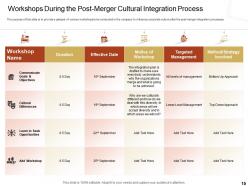
Slide 15: This slide presents Workshops During the Post-Merger Cultural Integration Process. It provides a glimpse of various workshops to be conducted in the company to influence corporate culture after the post-merger integration processes.
Slide 16: This is a table of content slide showing the Impact of developing a New Corporate Culture Plan.
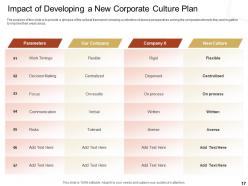
Slide 17: This slide presents the Impact of Developing a New Corporate Culture Plan. It provides a glimpse of the cultural framework showing a collection of diverse perspectives among the companies wherein they work together to improve their weak areas.
Slide 18: This is a table of content slide showing the Employee’s Performance Measurement Metrics Post Cultural Integration.
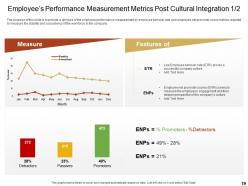
Slide 19: This slide presents part 1 of 2 of Employee’s Performance Measurement Metrics Post Cultural Integration. It provides a glimpse of the employee performance measurement by employee turnover rate and employee net promoter score metrics required to measure the stability and consistency of the workforce in the company.
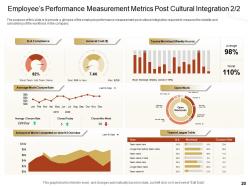
Slide 20: This slide presents part 1 of 2 of Employee’s Performance Measurement Metrics Post Cultural Integration. It provides a glimpse of the employee performance measurement post cultural integration required to measure the stability and consistency of the workforce in the company.
Slide 21: This is the Icons Slide for Cultural Mergers and Acquisitions for your choosing.
Slide 22: This slide introduces the Additional Slides.
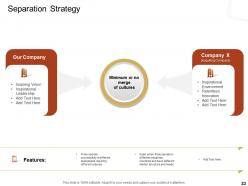
Slide 23: This slide presents the Separation Strategy. It shows the qualities of 2 companies before the merger. It is used when firms operate in different industries, countries and have different market structures and needs.
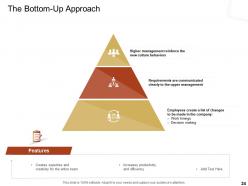
Slide 24: This slide presents The Bottom-Up Approach. It creates expertise and creativity for the entire team and increases productivity and efficiency among other benefits.
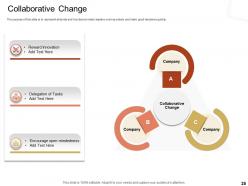
Slide 25: This slide presents Collaborative Change. It represents all levels and functions to make leaders work as a team and make good decisions quickly.
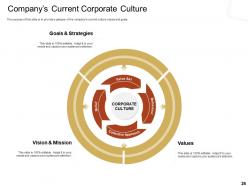
Slide 26: This slide presents the Company’s Current Corporate Culture. It provides a glimpse of the company’s current culture values and goals.
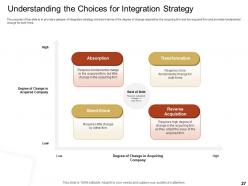
Slide 27: This slide presents Understanding the Choices for Integration Strategy. It provides a glimpse of integration strategy choices in terms of the degree of change required by the acquiring firm and the acquired firm and provides fundamental change for both firms.
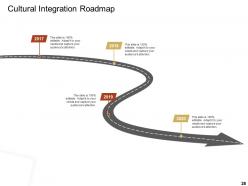
Slide 28: This slide is a Cultural Integration Roadmap to showcase its stages.
Slide 29: This is a slide with a 30 60 90 Days Plan to set goals for these important intervals.
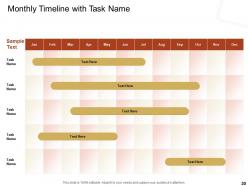
Slide 30: This slide contains a monthly timeline chart that can be used to portray the sequence of events for any project or goal with the name of the tasks.
Slide 31: This is a Thank You slide where details such as the address, contact number, email address are added.
Cultural mergers and acquisitions powerpoint presentation slides with all 31 slides:
Use our Cultural Mergers And Acquisitions Powerpoint Presentation Slides to effectively help you save your valuable time. They are readymade to fit into any presentation structure.





FAQs for Cultural mergers and acquisitions
Honestly, start with the basics - how do they make decisions and what's their leadership vibe like? Communication styles can be wildly different between companies, so that's huge. Check out their risk tolerance and whether people actually have work-life balance or just pretend they do. Meeting culture and hierarchies sound boring but they'll bite you later if you ignore them. See how aligned they are on innovation, customer stuff, and performance management. The whole point is spotting where things might clash before you've got people jumping ship or the integration turns into a nightmare.
First thing - figure out what leadership styles each company actually has and where they're gonna bump heads. Mix up some teams with leaders from both sides to tackle problems together. Trust me, some people just won't click no matter what you do, but that's normal. Focus on what everyone agrees on instead of trying to make identical clones. Set up clear ways for people to communicate and make decisions that pull good stuff from both places. Oh, and do regular check-ins with leadership before small issues turn into drama that spreads everywhere.
Honestly, communication makes or breaks these things. You've gotta be super transparent about what's changing and actually listen when people freak out (because they will). Town halls, mixed teams from both companies, feedback stuff - whatever gets people talking. I've watched mergers crash and burn when leadership just disappeared during the messy parts. Don't do that. People need to know what the new culture's gonna look like, not guess. Overcommunicate everything - values, expectations, the works. Your employees shouldn't feel like passengers on a mystery flight, you know?
Track retention rates and engagement scores for sure. But honestly? Those "vibe check" surveys are just as telling as the hard numbers. See how often people from different teams actually collaborate on projects - that's where the real magic happens. Set up pulse surveys asking if folks feel valued and included. Cross-company process adoption is another good indicator. Oh, and start measuring this stuff early so you're not scrambling later trying to figure out baselines. Cultural tensions decreasing over time - that's probably your best signal that things are working.
Start the cultural stuff way before you close the deal - seriously, don't wait. Map out how both companies actually work: their values, how they communicate, who makes decisions. Mixed integration teams are clutch because people need to build relationships early. Those random coffee conversations? They're honestly where you'll learn the most useful stuff. Run pulse surveys to spot problems before they blow up. Be super clear about what cultural pieces you're keeping vs changing. Oh, and create safe spaces for people to complain - skip-level meetings work great for this. Nobody should worry about getting fired for speaking up.
Honestly, you gotta get employees actually involved instead of just broadcasting at them. Town halls work great - but only if you're really listening and responding to feedback. Cross-company teams are clutch for this stuff. Let people share stories from both sides, be super transparent even when things get weird (and trust me, they will). Quick wins are your best friend here - find small projects where mixed teams can knock it out of the park together. That builds momentum way faster than any corporate memo ever could.
Honestly, treat culture like you would financials - do proper digging first. Survey employees, interview leadership, watch how people actually behave day-to-day at both companies. What's their decision-making speed like? How do they handle risk or focus on customers? I swear, so many teams blow this off completely and then wonder why everything falls apart later. Map out communication styles too - meeting cultures, conflict resolution, innovation approaches. The goal is spotting where cultures mesh well versus where you'll have major clashes. Start this stuff early so you can bake cultural fit into your valuation and integration plans. Trust me on this one.
Dude, cultural clash is what kills companies after mergers. Retention drops like 30-50% when cultures don't mesh. People bail fast when they feel like their way of doing things suddenly doesn't count anymore - LinkedIn gets real busy, you know? I watched one acquisition where the bigger company just bulldozed right over everyone else's culture. Half their top talent was gone in six months, which honestly seemed predictable. You've gotta spot these gaps during due diligence and actually create a plan that doesn't ignore either side's values.
First thing - map out both companies' values so you can spot the big conflicts upfront. Mix people from both sides into teams to figure out what stays, what goes, what gets blended together. Look, some tension is gonna happen no matter what. Find the stuff everyone already agrees on first - customer service, innovation, whatever - then expand from there. The tricky part is explaining *why* changes are happening. People hate being kept in the dark about this stuff. Oh, and definitely do regular check-ins. You'll need to pivot when things aren't working.
Start with psychological safety - that's where real change happens. Get your leaders trained on cultural sensitivity before they mess things up for everyone else. Cross-cultural mentorship programs work well, just pair people from both companies. Make sure your integration committees aren't just the usual suspects - you need voices from every level. Town halls are fine, but honestly? Those smaller focus groups give you the real dirt on what's actually going down. Oh, and create feedback channels where people can speak up without worrying they'll get fired. Leadership alignment first, then work your way down.
Honestly, you've gotta hit them from every angle with info. Email updates, town halls, maybe some kind of tracker they can actually see. Don't try to make everything sound perfect - people aren't stupid and they'll catch on if you're being fake about problems. I'd say be super direct about timelines and what's actually going wrong. Short sentences work sometimes. But also give them ways to complain back to you (trust me, they will anyway). The wins are great to share, but the messy stuff builds more credibility in the long run. Keep it simple and don't use corporate speak.
So the Cultural Web is really good for mapping out what you're dealing with right now. OCAI is another one that's super easy to use - probably your best bet if you want something quick. The Organizational Culture Inventory is solid too for measuring gaps between companies. Pulse surveys and focus groups are where you'll get the actual truth though, not just corporate speak. Pick one framework and stick with it - I've watched too many teams try to do everything at once and just spin their wheels. Choose based on whether your leadership loves data or just wants the basics. Oh, and definitely look for those big red flags early.
Where the companies are from matters way more than people think. A buttoned-up German firm and a relationship-heavy Japanese one? That's gonna need a totally different playbook than two Silicon Valley startups merging (those probably already speak the same "disrupt everything" language anyway). During due diligence, map out these cultural gaps early. Don't get so caught up in the financials that you miss how geography shapes their day-to-day work styles. Then build your whole integration around closing those specific differences. Trust me, it'll save you major headaches later.
Look, getting the culture piece right makes a huge difference in M&As. You'll keep more employees from jumping ship, plus teams actually work together instead of fighting each other. Honestly, I've seen too many deals where they rushed this part and regretted it later. Better decision-making happens when people aren't clashing over how things should work. Start mapping out cultural differences before you even close - not months later when problems are already brewing. Innovation flows better too when you've got diverse teams who actually get along. Oh, and customers notice when service stays consistent through the chaos.
Honestly, you can't skip the training stuff if you want this merger to actually work. People need to learn how the other company operates - their communication style, work culture, all that. I'd set up joint training sessions and maybe some cross-company mentoring within the first 90 days. Leadership development programs work great too, especially when you mix teams from both sides. Don't make it a one-and-done thing though - keep it rolling for months. Trust me, I've watched deals completely implode because companies thought they could wing the people side of things.
-
Top Quality presentations that are easily editable.
-
Awesome presentation, really professional and easy to edit.
-
Content of slide is easy to understand and edit.
-
Very unique and reliable designs.
-
Best Representation of topics, really appreciable.
-
Wonderful templates design to use in business meetings.
-
Wonderful templates design to use in business meetings.
-
Very well designed and informative templates.
-
The content is very helpful from business point of view.
-
Informative design.
-
Page:
- You're currently reading page 1
- Page 2
-
