


Custom Fragrance Business Plan Powerpoint Presentation Slides




Try Before you Buy Download Free Sample Product
 Impress Your
 Audience
 100%
100% Editable
 Save Hours
 of Time


Our Custom Fragrance Business Plan Powerpoint Presentation Slides are topically designed to provide an attractive backdrop to any subject. Use them to look like a presentation pro.
People who downloaded this PowerPoint presentation also viewed the following :
Content of this Powerpoint Presentation
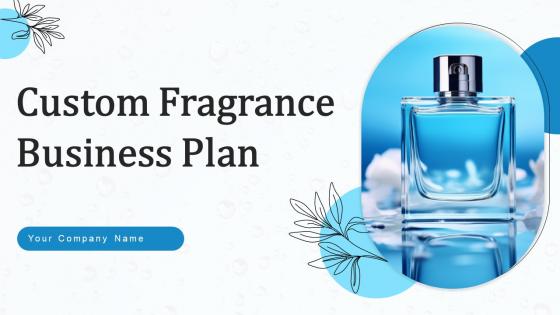
Slide 1: This slide introduces Custom Fragrance Business Plan. State your company name and begin.
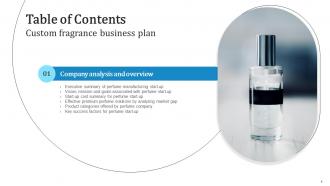
Slide 2: This slide shows Table of Content for the presentation.
Slide 3: This is another slide continuing Table of Content for the presentation.
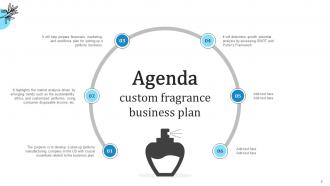
Slide 4: This slide states Agenda of the presentation.
Slide 5: This slide highlights title for topics that are to be covered next in the template.
Slide 6: This slide presents Executive summary of perfume manufacturing start-up.
Slide 7: This slide displays Executive summary of perfume manufacturing start-up.
Slide 8: This slide covers the perfume company's vision, mission, and goals to ensure that it will deliver outstanding perfumes while providing top-notch fragrance experiences to the customer.
Slide 9: This slide represents Start-up cost summary for perfume start-up.
Slide 10: This slide showcases Effective premium perfume solutions by analyzing market gap.
Slide 11: This slide shows Product categories offered by perfume company.
Slide 12: This slide presents Key success factors for perfume start-up.
Slide 13: This slide highlights title for topics that are to be covered next in the template.
Slide 14: This slide displays Global perfume market outlook.
Slide 15: This slide represents Key statistics associated with perfume industry.
Slide 16: This slide highlights the thorough assessment of a market within the perfume industry.
Slide 17: This slide showcases Key market trends shaping perfume industry.
Slide 18: This is another slide continuing Key market trends shaping perfume industry.
Slide 19: This slide shows Addressing major challenges catered by perfume industry.
Slide 20: This slide presents Exploring growth drivers for perfume industry.
Slide 21: This slide displays Geographical analysis for perfume business growth and expansion.
Slide 22: This slide highlights title for topics that are to be covered next in the template.
Slide 23: This slide represents Target customer profile for perfume business.
Slide 24: This slide showcases Buyer personas to increase perfume personalization.
Slide 25: This slide shows TAM SAM SOM analysis of perfume business.
Slide 26: This slide highlights title for topics that are to be covered next in the template.
Slide 27: This slide presents Perfume industry competitive analysis including attributes comparison.
Slide 28: This is another slide continuing Perfume industry competitive analysis including attributes comparison.
Slide 29: This slide highlights title for topics that are to be covered next in the template.
Slide 30: This slide displays Comprehensive SWOT analysis of perfume industry.
Slide 31: This slide highlights title for topics that are to be covered next in the template.
Slide 32: This slide represents Porter’s five forces analysis for perfume industry.
Slide 33: This slide highlights title for topics that are to be covered next in the template.
Slide 34: This slide showcases Perfume business go-to-market strategy to increase sales and revenue.
Slide 35: This is another slide continuing Perfume business go-to-market strategy to increase sales and revenue.
Slide 36: This is another slide continuing Perfume business go-to-market strategy to increase sales and revenue.
Slide 37: The purpose of this slide is to implement an effective go-to-market strategy for bringing the perfume business to an end customer.
Slide 38: The purpose of this slide is to implement an effective go-to-market strategy for bringing the perfume business to an end customer.
Slide 39: This is another slide continuing Perfume business go-to-market strategy to increase sales and revenue.
Slide 40: This is another slide continuing Perfume business go-to-market strategy to increase sales and revenue.
Slide 41: This slide shows Perfume business customer journey through sales funnel.
Slide 42: This slide highlights title for topics that are to be covered next in the template.
Slide 43: This slide presents Quarterly milestones for successful perfume business growth.
Slide 44: This slide highlights title for topics that are to be covered next in the template.
Slide 45: This slide displays Key financial assumptions for perfume business start-up.
Slide 46: This slide represents Effective revenue generation model for perfume start-up.
Slide 47: This is another slide continuing Effective revenue generation model for perfume start-up.
Slide 48: This is another slide continuing Effective revenue generation model for perfume start-up.
Slide 49: This slide showcases Break-even analysis with fixed and variable cost.
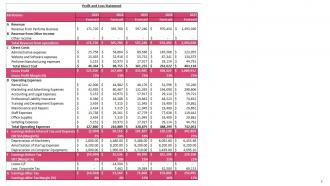
Slide 50: This slide shows Projected profit and loss account statement for perfume start-up.
Slide 51: This is another slide continuing Projected profit and loss account statement for perfume start-up.
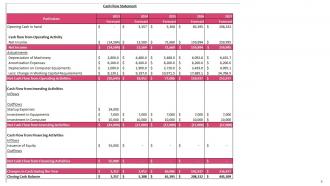
Slide 52: This slide presents Consolidated statements of cash flows for perfume start-up.
Slide 53: This is another slide continuing Consolidated statements of cash flows for perfume start-up.
Slide 54: This slide displays Comparative balance sheet statement for perfume start-up.
Slide 55: This slide represents Comparative balance sheet statement for perfume start-up.
Slide 56: This slide showcases Scenario analysis with optimistic, pessimistic and realistic cases.
Slide 57: This is another slide continuing Scenario analysis with optimistic, pessimistic and realistic cases.
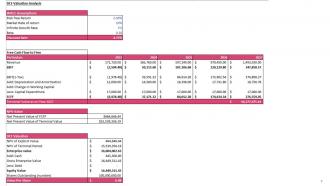
Slide 58: This slide shows Discounted cash flow valuation for perfume start-up.
Slide 59: This slide highlights title for topics that are to be covered next in the template.
Slide 60: This slide presents Organizational structure for smooth business operations.
Slide 61: This slide displays Professional summary of perfume start-up founder.
Slide 62: This slide represents Job roles and responsibilities of perfume business key management.
Slide 63: This slide showcases Job roles and responsibilities of perfume business key management.
Slide 64: This slide highlights title for topics that are to be covered next in the template.
Slide 65: This slide shows Possible exit strategies for perfume industry.
Slide 66: This slide highlights title for topics that are to be covered next in the template.
Slide 67: This slide presents Key abbreviations used in the plan.
Slide 68: This slide contains all the icons used in this presentation.
Slide 69: This slide is titled as Additional Slides for moving forward.
Slide 70: This slide showcases Magnifying Glass to highlight information, specifications etc
Slide 71: This slide depicts Venn diagram with text boxes.
Slide 72: This is Our Goal slide. State your firm's goals here.
Slide 73: This slide contains Puzzle with related icons and text.
Slide 74: This is an Idea Generation slide to state a new idea or highlight information, specifications etc.
Slide 75: This is a Thank You slide with address, contact numbers and email address.
Custom Fragrance Business Plan Powerpoint Presentation Slides with all 83 slides:
Use our Custom Fragrance Business Plan Powerpoint Presentation Slides to effectively help you save your valuable time. They are readymade to fit into any presentation structure.


































































FAQs for Custom Fragrance Business Plan
A custom fragrance business plan should include market analysis, target customer segmentation, product development strategy, manufacturing partnerships, brand positioning, pricing models, and distribution channels. These elements work together by identifying niche opportunities, establishing production capabilities, and creating scalable revenue streams, with many fragrance entrepreneurs finding that clear differentiation and strategic partnerships ultimately deliver sustainable competitive advantage in the luxury market.
**INPUT**: How do I identify my target market within the fragrance industry? **OUTPUT**: Identify your fragrance target market by analyzing demographics, lifestyle preferences, purchasing behaviors, scent profiles, and price sensitivity through surveys, focus groups, and competitor analysis. This strategic approach enables you to segment customers effectively, with many successful fragrance businesses finding that niche markets like luxury consumers, eco-conscious buyers, or specific age groups deliver stronger brand loyalty and higher profit margins. [Word count: 60 words]
**INPUT**: What strategies can I use to source high-quality raw materials for my fragrances? **OUTPUT**: Effective sourcing strategies include establishing direct relationships with certified suppliers, partnering with fragrance houses and ingredient distributors, attending industry trade shows, and conducting rigorous quality testing protocols. Many successful fragrance businesses find that diversifying suppliers across regions, negotiating long-term contracts for price stability, and building relationships with both synthetic and natural ingredient specialists ultimately delivers consistent quality while minimizing supply chain risks. [Word count: 60 words]
Effective differentiation strategies include developing signature scent profiles, targeting underserved niches, creating personalized fragrance experiences, leveraging sustainable ingredients, and building compelling brand narratives. Through strategic positioning and unique value propositions, custom fragrance businesses can establish premium market presence, cultivate loyal customer bases, and achieve sustainable competitive advantage in increasingly crowded markets.
Branding establishes emotional connections, differentiates products in competitive markets, communicates quality and luxury positioning, builds customer loyalty, and drives premium pricing strategies. Through compelling brand narratives and distinctive packaging, custom fragrance businesses create memorable experiences that resonate with target audiences, ultimately delivering enhanced customer retention and sustainable competitive advantage in an increasingly crowded marketplace.
Custom fragrance pricing should incorporate ingredient costs, development time, packaging, brand positioning, and target market analysis, typically using value-based pricing rather than cost-plus methods. Many luxury fragrance businesses find success with tiered pricing structures, premium positioning strategies, and subscription models, ultimately delivering higher margins while allowing flexibility for different customer segments and market positioning.
Legal requirements for launching a fragrance brand include product safety testing, FDA compliance for cosmetic regulations, trademark registration, labeling requirements, and obtaining necessary business licenses. These regulations ensure consumer safety while protecting intellectual property, with many fragrance entrepreneurs finding that early legal compliance streamlines market entry and builds customer trust, ultimately delivering competitive advantage.
Develop a compelling fragrance marketing strategy through sensory storytelling, influencer partnerships, experiential sampling events, targeted social media campaigns, and premium packaging design. Focus on creating emotional brand connections by highlighting your unique scent profiles, partnering with lifestyle influencers in beauty and fashion sectors, and offering personalized consultation services, ultimately building customer loyalty and premium positioning.
**INPUT**: What distribution channels should I consider for reaching my customers? **OUTPUT**: Distribution channels for custom fragrance businesses include direct-to-consumer online platforms, specialty boutiques, department store partnerships, subscription box services, and pop-up retail experiences. These channels streamline market reach by targeting different customer segments, enabling personalized shopping experiences, and building brand recognition, with many fragrance entrepreneurs finding that combining digital and physical touchpoints ultimately delivers broader market penetration and enhanced customer engagement. [Word count: 60 words]
Sustainable practices include sourcing natural ingredients ethically, using recyclable packaging materials, implementing carbon-neutral shipping methods, partnering with eco-certified suppliers, and developing refillable product lines. These approaches enhance brand reputation while reducing operational costs, with many fragrance companies finding that sustainability initiatives attract environmentally conscious consumers and deliver competitive advantages in an increasingly eco-focused marketplace.
Current trends influencing the custom fragrance industry include personalization technology, sustainable ingredients, AI-powered scent matching, direct-to-consumer models, and wellness-focused formulations. These developments streamline product customization, reduce environmental impact, and enhance customer experiences, with many beauty brands and retailers finding that personalized fragrance services deliver stronger customer loyalty and premium pricing opportunities in an increasingly competitive market.
Social media enhances fragrance marketing through visual storytelling, influencer partnerships, user-generated content, targeted advertising, and community building around scent experiences. Platforms like Instagram and TikTok enable brands to showcase fragrance aesthetics, collaborate with beauty influencers for authentic reviews, and create engaging content that drives brand awareness, ultimately delivering increased customer engagement and sales growth.
Financial projections should include revenue forecasts, startup costs, operating expenses, cash flow statements, profit and loss projections, and break-even analysis for at least three years. These comprehensive models enable investors and lenders to assess viability while helping entrepreneurs track key metrics like customer acquisition costs, average order values, and seasonal sales patterns, ultimately delivering strategic insights that streamline decision-making and enhance operational efficiency.
Customer feedback integration involves systematic collection through surveys, focus groups, social media monitoring, and direct consultations, followed by collaborative analysis with product development teams. This approach enables fragrance businesses to refine scent profiles, adjust packaging preferences, and identify emerging trends, with many artisanal perfumers finding that customer-driven iterations significantly enhance market acceptance and brand loyalty.
Strategic partnerships for fragrance businesses include supplier relationships with essential oil producers, collaborations with fashion brands, retail partnerships with beauty stores, influencer collaborations with lifestyle creators, and co-branding opportunities with complementary luxury products. These alliances enhance market reach, reduce production costs, and accelerate brand recognition, with many fragrance companies finding that retail partnerships and influencer collaborations deliver significantly faster customer acquisition and sustainable growth.
-
Best Representation of topics, really appreciable.
-
Excellent work done on template design and graphics.