


Custom market research model ppt slides download




Try Before you Buy Download Free Sample Product
 Impress Your
 Audience
 100%
100% Editable
 Save Hours
 of Time


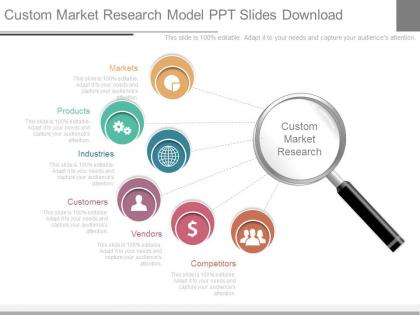
Package your ideas in our Custom Market Research Model Ppt Slides Download. They will get that attractive look.
People who downloaded this PowerPoint presentation also viewed the following :
Custom market research model ppt slides download with all 7 slides:
Achieve endlessly with our Custom Market Research Model Ppt Slides Download. Your accomplishments will become bigger and better.
FAQs for Custom market research model
Key components of a custom market research model include data collection methodologies, target audience segmentation, competitive analysis frameworks, statistical modeling techniques, and reporting mechanisms. These elements work together by enabling precise market insights, identifying consumer behavior patterns, and delivering actionable intelligence, with many organizations finding that strategic customization ultimately enhances decision-making accuracy and competitive positioning.
Businesses can tailor market research models by incorporating industry-specific metrics, customizing data collection methods, adapting analytical frameworks, and integrating sector-relevant benchmarks. For example, healthcare organizations emphasize patient satisfaction and regulatory compliance metrics, while retail companies focus on customer journey mapping and seasonal purchasing patterns, ultimately delivering more actionable insights and strategic competitive advantage.
Common challenges include data quality issues, sample bias, methodology selection, resource constraints, and timeline pressures. These obstacles can significantly impact research validity, with many organizations finding that inadequate planning, insufficient stakeholder alignment, and evolving market conditions create additional complexity, ultimately requiring strategic flexibility and robust validation processes to deliver actionable insights.
Custom market research models are specifically designed for unique business requirements, target audiences, and industry contexts, while off-the-shelf solutions offer standardized methodologies and generic data sets. These tailored approaches enable organizations to address specific market challenges, competitive landscapes, and consumer behaviors through personalized frameworks, ultimately delivering more relevant insights and strategic advantages than broad-spectrum alternatives.
Data analytics serves as the foundation of custom market research models by enabling precise audience segmentation, predictive trend analysis, real-time consumer behavior tracking, and competitive intelligence gathering. Through advanced analytics platforms, organizations can transform raw market data into actionable strategic insights, optimize resource allocation, and enhance decision-making accuracy, with many companies finding that data-driven research models deliver significantly faster market responses and competitive advantages.
Companies ensure data validity and reliability through rigorous sampling methodologies, multiple data collection methods, pre-testing survey instruments, and implementing quality control checkpoints throughout the research process. By combining quantitative metrics with qualitative insights, cross-referencing findings across different sources, and conducting statistical validation tests, organizations ultimately deliver more accurate market intelligence and strategic decision-making capabilities for sustained competitive advantage.
Qualitative methods in custom market research include in-depth interviews, focus groups, ethnographic studies, customer journey mapping, and observational research. These approaches enable businesses to uncover deeper consumer motivations, emotional drivers, and behavioral patterns, with many organizations finding that combining multiple qualitative techniques delivers richer insights and more strategic competitive advantage.
Demographic factors influence custom market research models by determining sample composition, survey methodologies, data collection channels, question framing, and analytical approaches. Through strategic demographic segmentation, organizations can tailor research instruments to capture generational preferences, cultural nuances, and socioeconomic behaviors, ultimately delivering more accurate market insights and targeted business strategies.
Effective strategies include implementing real-time feedback loops, establishing systematic survey protocols, conducting focus groups, utilizing social media monitoring, and creating continuous dialogue channels. These approaches enhance research accuracy by capturing diverse customer perspectives, identifying emerging trends, and validating assumptions, with many organizations finding that integrated feedback delivers more actionable insights and competitive market positioning.
Technology enhances custom market research efficiency through automated data collection, AI-powered analytics, real-time survey deployment, predictive modeling, and cloud-based collaboration platforms. These tools streamline research processes by reducing manual tasks, accelerating data analysis, and enabling faster insights generation, with many organizations finding significantly reduced research timelines and improved accuracy.
Costs include research design and methodology development, data collection and acquisition, specialized software and analytics tools, skilled personnel hiring or training, and ongoing maintenance and updates. These investments typically range from moderate to significant depending on scope and complexity, but many organizations find that custom models deliver superior insights and competitive advantages that justify the initial expenditure through better strategic decision-making.
Custom market research models should be reviewed quarterly and updated annually, though rapidly evolving sectors like technology or healthcare may require more frequent adjustments every six months. This strategic approach ensures data accuracy, methodology relevance, and competitive insights remain current, with many organizations finding that regular updates enhance decision-making precision, improve market positioning, and ultimately deliver stronger ROI on research investments.
Businesses ensure effective questioning in custom market research models by aligning inquiries with strategic objectives, conducting stakeholder interviews to identify knowledge gaps, and pre-testing questions with target audiences for clarity and relevance. Through iterative refinement and cross-functional collaboration, organizations can develop focused research frameworks that deliver actionable insights, ultimately enabling data-driven decision making and competitive positioning in increasingly complex markets.
Custom market research requires prioritizing participant consent, data privacy protection, transparent methodology disclosure, and avoiding deceptive practices or leading questions. These ethical frameworks ensure research integrity by safeguarding respondent confidentiality, preventing bias manipulation, and maintaining honest reporting standards, with many organizations finding that ethical compliance ultimately delivers more reliable insights and stronger stakeholder trust.
A custom market research model supports product development by identifying unmet customer needs, validating concepts early, tracking competitor innovations, analyzing market gaps, and predicting consumer trends. Through tailored methodologies, companies streamline development cycles, reduce launch risks, and enhance product-market fit, with many tech and consumer goods firms finding that targeted research accelerates innovation while minimizing costly market missteps.
-
Innovative and attractive designs.
-
Great quality product.