


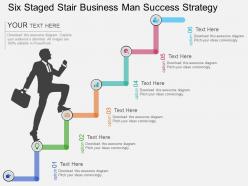
Cv six staged stair business man success strategy flat powerpoint design





Try Before you Buy Download Free Sample Product
 Impress Your
 Audience
 100%
100% Editable
 Save Hours
 of Time


Plan your success with our six staged stair business man success strategy PowerPoint slide. This PPT illustration demonstrates the growth concept in the corporate firm. Nowadays, achieving success can only be possible if it has been planned in the right manner. Our presentation visual allows you to make your viewers understand as what they need to do in order to achieve success in their life. The six stages can be useful in highlighting the six factors that assist you to plan your success in the professional manner. Apart from this, you can also showcase the steps to manage success. Whatever message you want to convey to your viewers, it can be easily achieved with this design. Moreover, the PowerPoint diagram is also useful for the individuals to accomplish their desires. The road to success can be difficult but if you are focused then you will achieve it. Let this design assist you to pass on your message to your viewers. Your audience will surely be able to understand your point with it. Crush the competition. Cv Six Staged Stair Business Man Success Strategy Flat Powerpoint Design with tailored design help you dominate your working life.
People who downloaded this PowerPoint presentation also viewed the following :
Cv six staged stair business man success strategy flat powerpoint design with all 4 slides:
You may have the best idea but you have to convince others about it. That's where great Cv Six Staged Stair Business Man Success Strategy Flat Powerpoint Design come in to make it work.



FAQs for Cv six staged stair business man success strategy
A successful business strategy encompasses clear vision and objectives, comprehensive market analysis, competitive differentiation, resource allocation optimization, and measurable performance metrics. These elements work synergistically to enhance operational efficiency and market positioning, with many organizations finding that strategic alignment across departments ultimately delivers sustainable growth and competitive advantage in increasingly dynamic markets.
Businesses can measure strategy effectiveness through key performance indicators, financial metrics, market share analysis, customer satisfaction scores, and operational efficiency benchmarks. These measurement frameworks enable organizations to track progress systematically, identify performance gaps, and make data-driven adjustments, with many companies finding that regular quarterly assessments ultimately deliver improved competitive positioning and sustained growth.
Market research plays a foundational role in business success strategy by identifying customer needs, analyzing competitor positioning, evaluating market opportunities, and validating product-market fit. Through comprehensive data collection and analysis, organizations can minimize risks, optimize resource allocation, and develop targeted approaches that resonate with their audiences, ultimately delivering strategic competitive advantages and sustainable growth outcomes.
Companies can adapt their strategy through continuous market monitoring, agile decision-making frameworks, diversified revenue streams, strategic partnerships, and robust scenario planning. By maintaining flexible operational structures and investing in emerging technologies, organizations across sectors like retail and financial services can pivot quickly during disruptions, ultimately delivering competitive advantage and sustained growth in increasingly dynamic markets.
Common strategic pitfalls include inadequate market research, unrealistic goal setting, poor resource allocation, insufficient competitive analysis, and lack of stakeholder alignment. These challenges often stem from rushing the planning process or ignoring market dynamics, with many organizations finding that comprehensive preparation and regular strategy reviews help minimize risks while delivering sustainable growth and competitive advantage.
Innovation is critically important in business success strategy as it drives competitive differentiation, enables market adaptation, and creates sustainable growth opportunities through new products, services, and operational efficiencies. Companies that prioritize innovation, from tech giants developing breakthrough technologies to retailers revolutionizing customer experiences, consistently outperform competitors by anticipating market changes and delivering enhanced value propositions.
Startups can establish strong market presence through targeted digital marketing, strategic partnerships, customer-centric product development, competitive pricing strategies, and brand differentiation initiatives. These approaches enable emerging companies to build credibility, acquire customers efficiently, and compete effectively with established players, with many startups finding that combining multiple strategies accelerates market penetration and sustainable growth.
Businesses align resources with strategic goals by conducting capability audits, mapping resource requirements to objectives, establishing clear performance metrics, and implementing regular review cycles. Through strategic resource allocation frameworks, companies in sectors like manufacturing and retail can optimize operational efficiency, reduce waste, and accelerate goal achievement, ultimately delivering competitive advantage and sustainable growth.
Leadership significantly impacts business strategy implementation by setting clear vision, allocating resources effectively, driving organizational alignment, and maintaining momentum through challenges. Strong leaders facilitate cross-departmental collaboration, communicate strategic priorities consistently, and adapt execution approaches when needed, with many organizations finding that engaged leadership teams deliver faster implementation timelines, higher employee buy-in, and ultimately greater strategic success.
Businesses can leverage technology to enhance their strategy through data analytics for informed decision-making, automation for operational efficiency, cloud computing for scalability, AI for predictive insights, and digital platforms for customer engagement. These technologies streamline processes, reduce costs, and accelerate growth, with many organizations finding that strategic technology integration delivers competitive advantage and sustainable success.
Customer feedback serves as a critical compass for refining business success strategies, providing insights into market needs, product gaps, service deficiencies, and competitive positioning. Through systematic feedback collection and analysis, organizations can pivot their approaches, enhance customer experiences, and identify new revenue opportunities, with many companies finding that customer-driven strategy refinements ultimately deliver stronger market alignment and sustainable competitive advantage.
Businesses ensure long-term strategic sustainability by conducting regular market analysis, diversifying revenue streams, investing in employee development, maintaining financial reserves, and adapting to technological changes. Through continuous innovation and stakeholder engagement, organizations strengthen operational resilience, anticipate market shifts, and build competitive advantages, with many companies finding that flexible strategic frameworks ultimately deliver sustained growth and market leadership.
Companies can effectively communicate strategy through regular town halls, visual strategy maps, departmental cascading sessions, interactive workshops, and digital dashboards tracking progress. These approaches enhance employee understanding and engagement by translating high-level objectives into role-specific actions, fostering transparency, and enabling real-time feedback, with many organizations finding that consistent, multi-channel communication significantly improves strategy execution and alignment.
Companies can evaluate their competitive landscape through market analysis, competitor profiling, SWOT assessments, customer feedback analysis, and industry benchmarking studies. This strategic combination enables organizations to identify market gaps, assess competitor strengths and weaknesses, understand customer preferences, and ultimately develop differentiated positioning strategies, with many businesses finding that regular competitive intelligence gathering delivers significant advantages in product development and market positioning.
Businesses can foster strategic thinking through regular scenario planning workshops, cross-functional collaboration initiatives, leadership development programs, data-driven decision-making frameworks, and encouraging calculated risk-taking. These approaches enhance organizational agility by breaking down silos, developing analytical capabilities, and empowering employees to think beyond immediate tasks, ultimately delivering competitive advantage and sustainable growth.
-
Colors used are bright and distinctive.
-
Very unique, user-friendly presentation interface.