


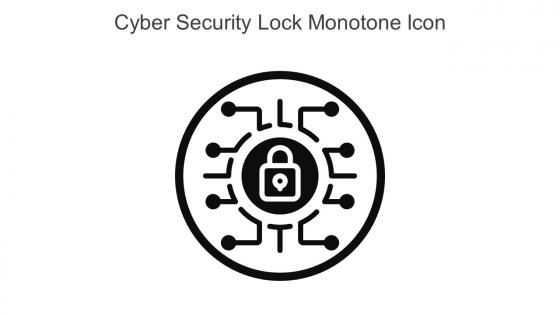
Cyber Security Lock Monotone Icon In Powerpoint Pptx Png And Editable Eps Format




Try Before you Buy Download Free Sample Product
 Impress Your
 Audience
 100%
100% Editable
 Save Hours
 of Time


This Cyber security lock monotone icon in powerpoint pptx png and editable eps format is a 100 percent editable icon. The downloaded file will have this icon in EPS, PNG and Powerpoint pptx format and is perfect for your next project. It has a simple yet stylish design.
People who downloaded this PowerPoint presentation also viewed the following :
Cyber Security Lock Monotone Icon In Powerpoint Pptx Png And Editable Eps Format with all 6 slides:
Use our Cyber Security Lock Monotone Icon In Powerpoint Pptx Png And Editable Eps Format to effectively help you save your valuable time. They are readymade to fit into any presentation structure.





FAQs for Cyber Security Lock Monotone Icon In Powerpoint Pptx Png And
The most common cyber threats include phishing attacks, ransomware, malware infections, data breaches, and social engineering schemes. These threats increasingly target organizations through email campaigns, vulnerable network endpoints, and employee manipulation, with many financial services, healthcare institutions, and retail companies finding that comprehensive security frameworks combining employee training, advanced detection systems, and incident response protocols deliver enhanced protection and operational resilience.
Businesses can implement effective cybersecurity frameworks through risk assessments, employee training, multi-factor authentication, regular software updates, and incident response planning. Organizations like banks and healthcare providers increasingly combine these elements with continuous monitoring and third-party audits, ultimately delivering enhanced data protection, regulatory compliance, and customer trust while minimizing costly security breaches.
Employee training serves as a critical frontline defense by educating staff on recognizing phishing attempts, social engineering tactics, password security, safe browsing practices, and incident reporting protocols. These programs significantly reduce human error vulnerabilities, with many organizations finding that well-trained employees become active security assets, ultimately strengthening overall cyber resilience and reducing breach risks.
Advanced persistent threats (APTs) differ from other cyber attacks through their prolonged stealth operations, sophisticated targeting of specific organizations, and multi-stage infiltration techniques designed to remain undetected for months or years. Unlike opportunistic malware or ransomware attacks, APTs involve sustained reconnaissance and resource investment, with many financial institutions and government agencies finding that these threats focus on long-term data exfiltration rather than immediate disruption.
Key components include incident detection and classification systems, designated response teams with clear roles, communication protocols for stakeholders, containment and eradication procedures, and comprehensive recovery processes. These elements work together by enabling rapid threat identification, coordinating swift remediation efforts, and minimizing business disruption, with many organizations finding that structured incident response reduces recovery time and operational costs significantly.
Companies can balance user privacy with necessary security measures through transparent data policies, privacy-by-design frameworks, selective data collection, user consent mechanisms, and regular security audits. This strategic approach enables organizations to maintain robust cybersecurity while respecting user rights, with many financial institutions and healthcare providers finding that clear communication and minimal data practices ultimately deliver both enhanced security and increased customer trust.
AI and machine learning significantly transform cybersecurity by enabling predictive threat detection, automating incident response, and enhancing behavioral analytics for anomaly identification. These technologies streamline security operations by processing vast data volumes, identifying previously unknown threats, and reducing response times, with many financial institutions and healthcare organizations finding that AI-driven security delivers faster threat mitigation and improved operational efficiency.
Small businesses can strengthen cybersecurity through employee training programs, multi-factor authentication, regular software updates, cloud-based security solutions, and automated backup systems. These cost-effective measures deliver significant protection by reducing human error, blocking unauthorized access, and ensuring business continuity, with many small enterprises finding that strategic cybersecurity investments ultimately prevent far costlier data breaches.
Data breaches carry significant legal implications including regulatory fines, compliance violations, civil lawsuits, notification requirements, and potential criminal liability. These consequences vary by jurisdiction and industry, with organizations in healthcare, finance, and retail facing stricter penalties under GDPR, HIPAA, and state privacy laws, ultimately requiring comprehensive legal preparedness and incident response strategies.
Social engineering exploits human psychology by leveraging trust, curiosity, fear, and authority to bypass technical security measures, using tactics like phishing emails, pretexting, baiting, and tailgating. These attacks target employees through emotional manipulation and urgency, with many organizations finding that human vulnerabilities often present greater risks than technological weaknesses, ultimately compromising sensitive data and systems.
**INPUT**: What best practices should be followed for securing remote work environments? **OUTPUT**: Remote work security best practices include implementing multi-factor authentication, using VPNs, regular software updates, endpoint protection, and employee training programs. These measures streamline security by establishing encrypted connections, monitoring device activity, and minimizing human error vulnerabilities, with many organizations finding that comprehensive remote policies ultimately deliver enhanced productivity while maintaining robust data protection.
Current ransomware trends include double extortion tactics, supply chain targeting, ransomware-as-a-service models, AI-enhanced attacks, and cloud infrastructure exploitation. Organizations mitigate these through zero-trust architectures, automated backup systems, employee training programs, and threat intelligence platforms, with many financial institutions and healthcare providers finding that layered security approaches significantly reduce vulnerability exposure and recovery times.
Organizations can ensure cloud security through multi-factor authentication, encryption protocols, regular security audits, access controls, and continuous monitoring systems. These approaches streamline protection by establishing layered defenses, automating threat detection, and maintaining compliance standards, with many financial services and healthcare institutions finding that strategic security investments ultimately deliver enhanced customer trust and competitive advantage.
Essential security measures for IoT devices include network segmentation, device authentication protocols, regular firmware updates, encrypted data transmission, and continuous monitoring systems. These technologies enhance organizational security by isolating compromised devices, preventing unauthorized access, and detecting anomalies in real-time, with many enterprises finding that layered approaches significantly reduce vulnerabilities while maintaining operational efficiency.
Threat intelligence helps organizations anticipate cyberattacks by analyzing emerging threat patterns, identifying vulnerabilities before exploitation, and providing actionable insights about attacker tactics and targets. Through real-time data analysis and threat monitoring, companies can strengthen their security postures, implement proactive defenses, and respond faster to incidents, ultimately reducing breach risks and maintaining competitive advantage in an increasingly dangerous digital landscape.
-
Great templates that you can use in your next keynote or conference. They are perfect for quick and visually-engaging delivery.
-
I want to thank SlideTeam for the work that they do, especially their customer service.