


Dashboard For Tracking Impact Of Transport Automation Supply Chain And Logistics Automation




Try Before you Buy Download Free Sample Product
 Impress Your
 Audience
 100%
100% Editable
 Save Hours
 of Time


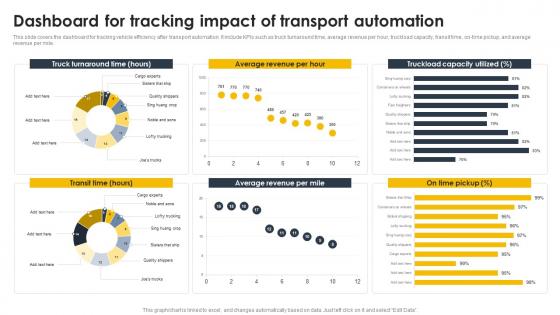
This slide covers the dashboard for tracking vehicle efficiency after transport automation. It include KPIs such as truck turnaround time, average revenue per hour, truckload capacity, transit time, on time pickup, and average revenue per mile.
People who downloaded this PowerPoint presentation also viewed the following :
Dashboard For Tracking Impact Of Transport Automation Supply Chain And Logistics Automation with all 7 slides:
Use our Dashboard For Tracking Impact Of Transport Automation Supply Chain And Logistics Automation to effectively help you save your valuable time. They are readymade to fit into any presentation structure.





FAQs for Dashboard For Tracking Impact Of Transport Automation Supply Chain
**INPUT**: What are the key features that make a transport automation dashboard effective for logistics management? **OUTPUT**: Effective transport automation dashboards include real-time tracking, predictive analytics, route optimization, automated scheduling, and comprehensive reporting capabilities. These features streamline logistics operations by minimizing delivery delays, reducing fuel costs, and enhancing fleet visibility, with many transportation companies finding that integrated dashboards ultimately deliver improved customer satisfaction and significant operational efficiency gains. **Word count: 54 words**
Data visualization tools enhance transport automation decision-making by transforming complex operational data into clear, actionable insights through real-time dashboards, predictive analytics displays, and performance trend visualizations. Through interactive charts and maps, transport managers can quickly identify bottlenecks, optimize route efficiency, and monitor fleet performance, ultimately enabling faster responses to operational challenges and strategic resource allocation decisions.
Real-time tracking serves as the operational backbone of transport automation dashboards by providing instant visibility into vehicle locations, delivery statuses, route deviations, and potential delays. This continuous data flow enables logistics managers to make immediate adjustments, optimize resource allocation, and proactively address disruptions, ultimately delivering faster response times and enhanced customer satisfaction.
A comprehensive transport automation dashboard should integrate real-time GPS tracking data, fuel consumption metrics, maintenance schedules, driver performance indicators, route optimization analytics, and predictive maintenance alerts. These data streams enable fleet managers to streamline operations, reduce operational costs, and enhance delivery efficiency, with logistics companies finding that integrated dashboards ultimately deliver significant competitive advantages through improved resource allocation and customer service transparency.
Transport automation dashboards improve compliance and regulatory reporting by centralizing data collection, automating documentation processes, and providing real-time monitoring of regulatory requirements like driver hours, vehicle inspections, and safety protocols. These systems enable transportation companies to generate accurate reports instantly, track compliance metrics across fleets, and identify potential violations before they occur, ultimately reducing regulatory risks and streamlining audit processes.
Common challenges include data integration complexities, resistance to change from staff, high initial implementation costs, system compatibility issues, and ensuring real-time accuracy across multiple transport modes. While these hurdles require careful planning, many logistics companies find that strategic phasing, comprehensive training programs, and robust API connections ultimately streamline operations and deliver significant efficiency gains.
User experience and interface design significantly impact transport automation dashboard usability by ensuring intuitive navigation, clear data visualization, and streamlined workflow integration for operators managing complex transportation networks. Well-designed interfaces enable faster decision-making, reduce operator training time, and minimize errors during critical operations, with many transportation authorities finding that thoughtful UX design ultimately enhances operational efficiency and system adoption rates.
Transport automation dashboards should prioritize real-time vehicle tracking, fuel consumption analytics, route optimization metrics, delivery time performance, and predictive maintenance indicators. These metrics enable fleet managers to streamline operations, reduce costs, and enhance customer satisfaction, with logistics companies finding that comprehensive visibility ultimately delivers competitive advantage through improved efficiency and proactive decision-making.
Transport automation dashboards help predict maintenance needs by analyzing real-time vehicle data, including engine performance metrics, mileage patterns, component wear indicators, and operational stress factors. Through predictive analytics and IoT sensors, fleet managers can identify potential failures before they occur, schedule proactive maintenance, and minimize unexpected breakdowns, ultimately reducing operational costs and enhancing service reliability.
Key technologies driving transport automation dashboard advancements include artificial intelligence for predictive analytics, IoT sensors for real-time vehicle monitoring, machine learning algorithms for route optimization, cloud computing for scalable data processing, and advanced visualization tools for intuitive interfaces. These technologies streamline fleet management by enhancing operational efficiency, reducing maintenance costs, and improving safety protocols, with many logistics companies finding that integrated dashboards ultimately deliver significant competitive advantages and cost savings.
Machine learning algorithms enhance transport automation dashboards by enabling predictive maintenance, optimizing route efficiency, and automating real-time decision-making based on traffic patterns and vehicle performance data. These algorithms analyze vast datasets from sensors, GPS systems, and operational metrics, allowing transportation companies to reduce fuel costs, minimize delays, and improve fleet utilization, ultimately delivering enhanced operational efficiency and competitive advantage.
A transport automation dashboard reduces operational costs by optimizing route planning, monitoring fuel consumption, tracking vehicle maintenance schedules, and minimizing idle time through real-time analytics. These systems enable transportation companies to streamline fleet utilization, reduce unnecessary mileage, and prevent costly breakdowns, with many logistics organizations finding that automated monitoring delivers up to 20% cost savings through enhanced operational efficiency.
Transport automation dashboards enhance interdepartmental collaboration by providing unified real-time visibility into operations, standardized performance metrics, and shared communication platforms for coordinated decision-making. Through centralized data access, departments like dispatch, maintenance, customer service, and finance can seamlessly coordinate responses to delays, optimize resource allocation, and deliver consistent customer updates, ultimately streamlining operations across the entire logistics organization.
Security considerations for transport automation dashboards include end-to-end encryption, multi-factor authentication, role-based access controls, real-time threat monitoring, and secure API integrations. These security measures streamline operations by protecting sensitive route data, passenger information, and fleet communications, with many transportation authorities finding that robust cybersecurity frameworks ultimately enhance operational reliability while maintaining public trust.
Cloud-based solutions enhance transport automation dashboards by enabling real-time data processing, scalable storage, and seamless integration across multiple transportation networks. These platforms deliver improved fleet visibility, predictive maintenance capabilities, and automated route optimization, with logistics companies and public transit authorities finding that cloud infrastructure significantly reduces operational costs while enhancing service reliability and passenger experiences.
-
Amazing slides! Unique, attractive, and easy to understand.
-
The slides come with appealing color schemes and relevant content that helped me deliver a stunning presentation without any hassle!