


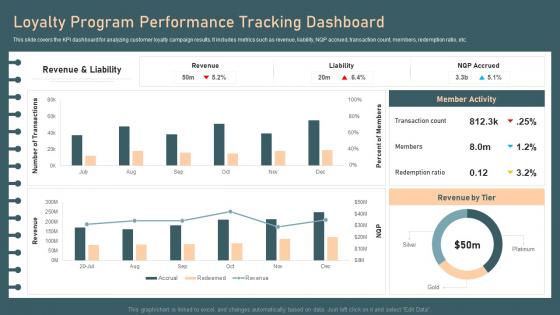
Identifying And Optimizing Customer Touchpoints Loyalty Program Performance Tracking Dashboard




Try Before you Buy Download Free Sample Product
 Impress Your
 Audience
 100%
100% Editable
 Save Hours
 of Time


This slide covers the KPI dashboard for analyzing customer loyalty campaign results. It includes metrics such as revenue, liability, NQP accrued, transaction count, members, redemption ratio, etc.
People who downloaded this PowerPoint presentation also viewed the following :
Identifying And Optimizing Customer Touchpoints Loyalty Program Performance Tracking Dashboard with all 7 slides:
Use our Identifying And Optimizing Customer Touchpoints Loyalty Program Performance Tracking Dashboard to effectively help you save your valuable time. They are readymade to fit into any presentation structure.






FAQs for Identifying And Optimizing Customer Touchpoints Loyalty Program
Key customer touchpoints in digital marketing include social media platforms, email campaigns, website interactions, search engine results, mobile apps, and online advertising. These touchpoints streamline customer acquisition and retention by creating consistent brand experiences, enabling personalized messaging, and tracking behavioral data, with many organizations finding that integrated touchpoint strategies deliver higher conversion rates and stronger customer loyalty.
Customer touchpoints significantly influence overall customer experience by shaping perceptions, building trust, and determining satisfaction levels at every interaction stage. Through consistent messaging, seamless transitions, and personalized engagement across channels, businesses create cohesive journeys that enhance loyalty, reduce friction, and ultimately drive retention, with many organizations finding that optimized touchpoint management delivers measurable competitive advantage and increased customer lifetime value.
Social media channels serve as dynamic, interactive touchpoints that enable real-time customer engagement, brand storytelling, community building, and direct feedback collection. These platforms revolutionize customer relationships by facilitating immediate responses to inquiries, personalized content delivery, and peer-to-peer recommendations, with many retail and hospitality brands finding that strategic social media engagement significantly enhances customer loyalty and drives measurable business growth.
Businesses measure touchpoint effectiveness through customer satisfaction surveys, conversion rates, Net Promoter Scores, customer journey analytics, and engagement metrics across channels. These measurement approaches enable organizations to identify high-performing interactions, optimize underperforming touchpoints, and streamline customer experiences, with many companies finding that data-driven touchpoint optimization significantly enhances customer retention and operational efficiency.
Best practices for optimizing customer touchpoints include mapping the entire customer journey, personalizing interactions based on customer data, ensuring consistent messaging across all channels, implementing feedback loops for continuous improvement, and training staff to deliver exceptional experiences. These strategies streamline customer interactions by reducing friction, enhancing satisfaction, and building stronger relationships, with many organizations finding that optimized touchpoints ultimately deliver increased loyalty and competitive advantage.
Personalization enhances customer touchpoints by analyzing individual preferences, behaviors, and purchase history to deliver tailored experiences across all interaction channels. Through AI-driven insights and real-time data processing, retailers, banks, and service providers streamline customer journeys, reduce friction, and increase engagement rates, ultimately delivering higher satisfaction scores and stronger customer loyalty.
Omnichannel touchpoints significantly enhance customer retention by creating seamless experiences across all interaction channels, reducing friction, and building stronger brand loyalty. Through integrated platforms, businesses deliver consistent messaging and personalized service whether customers engage via mobile, web, or in-store, with many retail and financial services companies finding retention rates improve dramatically.
Businesses should prioritize touchpoints by analyzing feedback frequency, sentiment scores, and impact on customer journey stages, focusing first on high-friction points that affect retention and acquisition. Through systematic feedback analysis, organizations can identify critical moments like onboarding, support interactions, and checkout processes, ultimately delivering improved experiences and competitive advantage.
Technologies that improve customer touchpoint interactions include AI chatbots, CRM systems, mobile apps, omnichannel platforms, and predictive analytics tools. These solutions streamline customer experiences by automating responses, personalizing interactions, and providing seamless transitions across channels, with many retail and financial services organizations finding they significantly enhance satisfaction while reducing operational costs.
Visual design in presentations elevates touchpoint understanding by transforming complex customer journey data into intuitive maps, flowcharts, and interactive diagrams that highlight pain points and opportunities. Through strategic use of color coding, icons, and visual hierarchy, organizations can immediately identify critical moments like checkout processes or support interactions, enabling teams to prioritize improvements and deliver enhanced customer experiences.
Companies often make mistakes like inconsistent messaging across channels, neglecting digital touchpoint optimization, failing to train staff adequately, and not collecting customer feedback systematically. These oversights result in fragmented customer experiences, with many organizations finding that poor touchpoint management leads to reduced customer satisfaction, decreased loyalty, and ultimately lost revenue opportunities in an increasingly competitive marketplace.
Customer touchpoints vary significantly across industries based on customer expectations, regulatory requirements, and service complexity. In healthcare, touchpoints emphasize appointment scheduling and patient portals, while retail focuses on e-commerce platforms and in-store experiences, and financial services prioritize mobile banking and branch interactions, with each industry ultimately delivering tailored experiences that enhance customer satisfaction and operational efficiency.
Customer touchpoints integrate with CRM systems through automated data capture, real-time interaction tracking, unified customer profiles, behavioral analytics, and seamless communication workflows. This strategic combination enables organizations to streamline customer experiences across channels, enhance personalized service delivery, and optimize relationship management, with many businesses finding that integrated touchpoint-CRM systems significantly improve customer retention and operational efficiency.
Emerging customer touchpoint trends for 2024 include AI-powered conversational interfaces, immersive augmented reality experiences, voice-activated shopping platforms, personalized video communications, and seamless omnichannel integration. These technologies streamline customer interactions by delivering hyper-personalized experiences, reducing response times, and enabling predictive service delivery, with retail and financial services finding significantly enhanced customer satisfaction and operational efficiency.
Storytelling enhances customer touchpoints by creating emotional connections, maintaining narrative consistency across channels, and personalizing experiences based on customer journey stages. Through compelling brand narratives, companies like Nike and Airbnb transform routine interactions into memorable experiences, ultimately building stronger customer loyalty, increasing engagement rates, and differentiating themselves in competitive markets.
-
Happy to found you SlideTeam. You guys are value for money. Amazing slides.
-
Wide collection of templates available. SlideTeam has made it easier to create presentations in just a few minutes.