


Data AI Artificial Intelligence Data AI Platform Multiple Layer Architecture AI SS




Try Before you Buy Download Free Sample Product
 Impress Your
 Audience
 100%
100% Editable
 Save Hours
 of Time


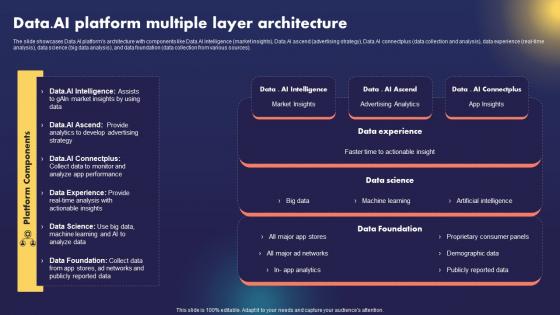
The slide showcases Data.AI platforms architecture with components like Data.AI intelligence market insights, Data.AI ascend advertising strategy, Data.AI connectplus data collection and analysis, data experience real-time analysis, data science big data analysis, and data foundation data collection from various sources.
People who downloaded this PowerPoint presentation also viewed the following :
Data AI Artificial Intelligence Data AI Platform Multiple Layer Architecture AI SS with all 9 slides:
Use our Data AI Artificial Intelligence Data AI Platform Multiple Layer Architecture AI SS to effectively help you save your valuable time. They are readymade to fit into any presentation structure.








FAQs for Data AI Artificial Intelligence Data AI Platform Multiple Layer
Key components include data ingestion layers, storage systems, processing engines, machine learning frameworks, and analytics interfaces. These technologies streamline operations by automating data workflows, enabling real-time analytics, and supporting scalable AI model deployment, with organizations across healthcare, finance, and retail finding enhanced decision-making capabilities and competitive advantage.
Scalability integrates into Data AI Platform Architecture through cloud-native infrastructure, microservices design, containerization, auto-scaling capabilities, and distributed computing frameworks. These architectural components enable organizations to handle growing data volumes, increasing user demands, and expanding AI workloads seamlessly, with many enterprises finding that strategic scalability planning delivers enhanced performance, reduced operational costs, and sustainable competitive advantage.
Data pipelines serve as the critical infrastructure connecting data sources to AI applications, enabling automated data ingestion, transformation, validation, and delivery across the platform. These pipelines streamline workflows by processing real-time and batch data, ensuring quality standards, and maintaining consistent data flow, ultimately delivering scalable analytics capabilities and faster AI model deployment for organizations.
Organizations ensure data quality within AI platform architecture through automated validation protocols, real-time monitoring systems, data lineage tracking, standardized cleansing processes, and governance frameworks. These mechanisms streamline accuracy by detecting anomalies early, maintaining consistent formats, and establishing clear accountability, with many enterprises finding that robust data quality foundations ultimately deliver more reliable AI insights and competitive advantage.
Best practices for implementing real-time data processing in AI architectures include stream processing frameworks, microservices architecture, automated scaling mechanisms, robust data pipelines, and efficient storage solutions. These approaches streamline operations by minimizing latency, ensuring continuous data flow, and enabling instant decision-making, with many financial services and retail organizations finding that real-time processing delivers faster customer responses and significant competitive advantages.
Cloud-based solutions fundamentally reshape Data AI Platform Architectures by enabling elastic scalability, distributed processing capabilities, and seamless integration across multiple data sources and analytics tools. These platforms streamline deployment through managed services, automated scaling, and reduced infrastructure overhead, with organizations in healthcare, finance, and retail finding that cloud architectures deliver faster model deployment, lower operational costs, and enhanced collaborative analytics capabilities.
Common machine learning frameworks in Data AI platforms include TensorFlow, PyTorch, Scikit-learn, Apache Spark MLlib, and XGBoost. These frameworks streamline model development, training, and deployment by offering pre-built algorithms, scalable processing capabilities, and seamless integration tools, with many financial services and healthcare organizations finding that strategic framework selection ultimately delivers faster time-to-market and enhanced predictive accuracy.
Data governance is incorporated through automated policy enforcement, data lineage tracking, access controls, quality monitoring frameworks, and compliance audit trails throughout the platform architecture. These governance mechanisms streamline regulatory compliance, enhance data trustworthiness, and enable scalable oversight, with many financial services and healthcare organizations finding that integrated governance ultimately delivers operational efficiency and risk mitigation.
Security challenges in Data AI Platform Architecture include data breaches, unauthorized access, model poisoning, privacy violations, and compliance gaps across distributed environments. These risks can be mitigated through end-to-end encryption, robust identity management, continuous monitoring, and zero-trust frameworks, with many organizations finding that layered security approaches ultimately deliver enhanced data protection and regulatory compliance.
Database technology significantly impacts AI platform performance through data processing speed, scalability capabilities, and query optimization features. Modern platforms leverage specialized databases like graph databases for relationship analysis, columnar stores for analytics workloads, and distributed systems for handling massive datasets, with organizations finding that strategic database selection can reduce processing times by up to 70% while enabling real-time AI insights.
Efficient model deployment methodologies include containerization with Docker and Kubernetes, CI/CD pipelines, blue-green deployments, canary releases, and automated monitoring systems. These approaches streamline operations by enabling faster rollouts, minimizing downtime, and ensuring scalable performance, with many financial services and healthcare organizations finding that automated deployment pipelines reduce deployment time by 70% while enhancing reliability.
Edge computing enhances Data AI Platform Architecture by reducing latency, enabling real-time processing, and minimizing bandwidth requirements through localized data analysis. By processing data closer to its source, organizations streamline operations across manufacturing, healthcare, and retail sectors, ultimately delivering faster decision-making, improved customer experiences, and significant cost reductions in data transmission.
Data privacy regulations like GDPR and CCPA significantly influence Data AI Platform architecture through mandatory data encryption, user consent management systems, automated deletion capabilities, and comprehensive audit trails. These compliance requirements drive organizations to implement privacy-by-design frameworks, data anonymization technologies, and granular access controls, ultimately delivering enhanced customer trust and competitive advantage while ensuring regulatory adherence across global markets.
Collaborative tools integrate into data AI platform architecture through shared development environments, version control systems, model registries, automated workflow orchestration, and real-time communication channels. These technologies streamline data science workflows by enabling seamless code sharing, experiment tracking, and model deployment pipelines, with many organizations finding that integrated collaboration reduces project timelines while enhancing cross-team coordination and reproducibility.
Organizations should consider edge computing integration, real-time streaming analytics, federated learning capabilities, automated MLOps pipelines, and cloud-native microservices architectures. These emerging trends enable faster decision-making, enhanced data privacy, and scalable AI deployment, with many enterprises finding that future-ready architectures deliver significant competitive advantages while reducing operational complexity.
-
Awesomely designed templates, Easy to understand.
-
Content of slide is easy to understand and edit.