


Data AI Artificial Intelligence Data AI Platform Offerings For Digital Ecosystem AI SS




Try Before you Buy Download Free Sample Product
 Impress Your
 Audience
 100%
100% Editable
 Save Hours
 of Time


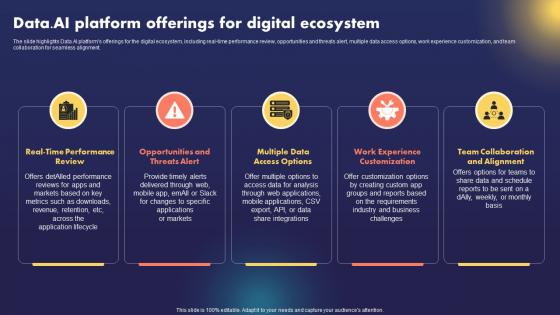
The slide highlights Data.AI platforms offerings for the digital ecosystem, including real-time performance review, opportunities and threats alert, multiple data access options, work experience customization, and team collaboration for seamless alignment.
People who downloaded this PowerPoint presentation also viewed the following :
Data AI Artificial Intelligence Data AI Platform Offerings For Digital Ecosystem AI SS with all 9 slides:
Use our Data AI Artificial Intelligence Data AI Platform Offerings For Digital Ecosystem AI SS to effectively help you save your valuable time. They are readymade to fit into any presentation structure.








FAQs for Data AI Artificial Intelligence Data AI Platform Offerings For Digital
Leading data AI platforms differentiate through advanced machine learning capabilities, real-time analytics processing, automated data integration, scalable cloud infrastructure, and intuitive user interfaces for non-technical users. These features enable organizations across healthcare, finance, and retail to streamline operations, accelerate decision-making, and enhance customer experiences, with many enterprises finding that comprehensive platforms deliver significant competitive advantages.
Data AI platforms ensure privacy and compliance through advanced encryption, automated data anonymization, access controls, audit trails, and built-in regulatory frameworks that automatically adapt to GDPR requirements. These comprehensive security measures enable organizations across healthcare, financial services, and retail to process sensitive information while maintaining strict compliance standards, ultimately delivering both operational efficiency and regulatory confidence in an increasingly data-driven business environment.
Machine learning serves as the core intelligence engine of data AI platforms, enabling automated pattern recognition, predictive analytics, real-time decision-making, and adaptive learning from vast datasets. Through advanced algorithms, these platforms streamline operations across industries like healthcare diagnostics, financial fraud detection, and retail personalization, ultimately delivering faster insights, reduced operational costs, and enhanced competitive advantage for organizations.
Businesses should evaluate data AI platforms based on scalability requirements, integration capabilities with existing systems, specific use cases, budget constraints, and technical expertise available. Organizations in healthcare, finance, and retail find success by prioritizing platforms that streamline data processing, enhance predictive analytics, and deliver measurable ROI, ultimately enabling competitive advantage through data-driven decision making.
Common integration challenges include legacy system compatibility, data silos across departments, inconsistent data formats, security protocol alignment, and scalability limitations during implementation phases. Organizations in sectors like banking and healthcare often find that addressing these challenges through phased migration strategies, standardized APIs, and cross-functional collaboration ultimately delivers streamlined operations and enhanced competitive advantage.
Data AI platforms facilitate real-time processing through distributed computing architectures, in-memory databases, stream processing engines, and automated machine learning pipelines that analyze data as it arrives. These technologies enable financial institutions to detect fraud instantly, healthcare systems to monitor patient vitals continuously, and retailers to personalize customer experiences dynamically, ultimately delivering faster decision-making and competitive operational advantages.
Data governance ensures data quality, security, and compliance across AI platforms by establishing clear policies, access controls, and data lineage tracking. Strong governance frameworks enable organizations to maintain regulatory compliance, minimize AI bias, and build stakeholder trust, while streamlining data workflows and enhancing model accuracy, ultimately delivering more reliable AI outcomes and competitive advantage.
Open-source data AI platforms offer greater customization flexibility and lower upfront costs compared to commercial alternatives, while commercial solutions provide comprehensive support, enterprise security, and streamlined implementation. Many organizations find that open-source platforms like Apache Spark excel in research environments, whereas commercial platforms deliver faster deployment and reduced technical overhead, ultimately enabling companies to balance innovation needs with operational efficiency requirements.
Effective strategies include hands-on workshops with real datasets, role-based training tailored to specific job functions, peer mentoring programs, continuous learning modules, and sandbox environments for safe experimentation. These approaches enhance adoption by building practical skills, reducing technology anxiety, and demonstrating immediate value, with many organizations finding that combining formal training with ongoing support ultimately delivers higher platform utilization and better analytical outcomes.
Data AI platforms enhance predictive analytics by processing vast datasets, identifying patterns through machine learning algorithms, automating forecasting models, and delivering real-time insights for strategic decisions. Through advanced analytics capabilities, organizations streamline risk assessment, optimize resource allocation, and anticipate market trends, with financial services and retail sectors finding that predictive models significantly improve customer targeting and operational efficiency.
Data AI platforms handle multi-cloud and hybrid environments through unified data orchestration, cross-platform integration APIs, and centralized governance frameworks that seamlessly connect disparate cloud services. These platforms enable organizations to leverage distributed computing resources, maintain consistent data pipelines across AWS, Azure, and Google Cloud, while optimizing costs and avoiding vendor lock-in for maximum strategic flexibility.
Data AI platforms offer healthcare solutions like predictive diagnostics, patient risk assessment, and treatment optimization, finance applications including fraud detection, algorithmic trading, and credit scoring, and retail capabilities such as demand forecasting, personalized recommendations, and inventory management. These industry-specific tools streamline operations by automating complex analyses, enhancing decision-making accuracy, and delivering faster customer services, with many organizations finding significant competitive advantages through improved operational efficiency.
Organizations measure data AI platform ROI through cost reduction analysis, revenue enhancement tracking, operational efficiency metrics, and time-to-insight improvements across departments. Through automated reporting and predictive analytics, companies quantify benefits like reduced manual processing costs, faster decision-making cycles, and enhanced customer experiences, with many finding measurable returns within 12-18 months of implementation.
Emerging trends in data AI platforms include automated machine learning, real-time analytics integration, edge computing capabilities, natural language processing interfaces, and enhanced data governance frameworks. These technologies streamline decision-making by reducing technical barriers, accelerating insights, and improving accessibility, with many organizations finding that modern platforms deliver faster implementation, lower operational costs, and significantly enhanced competitive advantage.
Data AI platforms combat biases through comprehensive data auditing, algorithmic transparency tools, diverse dataset integration, and continuous model monitoring systems. These platforms enable organizations to identify discriminatory patterns, implement fairness constraints during model training, and establish ongoing bias detection protocols, with many financial institutions and healthcare providers finding that systematic bias mitigation enhances decision accuracy while ensuring equitable outcomes across diverse populations.
-
Incredibly beautiful designs that will help you get noticed! These eye-catching templates are perfect for corporate presentations that can be altered to fit any occasion or taste.
-
Informative presentations that are easily editable.