


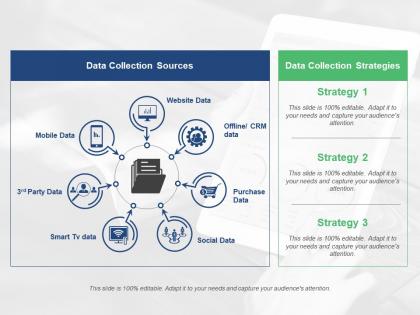
Data collection sources purchase data website data collection strategies




Try Before you Buy Download Free Sample Product
 Impress Your
 Audience
 100%
100% Editable
 Save Hours
 of Time


When you want to share the strategies that how data got collected for any project, Data Collection Strategies PowerPoint template is a very helpful tool to discuss the strategies. A user can share data source and data collection strategies simultaneously by using this template. With the help of Data Collection Source presentation slide, a user can give a brief overview from where you collected the data. An individual can share the links of the websites that he has used for collection of data by using Data Collection Website PPT slide. The Survey Data presentation template is perfect for data-driven presentations for marketing and sales. Project Data Collection is generic which also means that you can use to explain any subject matter. You can use the Collection Source PPT template in research presentations where you can visualize clustered results. Data Survey presentation template is ideal for statistics as well as inventory. Many organizational concepts can find Important Data Collection slide extremely useful for various purposes such as financial reporting and in weighing strategies. By using Data Source slide, you can discuss different sources such as website data, mobile data, offline or CRM data, Purchase Data, Social Data, Smart TV Data, Third Party Data. Our Data Collection Sources Purchase Data Website Data Collection Strategies are bound to flabbergast you. You will discover fascination anew.
People who downloaded this PowerPoint presentation also viewed the following :
Data collection sources purchase data website data collection strategies with all 5 slides:
Our Data Collection Sources Purchase Data Website Data Collection Strategies cover all alternatives. They help you figure out the best course.

FAQs for Data collection sources purchase data website
Qualitative methods deliver rich contextual insights, detailed customer perspectives, and nuanced understanding of behaviors, while quantitative approaches provide statistical validity, scalability, and measurable trends across larger populations. While qualitative research excels in exploratory phases and understanding the "why" behind customer decisions, quantitative methods streamline analysis and enable data-driven strategic decisions, with many organizations finding that combining both approaches ultimately delivers comprehensive market intelligence and competitive advantage.
A mixed-methods approach enhances data collection by combining quantitative measurements with qualitative insights, triangulating findings through multiple data sources, and capturing both statistical patterns and contextual depth. This strategic combination enables researchers to validate results across methodologies, uncover nuanced perspectives that single approaches might miss, and ultimately deliver more comprehensive, actionable findings for evidence-based decision-making.
Technology serves as the backbone of modern data collection strategies, enabling automated gathering through IoT sensors, web analytics, mobile apps, social media monitoring, and cloud-based platforms. These technologies streamline data capture by eliminating manual processes, ensuring real-time collection, and providing scalable storage solutions, with many organizations finding that automated systems deliver faster insights, reduced operational costs, and enhanced decision-making capabilities.
Organizations ensure data accuracy and reliability through automated validation systems, standardized collection protocols, real-time quality checks, duplicate detection algorithms, and regular auditing processes. These strategies streamline data integrity by minimizing human error, establishing consistent formats, and enabling immediate correction, with many financial institutions and healthcare organizations finding that systematic validation ultimately delivers enhanced decision-making capabilities and operational efficiency.
Ethical data collection considerations include informed consent, data minimization, transparency about usage, secure storage protocols, and respect for subject privacy rights. Organizations across healthcare, finance, and research sectors increasingly find that implementing robust ethical frameworks not only ensures regulatory compliance but also builds customer trust, ultimately delivering competitive advantage through enhanced reputation and stakeholder confidence.
Effective surveys maximize response rates through clear, concise questions, mobile-friendly design, personalized invitations, and optimal timing, while offering incentives and multiple reminder sequences. Organizations across retail, healthcare, and financial services find that pre-testing surveys, limiting length to under 10 minutes, and using mixed-method approaches ultimately delivers higher completion rates and more actionable insights.
Innovative data collection techniques include IoT sensors, social media sentiment analysis, computer vision, voice analytics, and blockchain-verified crowdsourcing. These technologies streamline data gathering by automating capture processes, reducing human bias, and enabling real-time insights, with organizations across retail, healthcare, and manufacturing finding significantly enhanced operational efficiency and customer understanding.
Cultural differences significantly impact global data collection through varying privacy expectations, communication styles, response patterns, and trust levels toward researchers and institutions. Organizations conducting international research must adapt their methodologies by using culturally appropriate survey designs, local partnerships, and region-specific data protection protocols, ultimately ensuring more accurate insights and higher participation rates across diverse markets.
**INPUT**: What strategies can be implemented to minimize data collection bias? **OUTPUT**: Effective bias minimization strategies include diversified sampling methods, standardized data collection protocols, blind or double-blind procedures, multiple data sources, and regular bias audits. These approaches streamline accuracy by eliminating subjective influences, ensuring representative samples, and maintaining consistent measurement standards, with many organizations finding that systematic bias controls ultimately deliver more reliable insights and better strategic decision-making.
Organizations leverage social media for data collection through social listening tools, sentiment analysis, hashtag tracking, engagement metrics monitoring, and customer feedback analysis. These technologies streamline market research by identifying consumer trends, competitor activities, and brand perception patterns, with many retail and financial services companies finding that social insights ultimately enhance customer targeting and deliver faster product development cycles.
**INPUT**: What are the best practices for using focus groups as a data collection strategy? **OUTPUT**: Best practices for focus groups include recruiting diverse participants, crafting open-ended questions, maintaining neutral moderation, ensuring comfortable environments, and recording sessions for analysis. These strategies enhance data quality by encouraging authentic discussions, minimizing bias, and capturing nuanced insights, with many organizations finding that well-structured focus groups deliver deeper customer understanding and more actionable market intelligence. [Word count: 58 words]
Pilot testing is crucial for identifying flaws, validating instruments, and optimizing procedures before full-scale implementation. Through small-scale trials, organizations can refine survey questions, test technology platforms, and adjust methodologies, with many research teams finding that pilot studies significantly reduce costs, enhance data quality, and ultimately deliver more reliable insights.
Effective data visualization types include bar charts, line graphs, heat maps, scatter plots, and interactive dashboards for quantitative data, alongside infographics and process flows for qualitative insights. These visualization methods enhance decision-making by transforming complex datasets into accessible formats, with organizations across healthcare, finance, and retail finding that strategic visual presentation accelerates stakeholder understanding and drives faster, more informed business outcomes.
Researchers can balance comprehensive data needs with resource constraints by prioritizing strategic sampling methods, leveraging automated collection tools, and focusing on high-impact variables that directly address research objectives. Through phased data collection approaches and collaborative partnerships, organizations streamline processes while maintaining quality, with many finding that targeted methodologies deliver robust insights more efficiently than exhaustive approaches.
Data management software centralizes data collection workflows by automating data capture, standardizing formats, eliminating manual entry errors, and providing real-time validation checks. Through integrated dashboards and automated pipelines, organizations streamline operations across departments, reduce processing time by significant margins, and enhance data accuracy, with many enterprises finding that centralized management delivers faster insights and improved decision-making capabilities.
-
Best way of representation of the topic.
-
Wonderful templates design to use in business meetings.