

Data Complexity Slows Down The Business Process Multi Cloud Architecture Cloud Architecture Review




Try Before you Buy Download Free Sample Product
 Impress Your
 Audience
 100%
100% Editable
 Save Hours
 of Time


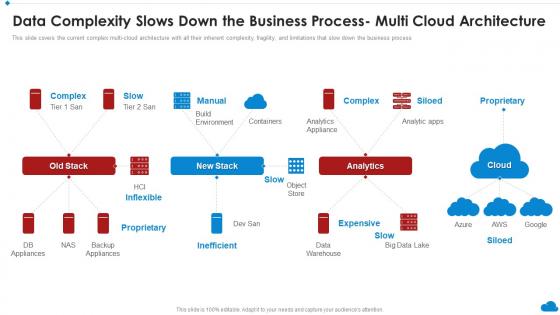
This slide covers the current complex multi cloud architecture with all their inherent complexity, fragility, and limitations that slow down the business process
People who downloaded this PowerPoint presentation also viewed the following :
Data Complexity Slows Down The Business Process Multi Cloud Architecture Cloud Architecture Review with all 6 slides:
Use our Data Complexity Slows Down The Business Process Multi Cloud Architecture Cloud Architecture Review to effectively help you save your valuable time. They are readymade to fit into any presentation structure.





FAQs for Data Complexity Slows Down The Business Process Multi Cloud Architecture
Key factors contributing to data complexity include volume growth, diverse data types, multiple source integration, real-time processing demands, and varying quality standards. These challenges present both operational hurdles and strategic opportunities, with many organizations finding that advanced analytics platforms and automated data management systems streamline processing, enhance accuracy, and ultimately deliver competitive advantages through faster insights.
Organizations can effectively manage data complexity through comprehensive data governance frameworks, automated integration tools, advanced analytics platforms, standardized data models, and cross-functional collaboration structures. These strategies streamline operations by eliminating silos, improving data quality, and accelerating decision-making processes, with many enterprises finding that strategic data management ultimately delivers competitive advantages and enhanced operational efficiency.
Machine learning addresses data complexity challenges by automating pattern recognition, handling unstructured information, and processing vast datasets across multiple formats simultaneously. Through advanced algorithms, organizations streamline data analysis, reduce manual processing time, and extract actionable insights from complex sources, with many financial services and healthcare institutions finding that automated systems ultimately deliver faster decision-making and competitive advantages.
Data dimensionality and volume significantly increase analysis complexity by requiring more sophisticated algorithms, greater computational resources, and advanced statistical techniques to avoid overfitting and curse of dimensionality. High-dimensional datasets in sectors like genomics, finance, and marketing demand specialized preprocessing, feature selection, and visualization methods, ultimately challenging traditional analytical approaches while requiring organizations to invest in scalable infrastructure and expertise.
Techniques for visualizing complex data include interactive dashboards, multi-dimensional charts, heat maps, treemaps, network diagrams, and layered filtering systems. These approaches streamline data interpretation by enabling drill-down capabilities, highlighting patterns through color coding, and presenting hierarchical relationships, with many organizations finding that strategic visualization combinations ultimately enhance decision-making speed and analytical accuracy.
Data complexity significantly influences business decision-making by requiring advanced analytics tools, extending analysis timeframes, and demanding specialized expertise to extract meaningful insights. While complex datasets from multiple sources can slow initial processing, they ultimately enable more comprehensive strategic decisions, with financial services and healthcare organizations finding that sophisticated data integration delivers deeper market understanding and competitive advantage.
Common pitfalls include inadequate data cleaning, insufficient storage infrastructure, poor visualization strategies, lack of standardization protocols, and ineffective team collaboration frameworks. These challenges often overwhelm organizations initially, but many financial services and healthcare institutions find that implementing systematic preprocessing workflows, scalable cloud architectures, and cross-functional data governance ultimately delivers streamlined analytics and competitive operational advantages.
Data governance frameworks mitigate complexity issues by establishing standardized data classification systems, implementing consistent quality controls, and creating clear ownership protocols across organizational silos. These frameworks enable companies to streamline data access, enhance regulatory compliance, and reduce integration costs, with many financial services and healthcare organizations finding that structured governance ultimately delivers faster decision-making and improved operational efficiency.
**INPUT**: What tools or software are most effective for simplifying complex data interpretation? **OUTPUT**: Effective data interpretation tools include Tableau, Power BI, Python libraries, R statistical software, and cloud-based analytics platforms like AWS QuickSight. These technologies streamline complex analysis by automating visualization creation, enabling interactive dashboards, and providing intuitive interfaces, with many organizations finding that strategic tool combinations ultimately deliver faster insights and enhanced decision-making capabilities. [Word count: 54 words]
Data complexity varies significantly across industries, with healthcare managing unstructured clinical notes, medical imaging, and patient records requiring real-time analysis, while finance handles high-frequency trading data, regulatory compliance requirements, and risk assessment models. Healthcare organizations face interoperability challenges between different systems and providers, whereas financial institutions must process massive transaction volumes with millisecond precision, ultimately requiring tailored data strategies for each sector's unique operational demands.
Data standardization reduces complexity by establishing consistent formats, unified naming conventions, streamlined integration processes, and common data quality rules across systems. Through standardized schemas and protocols, organizations minimize redundant processing, accelerate data migration projects, and enhance cross-platform compatibility, while reducing training requirements and maintenance overhead, ultimately delivering improved operational efficiency and faster decision-making capabilities.
Teams can foster data complexity understanding through comprehensive training programs, cross-functional collaboration workshops, standardized documentation practices, mentorship initiatives, and regular knowledge-sharing sessions. Through structured learning environments, organizations streamline data literacy across departments, enhance analytical capabilities, and minimize interpretation errors, with many companies finding that collaborative data culture ultimately delivers improved decision-making speed and competitive advantage.
Data complexity significantly complicates GDPR and HIPAA compliance by making it harder to track data lineage, implement access controls, and ensure accurate deletion or anonymization across interconnected systems. Organizations with complex data architectures often struggle to maintain audit trails, classify sensitive information consistently, and respond to data subject requests within regulatory timeframes, ultimately requiring more robust governance frameworks and automated compliance tools to manage risk effectively.
Real-time data processing techniques significantly reduce data complexity by enabling immediate analysis, automated filtering, and instant pattern recognition across multiple data streams. These technologies streamline decision-making by processing vast datasets continuously, identifying anomalies instantly, and delivering actionable insights without delays, with many financial services and manufacturing organizations finding that real-time processing ultimately enhances operational efficiency and competitive responsiveness.
Untreated data complexity leads to cascading organizational decline through degraded decision-making accuracy, increased operational costs, and diminished competitive responsiveness. Over time, organizations face strategic paralysis, reduced market agility, and compromised customer experiences, with many enterprises finding that data silos ultimately erode innovation capacity and long-term sustainability.
-
Illustrative design with editable content. Exceptional value for money. Highly pleased with the product.
-
Topic best represented with attractive design.