


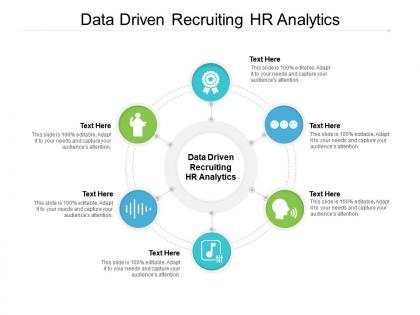
Data driven recruiting hr analytics ppt powerpoint presentation visual aids infographic template cpb




Try Before you Buy Download Free Sample Product
 Impress Your
 Audience
 100%
100% Editable
 Save Hours
 of Time


Our Data Driven Recruiting HR Analytics Ppt Powerpoint Presentation Visual Aids Infographic Template Cpb are topically designed to provide an attractive backdrop to any subject. Use them to look like a presentation pro.
People who downloaded this PowerPoint presentation also viewed the following :
Data driven recruiting hr analytics ppt powerpoint presentation visual aids infographic template cpb with all 2 slides:
Use our Data Driven Recruiting HR Analytics Ppt Powerpoint Presentation Visual Aids Infographic Template Cpb to effectively help you save your valuable time. They are readymade to fit into any presentation structure.
FAQs for Data driven recruiting hr analytics ppt powerpoint presentation visual aids
Key metrics include time-to-fill, cost-per-hire, quality-of-hire scores, candidate source effectiveness, and offer acceptance rates. These measurements enable organizations to streamline recruitment processes, optimize resource allocation, and enhance candidate experiences, with many companies finding that tracking conversion rates at each funnel stage ultimately delivers faster hiring decisions and competitive talent acquisition advantages.
AI and machine learning enhance recruiting data analysis by automating candidate screening, predicting job performance through behavioral patterns, and identifying optimal sourcing channels across platforms. These technologies streamline talent acquisition by reducing time-to-hire, minimizing unconscious bias in selection processes, and improving candidate matching accuracy, with many HR departments finding that automated insights deliver faster hiring decisions and better long-term employee retention.
Candidate experience in data-driven recruitment serves as both a competitive differentiator and measurable outcome, tracked through metrics like application completion rates, time-to-hire, feedback scores, and post-interview satisfaction surveys. By analyzing these data points, organizations streamline their hiring processes, reduce candidate drop-off rates, and enhance employer branding, ultimately delivering faster recruitment cycles and stronger talent acquisition outcomes.
Recruiting teams can leverage data to optimize sourcing channels by analyzing candidate quality metrics, cost-per-hire across platforms, time-to-fill rates, and conversion ratios from application to hire. Through tracking these analytics, organizations can identify high-performing channels like LinkedIn for executive roles or job boards for technical positions, ultimately reallocating budgets toward sources delivering the strongest candidates most efficiently.
Essential data-driven recruiting tools include applicant tracking systems (ATS), recruitment analytics platforms, candidate assessment software, social media recruiting tools, and AI-powered sourcing platforms. These technologies streamline talent acquisition by automating candidate screening, tracking recruitment metrics, and predicting hiring success, with many HR departments finding that integrated platforms ultimately deliver faster time-to-hire and improved candidate quality.
Historical hiring data informs future recruitment decisions by revealing successful sourcing channels, identifying high-performing candidate profiles, and predicting time-to-fill patterns across different roles. Through predictive analytics, organizations can optimize job posting strategies, refine screening criteria, and allocate recruitment budgets more effectively, ultimately reducing hiring costs while improving candidate quality and retention rates.
Data-driven recruiting requires careful attention to privacy protection, bias mitigation, transparency in algorithms, consent management, and fair representation across demographics. Organizations must balance analytical insights with candidate rights, ensuring data collection serves legitimate business purposes while maintaining trust, with many companies finding that ethical frameworks ultimately enhance both recruitment quality and employer brand reputation.
Data analytics helps reduce hiring bias by standardizing evaluation criteria, analyzing historical hiring patterns for discriminatory trends, and using blind resume screening tools that focus on qualifications over demographics. Through predictive modeling and structured interview scoring, organizations can identify unconscious bias patterns, ensure consistent candidate assessment across all demographics, and make evidence-based decisions that promote diversity while maintaining hiring quality standards.
Common pitfalls include over-relying on metrics without human insight, implementing poor data quality controls, lacking proper analytics training, focusing on vanity metrics rather than predictive indicators, and insufficient integration between recruiting platforms. While these challenges can initially slow adoption, organizations that address data governance, invest in team training, and balance quantitative insights with recruiter expertise ultimately deliver faster hiring, reduced bias, and significantly improved candidate quality across their talent acquisition processes.
Recruiting metrics align with business objectives by tracking quality of hire, time-to-productivity, retention rates, and cost-per-hire against strategic goals like revenue growth and operational efficiency. Organizations increasingly connect recruitment KPIs to business outcomes, with many companies finding that aligning talent acquisition metrics with departmental performance indicators ultimately delivers faster scaling, reduced turnover costs, and enhanced competitive positioning.
Interview data collection should include candidate assessment scores, interviewer feedback patterns, time-to-decision metrics, question response quality, and behavioral indicator observations. These data points enhance recruiting accuracy by identifying successful interviewer techniques, predicting candidate performance, and streamlining selection processes, with many organizations finding that structured data collection significantly improves hire quality and reduces turnover rates.
Organizations assess quality of hire through performance metrics, retention rates, time-to-productivity measurements, cultural fit assessments, and manager satisfaction scores. These data-driven approaches enable HR teams to track new employee success across multiple dimensions, with many companies finding that combining quantitative performance data with qualitative feedback delivers more accurate hiring insights and improved recruitment strategies.
Predictive analytics forecasts hiring needs by analyzing historical turnover patterns, seasonal demand fluctuations, business growth projections, and market expansion plans. Through advanced algorithms, organizations can anticipate talent gaps, optimize recruitment timelines, and align staffing strategies with business objectives, while reducing time-to-hire costs and ensuring seamless workforce planning in increasingly competitive markets.
Interviewers can leverage data analytics to standardize evaluation rubrics, track interviewer bias patterns, and analyze historical hiring outcomes to refine scoring criteria. Through structured data collection on candidate performance metrics, interview consistency scores, and long-term employee success correlations, hiring teams can minimize subjective bias while enhancing prediction accuracy, ultimately delivering more objective recruitment decisions and improved hiring quality.
Best practices for visualizing recruitment data include interactive dashboards, real-time pipeline tracking, candidate journey mapping, performance scorecards, and collaborative filtering tools. These visualizations enhance team coordination by enabling shared access to key metrics, streamlining decision-making processes, and providing transparent candidate status updates, with many HR teams finding that visual data storytelling significantly improves recruitment outcomes and stakeholder alignment.
No Reviews