


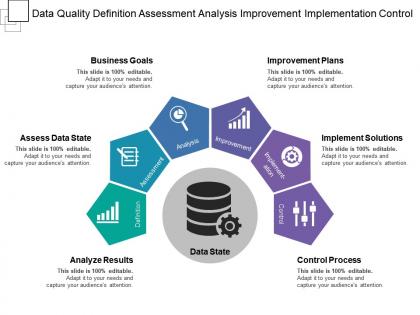
Data quality definition assessment analysis improvement implementation control




Try Before you Buy Download Free Sample Product
 Impress Your
 Audience
 100%
100% Editable
 Save Hours
 of Time


Experience elegant craftsmanship with our Data Quality Definition Assessment Analysis Improvement Implementation Control. Get your hands on a designer collection.
People who downloaded this PowerPoint presentation also viewed the following :
Data quality definition assessment analysis improvement implementation control with all 5 slides:
Buoy up spirits with our Data Quality Definition Assessment Analysis Improvement Implementation Control. Keep all the hopes afloat with your views.


FAQs for Data quality definition assessment analysis
Key data quality dimensions include accuracy, completeness, consistency, timeliness, validity, and uniqueness, with each dimension reinforcing the others to create comprehensive data integrity. These dimensions interact synergistically, where improved accuracy enhances completeness, consistent formatting enables better validity checks, and timely updates maintain relevance, with many organizations finding that addressing multiple dimensions simultaneously delivers greater operational efficiency and more reliable business insights.
Organizations can effectively measure data quality through completeness assessments, accuracy validation, consistency checks, timeliness monitoring, and uniqueness verification across systems. These measurement frameworks enable businesses to identify data gaps, reduce operational errors, and enhance decision-making capabilities, with many financial services and healthcare institutions finding that systematic quality metrics ultimately deliver improved customer experiences and competitive advantage.
Data governance establishes comprehensive frameworks for data management through standardized policies, quality standards, accountability measures, and systematic oversight processes. These governance structures enable organizations to maintain consistent data accuracy, integrity, and compliance across departments, with many financial institutions and healthcare providers finding that robust governance frameworks significantly reduce errors, enhance regulatory compliance, and ultimately deliver more reliable business intelligence.
Data validation techniques enhance data quality by implementing automated checks, establishing consistency rules, and applying real-time monitoring across both structured and unstructured formats. These methods streamline accuracy verification, minimize errors through standardized protocols, and enable comprehensive data profiling, with organizations in healthcare and finance finding that systematic validation delivers improved decision-making capabilities and operational efficiency.
Common data quality challenges include data decay, inconsistent entry standards, system integration issues, volume scalability problems, and lack of governance protocols. These challenges compound over time, with many organizations finding that without proactive monitoring and standardized processes, their databases experience degraded accuracy, duplicate records, and operational inefficiencies that ultimately impact decision-making and customer experiences.
Cultural and organizational factors significantly influence data quality management through leadership commitment, employee training protocols, cross-departmental collaboration standards, and established accountability frameworks. Organizations with strong data governance cultures typically achieve higher accuracy rates and faster issue resolution, while companies lacking structured oversight often struggle with inconsistent data practices, ultimately impacting decision-making effectiveness and competitive positioning.
Effective data quality technologies include data profiling software, automated validation tools, data lineage platforms, master data management systems, and real-time monitoring solutions. These technologies enhance organizational efficiency by identifying inconsistencies, automating cleansing processes, and ensuring compliance standards, with many financial services and healthcare institutions finding that integrated approaches deliver improved decision-making and operational transparency.
Poor data quality significantly undermines decision-making by creating inaccurate insights, delayed responses, and misallocated resources across organizational levels. Organizations with robust data quality frameworks enable faster strategic decisions, reduce operational risks, and enhance competitive positioning, with many financial services and healthcare institutions finding that clean, reliable data ultimately delivers measurable improvements in customer outcomes and profitability.
Poor data quality leads to incorrect customer information, delayed service responses, personalized recommendations failures, billing errors, and fragmented communication across touchpoints. These issues result in frustrated customers experiencing longer resolution times, irrelevant marketing messages, and inconsistent service interactions, ultimately driving customer churn and reducing loyalty, with many organizations finding that data quality investments directly correlate with improved satisfaction scores.
Machine learning enhances data quality by automatically detecting anomalies, standardizing formats, identifying duplicates, and correcting inconsistencies across datasets. These algorithms streamline data validation processes, reduce manual cleaning efforts, and continuously learn from patterns, with many financial institutions and healthcare organizations finding that ML-driven quality checks deliver more accurate analytics and faster decision-making capabilities.
Data quality assessment best practices include establishing clear data standards, implementing automated validation rules, conducting regular audits, profiling data sources for completeness and accuracy, and creating comprehensive documentation processes. These approaches streamline quality management by identifying inconsistencies early, reducing manual verification costs, and ensuring regulatory compliance, with many financial institutions and healthcare organizations finding that systematic assessments ultimately deliver improved decision-making capabilities and operational efficiency.
Data integration from multiple sources presents both challenges and opportunities for overall data quality, as inconsistent formats, duplicate records, and varying accuracy standards can initially compromise reliability. However, with proper data governance frameworks and automated cleansing tools, organizations ultimately achieve enhanced data completeness and comprehensive insights, enabling better decision-making across departments while streamlining operations and delivering competitive advantage.
Organizations can foster a data quality culture by establishing clear governance frameworks, implementing regular training programs, creating accountability metrics for data stewards, and integrating quality checks into daily workflows. By combining executive sponsorship with cross-departmental collaboration and recognition systems, companies streamline decision-making processes while enhancing operational efficiency, ultimately delivering competitive advantage through reliable, actionable insights.
Data quality issues can be effectively communicated through standardized reporting dashboards, cross-functional workshops, automated alerts, clear documentation protocols, and regular inter-departmental meetings. These approaches streamline transparency by establishing common metrics, fostering collaborative problem-solving, and creating shared accountability frameworks, with many organizations finding that structured communication ultimately delivers faster issue resolution and enhanced operational efficiency.
Investing in data quality initiatives delivers substantial long-term financial returns through reduced operational costs, improved decision-making accuracy, enhanced customer retention, and minimized compliance risks. Organizations typically see 15-20% cost reductions in data management, faster analytics processing, and increased revenue from better-targeted marketing campaigns, with many financial services and retail companies finding that quality data investments pay for themselves within two years.
-
Commendable slides with attractive designs. Extremely pleased with the fact that they are easy to modify. Great work!
-
Good research work and creative work done on every template.