


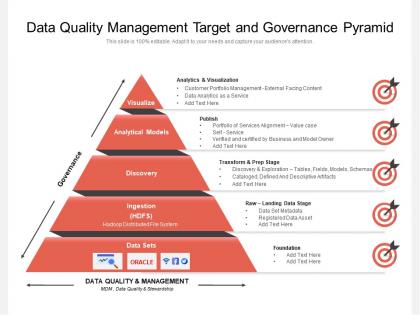
Data quality management target and governance pyramid




Try Before you Buy Download Free Sample Product
 Impress Your
 Audience
 100%
100% Editable
 Save Hours
 of Time


Our Data Quality Management Target And Governance Pyramid get your canvas to come alive. Fascinating colors will begin to burst forth.
People who downloaded this PowerPoint presentation also viewed the following :
Data quality management target and governance pyramid with all 2 slides:
Be a great ambassador for your cause with our Data Quality Management Target And Governance Pyramid. Their belief will get fortified.
FAQs for Data quality management target
So you need six main things for good data quality. First, profile your data to see what mess you're dealing with. Set up validation rules that catch crap before it gets in. Monitoring dashboards help you catch problems fast - honestly this one's a lifesaver. You'll need processes to clean stuff up when it breaks. Governance policies sound super boring but they actually matter. Oh, and make sure someone owns each dataset or nothing gets fixed. Automate whatever you can because checking everything manually will drive you insane. Start small with your most important data, then expand from there.
Start with your most important stuff first - like if your customer data's screwed up, fix that before worrying about anything else. Run some profiling tools to catch missing values, duplicates, weird outliers, that kind of thing. Create scorecards so you can actually measure how bad (or good) things are. Oh and definitely ask the people who actually USE the data what's driving them crazy - they'll tell you exactly where the problems are. I'd honestly just pick one dataset that'll make a big impact and go from there instead of trying to boil the ocean.
Ugh, data quality issues are the worst - incomplete records, duplicates everywhere, systems that don't talk to each other, plus tons of outdated junk. It's like that messy closet you keep avoiding. Start by actually auditing what you've got so you're not going in blind. Set up validation rules when data gets entered, run dedup processes regularly, and honestly? Make it someone's actual job, not just something everyone ignores. Automated monitoring catches problems early before they blow up. Oh, and get some real governance policies in place - sounds boring but it works.
Honestly, your data quality makes or breaks every decision you'll make. Clean, accurate data? You'll spot actual trends and feel confident about where to spend money or pivot strategy. But crappy data is like driving blindfolded - I've seen teams think customer satisfaction was soaring when it was actually crashing because duplicate records messed up their numbers. That whole "garbage in, garbage out" thing is painfully real. You can't trust analytics built on messy datasets. My advice? Start with your most important data first, then tackle the rest.
Dude, automation is a lifesaver for data quality stuff. You can set it up to handle all the boring checks - duplicates, weird outliers, validation rules - instead of your team doing it by hand for hours. It runs 24/7 and catches problems right when they happen, not three weeks later when someone's like "wait, why do these numbers look funky?" Plus machines don't have off days, so they're way more consistent than people. The best part? Set up alerts so you know immediately when something breaks. Honestly, just start with whatever takes you the longest to check manually.
So data governance is basically setting up rules and ownership around your data to keep it clean and reliable. You assign specific people as stewards who actually care about data quality - because honestly, without clear ownership, everyone assumes someone else will handle it. Short answer: nobody does. Create standards for what "good data" looks like, then put monitoring in place to catch issues early. When problems pop up, you'll know exactly who's responsible for fixing them. Start with your most critical data first and assign clear owners there. That's where you'll see the biggest wins right away.
Track your cost savings first - fewer errors, quicker decisions, less time fixing messy data. Then compare that against what you spent on tools and training. Honestly, getting leadership buy-in is the real nightmare here. They just see upfront costs, not the long-term payoff. Pick one obvious problem bad data's causing you right now. Figure out what it's costing your business today. After you fix it, measure the difference. Customer complaints drop? Operations run smoother? That's your story right there. Those concrete before/after numbers do all the talking for you.
Honestly, you gotta nail down what actually matters for data quality first - accuracy, completeness, timing, consistency. Those are your big four. Set up automated alerts that ping you when stuff breaks (manual checking is just asking for trouble). Dashboards help your team spot trends without digging around. Someone definitely needs to own each data source though - can't have everything floating around with no accountability. Oh, and build those quality checks right into your pipelines from the start. Way easier than fixing a mess later when your reports are already screwed up.
So regulations actually force you to get way more serious about data quality than you'd probably do on your own. All the documentation, audit trails, validation stuff - it's annoying but honestly makes everything better. GDPR, SOX, whatever applies to you, they all want bulletproof governance. Regular assessments, clear lineage tracking, automated monitoring. Pain in the ass upfront, but once you've built it for compliance? Your data quality shoots through the roof. I'd start by figuring out which regs actually hit your specific data flows first - saves you from over-engineering everything at once.
Start with deduplication and standardizing stuff like date formats - that'll clean up a lot right away. Validation checks against your business rules help catch weird data too. Honestly, automated outlier detection is a game changer because who has time to manually review everything? For enrichment, you can pull in external data sources, geocode addresses, or create new fields from what you already have. ML models work pretty well for filling in missing values. Oh, and definitely build this into repeatable pipelines instead of doing one-off fixes every time. Pick your messiest dataset first and expand from there.
Honestly, you've got to get everyone to own this, not just dump it on the data team. Show people how crappy data screws up their actual work - marketing can't trust lead scores, sales deals with duplicate accounts, that kind of stuff. Once they see it's not some abstract IT thing, people actually start caring. Set up shared dashboards so everyone can see the mess (or progress). Make it super easy to flag problems without people feeling weird about it. Regular team check-ins help too - just talk about data issues openly. The trick is tying it back to stuff they actually care about, like hitting their numbers or not looking stupid in meetings.
Oh man, the data formatting thing will drive you insane - one system calls it "customer_id" while another uses "cust_num" or whatever. Plus they all update on different schedules so nothing syncs up right. Each system has its own weird quality rules that clash with everything else. Integration tools are honestly pretty temperamental too. Getting teams to actually agree on standards? Good luck with that political mess. I'd probably start by mapping out what you've got with a data catalog first. Then just pick the worst offender and fix that before moving on.
Dude, ML and AI are game-changers for cleaning up messy data. They spot duplicates and weird anomalies way faster than doing it by hand - honestly, it's like having someone who actually pays attention to details 24/7. The algorithms learn your data's quirks over time too. You can automate profiling, set up validation that runs constantly, even build models that predict where problems might pop up. I'd say start with just one annoying task you're sick of doing manually. See how it goes from there.
Dude, metadata is like your data's backstory - shows you where it came from, when someone made it, how it got messed with. You're basically screwed without it when stuff breaks. It's like debugging code with zero comments (been there, hate it). With good metadata you can actually trace problems back to whatever caused them in the first place. Plus you can build decent validation rules. Oh and capture this stuff from the start - don't be that person trying to piece together what happened months later when everything's on fire.
Start with role-specific stuff - your sales people need totally different data skills than analysts. Make workshops hands-on with real scenarios they'll actually deal with (nobody cares about made-up customer examples). Here's the thing though - explain WHY data quality matters, not just what the rules are. When people see how messy data costs money and creates more work for THEM, they actually start caring. Oh, and set up refresher sessions regularly. Maybe pick some data champions in each department to keep everyone on track. Trust me, without that follow-up the training just fades away.
No Reviews