


Data science it life cycle of data science




Try Before you Buy Download Free Sample Product
 Impress Your
 Audience
 100%
100% Editable
 Save Hours
 of Time


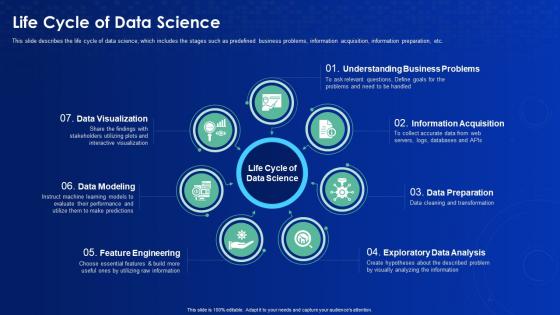
This slide describes the life cycle of data science, which includes the stages such as predefined business problems, information acquisition, information preparation, etc.
People who downloaded this PowerPoint presentation also viewed the following :
Data science it life cycle of data science with all 6 slides:
Use our Data Science It Life Cycle Of Data Science to effectively help you save your valuable time. They are readymade to fit into any presentation structure.





FAQs for Data science it life cycle
So there's six stages to data science projects: business understanding, data acquisition, data prep, modeling, evaluation, and deployment. Start by figuring out what problem you're actually solving. Then collect your data and clean it - seriously, this part is like 70% of the work and nobody warns you. Build models, test them, check if they're any good, then push to production. But here's the thing - you'll bounce between these stages constantly. Found a data issue? Back to cleaning. Model sucks? Maybe your problem definition was off. Oh, and write everything down because future you will hate past you if you don't document your decisions.
You can grab data from APIs, databases, surveys, web scraping - honestly wherever it lives. Quality-wise, check for dupes, missing stuff, and validate data types. Set up monitoring if you can swing it. That whole "garbage in, garbage out" thing? Yeah, it's painfully true. Always connect it back to your actual business question - I can't stress this enough. Document how you collected everything so you don't hate yourself later when something breaks. Oh, and test with a small sample first before going full scale. Trust me on that one.
Honestly? You'll spend like 80% of your time on data preprocessing - it's boring but super critical. Raw data is usually a mess, so you're basically cleaning it up so your models don't choke. Handle missing values (fill them in or toss them), catch outliers, normalize your features, encode categorical stuff. Oh and remove duplicates - seems obvious but you'd be surprised how often people skip that. I learned this the hard way, but seriously don't rush this part. Bad data going in means garbage results coming out. Profile your dataset first to see what you're dealing with.
Think of EDA as detective work - you're digging through data to find patterns and weird outliers. Visualization is just one piece of that puzzle though. You're also running statistical summaries, checking how things are distributed, all that fun stuff. I definitely mixed them up when I first started! But here's the thing - you can visualize data outside of EDA too, like when you're showing results to your boss. EDA helps you make smarter choices about models, while solid visuals help you actually explain what you discovered. Both are pretty crucial honestly.
First thing - figure out if you're doing classification, regression, clustering, whatever. Data size matters too, plus how many features you're dealing with. Honestly, I just throw 3-4 different approaches at it right away because there's no predicting what'll actually work. Random forest is usually my go-to starting point - it's like the Swiss Army knife of ML. Linear models give you a decent baseline, neural nets if your dataset is huge. But here's the thing: let your eval metrics make the final call. Cross-validation will tell you everything you need to know about which one's actually performing.
Cross-validation is honestly your best friend here - it'll show you how your model actually performs on new data. L1/L2 regularization works great too since it punishes overly complicated models. Try simplifying things: fewer features, simpler algorithms, or just stop training early. More training data helps a ton if you can get it (though I know that's not always realistic). Feature selection matters more than people think - sometimes cutting stuff out is better than adding more. Oh, and early stopping during training is clutch. Start with cross-validation and regularization first. Those two will fix like 80% of your overfitting problems.
So it really comes down to what problem you're solving. Classification? Go with accuracy, precision, recall, F1-score. Accuracy works for balanced data, but precision matters more when false positives will kill you. Recall's your friend when missing something is catastrophic. For regression stuff, stick to MAE, MSE, and R-squared. ROC-AUC is solid for binary classification, though honestly it'll mislead you with imbalanced datasets - trust me on that one. Pick maybe 2-3 metrics that actually match what you're trying to achieve business-wise. Don't chase every metric or you'll go crazy.
Dude, feature engineering is seriously where you'll make or break your whole project. Most of the actual magic happens right there - not in fancy algorithms or whatever. Get the features right and your model suddenly knows exactly what patterns to look for. Mess it up? Doesn't matter if you're using the most cutting-edge ML approach, it's still gonna suck. I've seen people waste weeks tweaking hyperparameters when their features were just garbage from the start. Really dig into your domain first, figure out what relationships actually matter, then go wild experimenting with transformations and combinations.
Consent and privacy are huge - people need to know what you're doing with their data and actually agree to it. Biased datasets are another nightmare, especially around race/gender stuff that can really screw people over. Data security matters too, obviously. Honestly? The whole thing stresses me out because one bad dataset can cause serious harm. Oh, and don't wait until you're done to think about ethics - build in reviews from the start. I've seen too many projects get derailed because they realized way too late they'd built something problematic.
Honestly, the biggest mistake I see is treating data science like some separate tech playground. You've gotta solve actual business problems from the start - think reducing churn, fixing pricing, stuff that moves the needle. I can't tell you how many brilliant models I've watched collect dust because nobody cared about the business case. Talk ROI and revenue, not just model scores. Get the business folks defining what "success" looks like upfront (trust me on this one). Oh, and build in ways to measure real impact, not just whether your accuracy improved by 2%.
Honestly, model drift is gonna be your biggest headache - your models just start sucking as data patterns shift. Infrastructure scaling is brutal too, especially when you're dealing with real-time inference and users hate waiting. I learned this the hard way lol. Monitoring dashboards should be your first priority so you catch problems early. Version control gets messy fast when you're A/B testing different models. Don't even get me started on data pipelines breaking at 3am. Security and compliance stuff will pile on later, but focus on the monitoring first.
Start with Python and Git - those are absolute essentials. SQL too since you'll be pulling data constantly. Jupyter notebooks are perfect for messing around and documenting your work. For ML stuff, I'd go with scikit-learn first, then maybe TensorFlow or PyTorch once you get comfortable. Honestly, Docker seemed overkill to me at first, but it's a lifesaver for keeping environments consistent. Airflow's great for automating pipelines when you get to that point. Don't try to learn everything at once though - just grab Python, Git, and Jupyter to start, then add tools as your projects actually need them.
Dude, monitoring is huge - way more important than most people realize. After deployment, your model starts degrading pretty much immediately. Data shifts, performance drops, requirements change. I've seen so many teams celebrate the launch then completely ignore maintenance (big mistake). Track your accuracy, data quality, prediction patterns - all that stuff. Set up alerts now before things go sideways. Also plan regular retraining from the start. Trust me, you don't want to be firefighting when your model suddenly tanks. It's really just the beginning once you deploy.
Dude, you HAVE to get stakeholders involved early - seriously makes all the difference. They'll help you figure out what problem you're actually solving instead of wasting time on something that sounds cool but doesn't matter. Regular check-ins are clutch for catching issues before you go too far down a rabbit hole. Also, translate your findings into normal people language or they'll just nod politely and ignore everything later. When they feel included in the process, they'll actually use what you build. Trust me on this one - learned it the hard way on a project last year.
Dude, MLOps platforms are seriously changing everything - they automate deployment and monitoring so you don't have to babysit your models. AutoML tools handle the feature engineering grunt work too. Those drag-and-drop platforms? Actually getting pretty solid, which is kinda wild if you think about it. Real-time streaming is basically standard now instead of just batch processing. Edge computing's pushing models closer to where the data lives. Honestly, just pick up MLflow or Kubeflow when you get a chance. Trust me, it'll save you so many headaches later when you're trying to deploy stuff.
-
Use of icon with content is very relateable, informative and appealing.
-
Innovative and Colorful designs.