


Data Science Technology Life Cycle Of Data Science Ppt Slides Inspiration




Try Before you Buy Download Free Sample Product
 Impress Your
 Audience
 100%
100% Editable
 Save Hours
 of Time


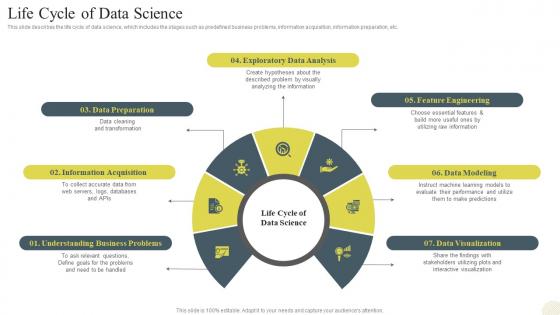
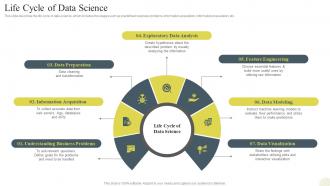
This slide describes the life cycle of data science, which includes the stages such as predefined business problems, information acquisition, information preparation, etc.
People who downloaded this PowerPoint presentation also viewed the following :
Data Science Technology Life Cycle Of Data Science Ppt Slides Inspiration with all 6 slides:
Use our Data Science Technology Life Cycle Of Data Science Ppt Slides Inspiration to effectively help you save your valuable time. They are readymade to fit into any presentation structure.





FAQs for Data Science Technology Life Cycle Of Data Science
The Data Science Technology Life Cycle includes data discovery and collection, data preparation and cleaning, exploratory analysis, model development and training, validation and testing, deployment, and continuous monitoring. These phases interconnect seamlessly, with insights from monitoring feeding back into data collection, model performance results informing preparation strategies, and validation outcomes driving iterative development, ultimately delivering scalable analytics solutions and competitive advantage.
Data collection significantly impacts project effectiveness by determining model accuracy, analytical insights, and business outcomes through comprehensive, high-quality datasets. Poor collection methods can compromise entire projects, while strategic data gathering from diverse sources, including customer interactions, operational systems, and market research, enables organizations to build robust models that deliver actionable insights and competitive advantage.
Essential data preparation tools include SQL databases, Python libraries like Pandas and NumPy, Apache Spark for big data processing, Tableau Prep for visual data cleaning, and cloud platforms like AWS Glue. These technologies streamline data cleaning, transformation, and integration by automating repetitive tasks, handling missing values, and ensuring data quality, with many organizations finding that robust preparation ultimately delivers faster analytics and more reliable business insights.
Data quality can be assessed through completeness checks, accuracy validation, consistency testing, and duplicate detection, while improvements involve data cleansing, standardization, and validation rules. Organizations across healthcare, finance, and retail implement automated quality frameworks that streamline these processes, ultimately delivering more reliable analytics and enabling faster, more confident business decisions.
Exploratory data analysis reveals hidden patterns, correlations, anomalies, outliers, and statistical relationships within datasets, enabling data scientists to identify potential causal factors and formulate testable hypotheses. Through visualization techniques and statistical summaries, organizations across sectors like healthcare, finance, and retail uncover unexpected insights that guide strategic research directions, ultimately delivering more targeted investigations and competitive analytical advantages.
Feature engineering significantly enhances model performance by creating, selecting, transforming, and optimizing input variables to better represent underlying patterns in data. Through techniques like dimensionality reduction, scaling, and domain-specific transformations, data scientists in sectors like finance and healthcare improve prediction accuracy, reduce overfitting, and ultimately deliver more reliable models for business decision-making.
Organizations effectively choose between modeling techniques by evaluating data complexity, business objectives, interpretability requirements, computational resources, and performance metrics like accuracy and speed. Through systematic comparison testing, companies in finance, healthcare, and retail can assess techniques like regression, decision trees, and neural networks, ultimately selecting approaches that deliver optimal results while balancing implementation complexity with strategic business outcomes.
Model performance metrics include accuracy, precision, recall, F1-score, ROC-AUC, and mean squared error, depending on the specific problem type and business objectives. These metrics enable organizations to assess model reliability across different scenarios, with financial institutions using precision for fraud detection and healthcare systems leveraging recall for diagnostic accuracy, ultimately delivering measurable business value and competitive advantage.
Data science deployment varies significantly based on project requirements, with real-time systems demanding low-latency infrastructure, continuous monitoring, and instant response capabilities, while batch processing focuses on scheduled execution, resource optimization, and handling large data volumes efficiently. Financial institutions use real-time deployment for fraud detection requiring millisecond responses, whereas retail companies leverage batch processing for inventory forecasting and customer segmentation, ultimately delivering tailored operational efficiency.
Best practices for monitoring data science models post-deployment include continuous performance tracking, data drift detection, automated retraining pipelines, model versioning, and comprehensive logging systems. These practices streamline model reliability by identifying performance degradation early, ensuring data quality consistency, and enabling rapid updates, with many financial services and healthcare organizations finding that proactive monitoring ultimately delivers sustained accuracy and competitive advantage in their predictive capabilities.
Data governance frameworks integrate into the Data Science Technology Life Cycle through establishing data quality standards, implementing access controls, ensuring compliance protocols, and creating audit trails across all phases. These frameworks streamline project workflows by standardizing data collection, enhancing model transparency, and accelerating deployment processes, with many organizations finding that integrated governance ultimately delivers faster time-to-market and improved regulatory compliance.
Common challenges include translating complex technical findings into business language, overcoming stakeholder resistance to data-driven recommendations, managing conflicting interpretations of results, and ensuring actionable insights reach decision-makers timely. These communication barriers often result in delayed implementations and missed opportunities, with many organizations finding that establishing clear visualization standards, regular stakeholder education sessions, and cross-functional data literacy programs ultimately enhances decision-making speed and strategic alignment.
The iterative nature enables continuous refinement through repeated cycles of data collection, model testing, validation, and deployment feedback. Each iteration incorporates new insights, addresses previous limitations, and adapts to changing business requirements, with organizations in sectors like retail and healthcare finding that this cyclical approach delivers increasingly accurate predictions, enhanced decision-making capabilities, and sustained competitive advantage.
Ethical considerations include data privacy protection, algorithmic bias mitigation, informed consent protocols, transparency in model decision-making, and fair representation across demographics. These principles guide responsible development by ensuring equitable outcomes, protecting sensitive information, and maintaining stakeholder trust, with organizations increasingly finding that ethical frameworks ultimately deliver sustainable competitive advantage and regulatory compliance.
Cloud computing resources enhance data science teams by providing scalable infrastructure, collaborative platforms, automated machine learning tools, and cost-effective storage solutions. Through cloud services, teams streamline model deployment, accelerate data processing, and enable real-time analytics across distributed environments, while reducing infrastructure costs and improving project delivery timelines, ultimately delivering competitive advantage in data-driven decision making.
-
Their templates are super easy to edit and use even for the one like me who is not familiar with PowerPoint. Great customer support.
-
I am extremely pleased with these PPT slides that we used for our event. They were easy to modify and came out great in all aspects!