


Data storage system optimization action plan powerpoint presentation slides





Try Before you Buy Download Free Sample Product
 Impress Your
 Audience
 100%
100% Editable
 Save Hours
 of Time


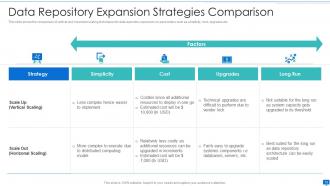
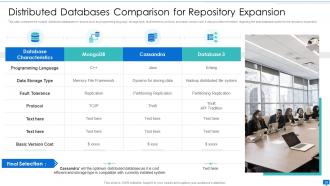
Data storage systems increase the capacity of an organizations existing databases to fulfill the storage needs of multiple operations. The primary objective of this module is to draft an actionable strategy to enhance the current storage system of the data repository system. Here is a competently designed Data Storage System Optimization Action Plan template highlighting critical issues. Further, we have compared database expansion strategies, i.e., scale-up vertical scaling and scale-out horizontal scaling, on multiple factors such as implementation ease, the cost involved, upgrades required, etc. Also, this module includes the action plan, team structure, budget plan, and training plan to implement the action plan successfully. Additionally, it covers the comparison of multiple distributed databases on different parameters. Using the horizontal scaling approach, the comparative analysis helps select the ideal database to expand the current data repository. Further, the PPT lists down critical risks and strategies to mitigate them in the storage system. Eventually, it also incorporates dashboards to monitor the performance of the expanded database system using key performance indicators such as average database response time, database throughput, etc. Get access now.
People who downloaded this PowerPoint presentation also viewed the following :
Content of this Powerpoint Presentation
Slide 1: This slide introduces Data Storage System Optimization Action Plan. State Your Company Name and begin.
Slide 2: This slide shows Agenda for Data Storage System Optimization Action Plan.
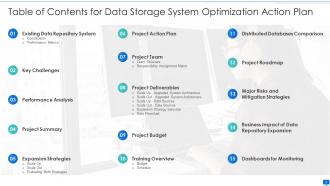
Slide 3: This slide presents Table of Contents for Data Storage System Optimization Action Plan.
Slide 4: This slide shows Table of Contents for Data Storage System Optimization Action Plan.
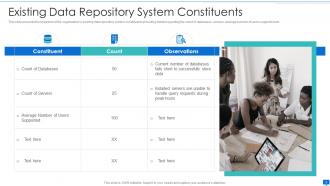
Slide 5: This slide displays snapshot of the organization’s existing data repository system constituents.
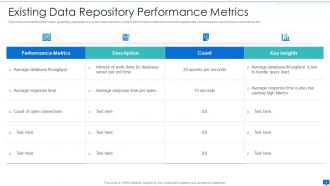
Slide 6: This slide represents organization’s current data repository system performance metrices such as throughput rate, response time, etc.
Slide 7: This slide shows Table of Contents for Data Repository Expansion and Optimization.
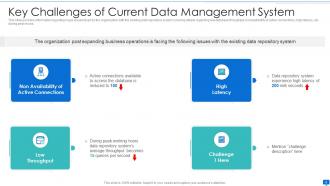
Slide 8: This slide presents Key Challenges of Current Data Management System.
Slide 9: This slide shows Table of Contents for Data Repository Expansion and Optimization.
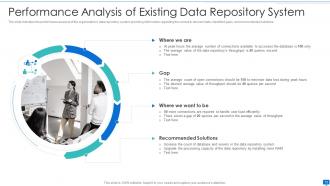
Slide 10: This slide displays Performance Analysis of Existing Data Repository System.
Slide 11: This slide represents Table of Contents for Data Repository Expansion and Optimization.
Slide 12: This slide shows Project Summary for Data Repository Expansion and Optimization.
Slide 13: This slide presents Table of Contents for Data Repository Expansion and Optimization.
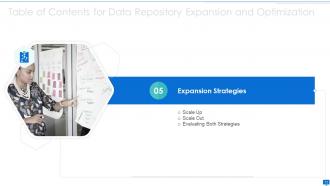
Slide 14: This slide shows overview of scale up strategy for data repository expansion.
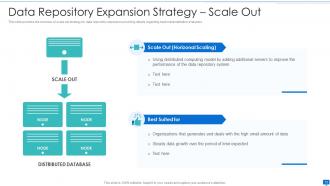
Slide 15: This slide displays scale out strategy for data repository expansion providing details regarding best implementation scenarios.
Slide 16: This slide represents Data Repository Expansion Strategies Comparison.
Slide 17: This slide shows Table of Contents for Data Repository Expansion and Optimization.
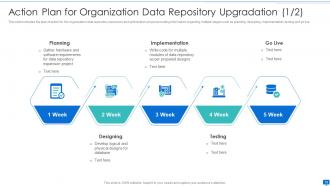
Slide 18: This slide presents Action Plan for Organization Data Repository Upgradation.
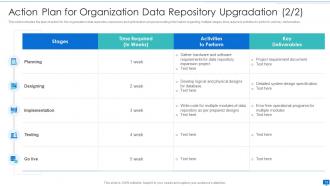
Slide 19: This slide shows action for the organization data repository expansion and optimization project.
Slide 20: This slide displays Table of Contents for Data Repository Expansion and Optimization.
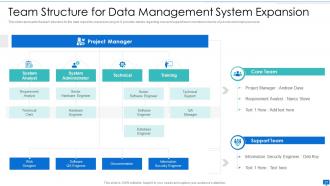
Slide 21: This slide represents Team Structure for Data Management System Expansion.
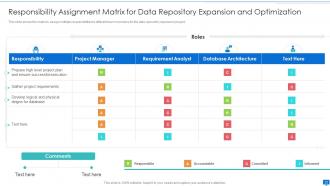
Slide 22: This slide shows Responsibility Assignment Matrix for Data Repository Expansion and Optimization.
Slide 23: This slide presents Table of Contents for Data Repository Expansion and Optimization.
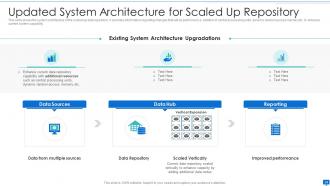
Slide 24: This slide shows system architecture of the scaled up data repository.
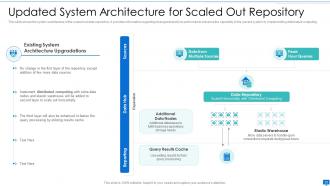
Slide 25: This slide displays Updated System Architecture for Scaled Out Repository.
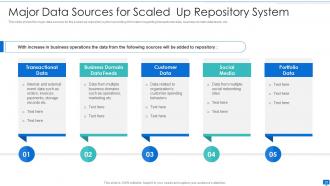
Slide 26: This slide represents major data sources for the scaled up repository system providing information regarding transactional data, business domain data feeds, etc.
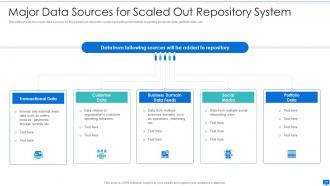
Slide 27: This slide shows Major Data Sources for Scaled Out Repository System.
Slide 28: This slide presents merits of scaled out strategy for data repository expansion such as less costly, supports distributed computing, etc.
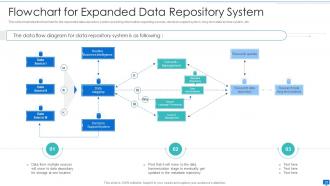
Slide 29: This slide shows flowchart for the expanded data repository system providing information regarding sources, decision support system, etc.
Slide 30: This slide displays Table of Contents for Data Repository Expansion and Optimization.
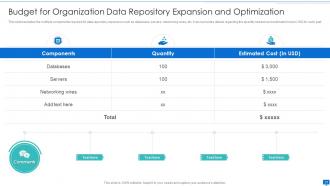
Slide 31: This slide represents Budget for Organization Data Repository Expansion and Optimization.
Slide 32: This slide shows Table of Contents for Data Repository Expansion and Optimization.
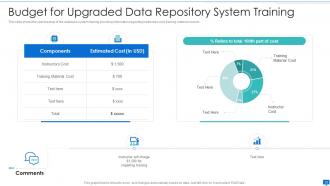
Slide 33: This slide presents Budget for Upgraded Data Repository System Training.
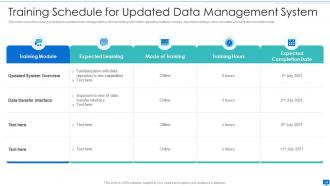
Slide 34: This slide shows Training Schedule for Updated Data Management System.
Slide 35: This slide displays Table of Contents for Data Repository Expansion and Optimization.
Slide 36: This slide represents Distributed Databases Comparison for Repository Expansion.
Slide 37: This slide shows Table of Contents for Data Repository Expansion and Optimization.
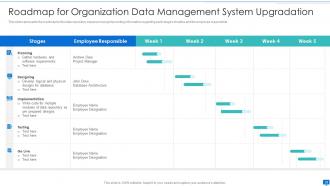
Slide 38: This slide presents Roadmap for Organization Data Management System Upgradation.
Slide 39: This slide shows Table of Contents for Data Repository Expansion and Optimization.
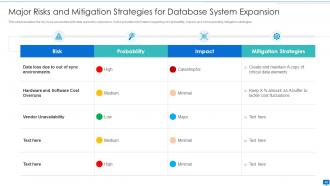
Slide 40: This slide displays Major Risks and Mitigation Strategies for Database System Expansion.
Slide 41: This slide represents Table of Contents for Data Repository Expansion and Optimization.
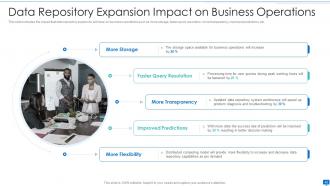
Slide 42: This slide shows Data Repository Expansion Impact on Business Operations.
Slide 43: This slide presents Table of Contents for Data Repository Expansion and Optimization.
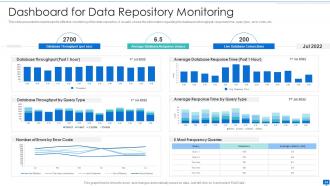
Slide 44: This slide shows dashboard for effective monitoring of the data repository.
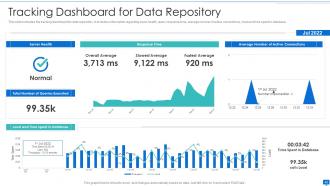
Slide 45: This slide displays tracking dashboard for data repository.
Slide 46: This slide represents Icons for Data Storage System Optimization Action Plan.
Slide 47: This slide is titled as Additional Slides for moving forward.
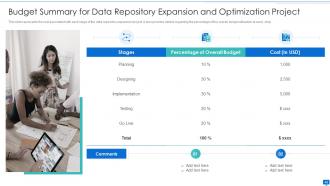
Slide 48: This slide presents Budget Summary for Data Repository Expansion and Optimization Project.
Slide 49: This is Our Team slide with names and designation.
Slide 50: This is About Us slide to show company specifications etc.
Slide 51: This is Our Target slide. State your targets here.
Slide 52: This is Our Mission slide with related imagery and text.
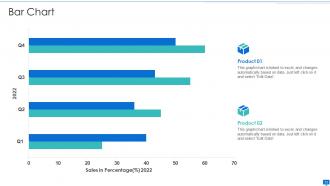
Slide 53: This slide presents Bar Chart with two products comparison.
Slide 54: This slide shows Venn diagram with text boxes.
Slide 55: This slide displays Puzzle with related icons and text.
Slide 56: This slide represents Post It Notes. Post your important notes here.
Slide 57: This is a Timeline slide. Show data related to time intervals here.
Slide 58: This slide presents Roadmap with additional textboxes.
Slide 59: This is a Thank You slide with address, contact numbers and email address.
Data storage system optimization action plan powerpoint presentation slides with all 59 slides:
Use our Data Storage System Optimization Action Plan Powerpoint Presentation Slides to effectively help you save your valuable time. They are readymade to fit into any presentation structure.










FAQs for Data storage system optimization action plan
The most effective data compression techniques include lossless algorithms like LZ77 and Huffman coding, lossy compression for media files, dictionary-based methods, and advanced neural compression technologies. These approaches streamline storage requirements by reducing file sizes significantly, minimizing bandwidth costs, and accelerating data transfer speeds, with many organizations finding that strategic compression delivers up to 90% storage savings while maintaining operational efficiency.
Cloud data storage solutions enhance accessibility by providing real-time remote access, automatic synchronization across devices, scalable bandwidth allocation, and seamless integration with existing systems. These platforms minimize costs through pay-as-you-use pricing models, reduced infrastructure maintenance, and automated data tiering, with many enterprises finding that hybrid cloud approaches deliver both immediate accessibility and long-term cost optimization.
Data deduplication technologies eliminate redundant copies of identical data blocks, significantly reducing storage requirements by 50-90% while maintaining data integrity and accessibility. These solutions enhance operational efficiency by minimizing backup windows, reducing network bandwidth consumption, and lowering storage infrastructure costs, with many enterprises finding that strategic deduplication delivers substantial competitive advantages in increasingly data-intensive environments.
File systems significantly impact storage performance through factors like block size allocation, metadata handling, journaling mechanisms, and I/O optimization techniques. While NTFS excels in Windows enterprise environments and ext4 delivers strong Linux performance, ZFS provides advanced features like compression and deduplication, with many organizations finding that strategic file system selection enhances throughput, reduces latency, and maximizes storage efficiency across their infrastructure.
Organizations can assess data storage needs through capacity utilization monitoring, growth trend analysis, performance benchmarking, cost-per-gigabyte tracking, and automated storage tiering evaluations. These monitoring approaches enable businesses to optimize resource allocation, predict future requirements, and implement scalable solutions, with many enterprises finding that proactive assessment reduces costs while enhancing operational efficiency.
Key considerations include data classification and tiering strategies, compatibility assessments, migration timeline planning, performance requirements analysis, and cost-benefit evaluation. Organizations must also address downtime minimization, security protocols during transfer, and staff training needs, with many enterprises finding that phased migrations reduce risks while enabling better resource allocation and improved system performance.
Hybrid storage solutions combine on-premises control and security with cloud scalability and cost-effectiveness, enabling organizations to store critical data locally while leveraging cloud resources for backup, archiving, and overflow capacity. This strategic approach allows businesses to optimize costs, maintain compliance requirements, and ensure seamless data accessibility, with many enterprises finding that hybrid models deliver enhanced flexibility and reduced infrastructure investments while maintaining performance standards.
Data optimization in big data scenarios enhances analytics performance through faster query processing, reduced storage costs, and improved data accessibility across distributed systems. Organizations leveraging optimized data architectures, particularly in sectors like finance and healthcare, achieve significantly faster insights, streamlined analytics workflows, and enhanced decision-making capabilities, ultimately delivering competitive advantages through accelerated time-to-market and operational efficiency.
Tiered storage strategies improve data access speed and costs by automatically placing frequently accessed data on high-performance storage while moving rarely used data to cost-effective archives. Through intelligent data classification and automated migration, organizations in banking, healthcare, and retail can reduce storage expenses by 40-60% while maintaining millisecond access to critical information, ultimately delivering faster customer services and optimized resource allocation.
Data archiving best practices include implementing tiered storage architectures, using compression algorithms, establishing clear retention policies, maintaining comprehensive metadata indexing, and deploying automated lifecycle management systems. These approaches streamline storage costs while preserving quick access capabilities, with many financial services and healthcare organizations finding that strategic tiering and intelligent caching deliver both operational efficiency and regulatory compliance.
Growing demand for real-time data processing drives storage optimization strategies toward high-performance, low-latency solutions like in-memory databases, edge computing, and tiered storage architectures. Organizations increasingly implement hybrid cloud models, data compression techniques, and automated storage management systems to handle streaming analytics, with financial services and healthcare sectors finding that strategic storage placement ultimately delivers faster decision-making capabilities.
Emerging technologies influencing data storage optimization include artificial intelligence-driven analytics, edge computing architectures, quantum storage systems, software-defined storage platforms, and advanced compression algorithms. These innovations streamline storage management by automating resource allocation, reducing latency, and minimizing infrastructure costs, with many enterprises finding that strategic implementation delivers significantly enhanced performance and competitive advantage.
Organizations utilize AI and machine learning to enhance data storage management through automated tiering, predictive capacity planning, intelligent compression, and real-time performance optimization. These technologies streamline operations by identifying usage patterns, predicting storage needs, and automatically moving data to appropriate storage tiers, ultimately delivering cost reductions and improved system performance while minimizing manual oversight.
Data storage optimization security concerns include encryption vulnerabilities, access control weaknesses, data breach risks during migration, compliance violations, and backup security gaps. These challenges require implementing multi-layered encryption, robust authentication protocols, and comprehensive monitoring systems, with many organizations finding that proactive security integration during optimization ultimately delivers enhanced data protection and regulatory compliance advantages.
Data lifecycle management optimizes long-term storage by automatically moving data through cost-effective tiers, archiving rarely accessed information, and implementing intelligent retention policies based on business requirements and compliance needs. Through automated tiering and policy-driven archiving, organizations reduce storage costs by 40-60%, improve system performance, and ensure regulatory compliance, while maintaining seamless access to critical business data.
-
Presentation Design is very nice, good work with the content as well.
-
Understandable and informative presentation.
-
Innovative and attractive designs.