


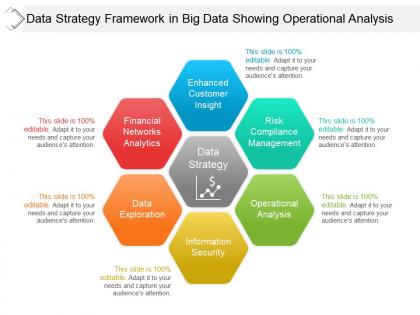
Data strategy framework in big data showing operational analysis




Try Before you Buy Download Free Sample Product
 Impress Your
 Audience
 100%
100% Editable
 Save Hours
 of Time


Our Data Strategy Framework In Big Data Showing Operational Analysis are of high wattage. They amplify the value of your thoughts.
People who downloaded this PowerPoint presentation also viewed the following :
Data strategy framework in big data showing operational analysis with all 5 slides:
Encourage civilized debate with our Data Strategy Framework In Big Data Showing Operational Analysis. Advocate discussions in an amicable environment.




FAQs for Data strategy framework in big data
So you'll want five main things: data governance (who owns what, quality standards), solid technical architecture for storage, analytics tools plus people who know how to use them, getting your team to actually make data-driven decisions, and real business use cases. Most companies totally botch the governance part right out of the gate - it's wild how often that happens. Also need metrics to track how you're doing and some kind of roadmap. I'd start by figuring out what you already have, then tackle whatever gaps are hurting your business most.
Honestly, just tie your data stuff directly to what the business actually wants - like if you're losing customers, dig into why they're leaving instead of hoarding random metrics. Too many teams collect data just because they can (guilty of this myself). Your data KPIs should mirror the business ones, period. Regular coffee chats between data folks and business people work wonders. Quick wins matter more than perfect dashboards. Always ask "does this help us hit our numbers?" If not, ditch it. Data's just a tool to reach your goals, not the goal itself.
Ok so data governance is basically what stops your data from becoming a total nightmare. You need rules and processes so teams aren't all working with different versions of the "truth" - trust me, I've seen that mess happen. Quality standards, who can access what, compliance stuff... yeah it sounds boring but it prevents way bigger headaches down the road. Start by figuring out what data actually matters to your business. Then assign someone to own each piece. Without this structure, you'll have security holes everywhere and inconsistent info that makes decision-making impossible.
Start by doing a data maturity assessment - basically you're checking five main things: governance, data quality, your analytics setup, company culture around data, and tech infrastructure. Most places either use DAMA-DMBOK or just make their own scorecard (1-5 rating system). The scoring honestly feels pretty made-up sometimes, but whatever - you need a starting point. Check if your teams actually use data to make decisions, if someone owns the data processes, and whether people trust what they're seeing in reports. Don't obsess over the final number though. What matters is spotting the gaps so you can fix them one by one.
Only grab data you actually need - don't fall into that "let's collect everything" trap. Automate your pipelines whenever you can because manual entry is where things go wrong (plus it's mind-numbing). Cloud storage like AWS works well for most situations, just pick something that fits your budget and scales. You'll want solid naming conventions and access controls right from the start - trust me on this one. The whole point is keeping everything clean and easy to find, not building some massive digital junkyard where nothing makes sense.
Start with your actual business questions first - which customers are leaving, what products make money, where things get stuck operationally. Most companies do it backwards and just hoover up data without knowing why (I've definitely seen this mess before). Build your analytics around those specific decisions you need to make. Set up dashboards that actually answer those questions, not just pretty charts. The real trick is getting this info to the people making decisions and honestly training them to use it daily. Otherwise it just sits there looking impressive but doing nothing.
Honestly, just focus on the data that actually affects your bottom line and big decisions. Customer stuff, sales numbers, operational metrics - you know, things that matter. Way too many people try to track literally everything and then wonder why they're drowning in useless info. Pick maybe 3-5 data sources that tie directly to your main goals. Has to be reliable and something you can actually act on, not just random metrics that look cool on a dashboard. You can always add more later, but get the core stuff right first.
So GDPR and CCPA basically make you build privacy stuff into your data plan from the start instead of scrambling later. Map out what data you're grabbing, where it lives, retention periods, access controls - the whole thing. Honestly it's annoying but you end up way more organized lol. Design your framework around consent management and data minimization from day one. Oh and user rights too, obviously. First step though? Audit whatever personal data you've already got sitting around and set up clear retention policies. Don't expand anything until that's sorted.
Start with cloud stuff - AWS, Azure, whatever you're comfortable with. Then grab a data warehouse like Snowflake or BigQuery for storage. For moving data around, Airflow's pretty solid, or Fivetran if you want something more plug-and-play. Tableau and PowerBI are still king for dashboards, though honestly there's like 50 alternatives now. DBT handles transformations well, plus you'll want Python or R for the heavy analysis work. But seriously, don't go crazy with tools at first - pick maybe 3-4 that actually play nice together instead of cobbling together some weird setup.
Honestly, most people are just scared of data because they think it's this complicated thing. Train your team on basic stuff first - dashboards aren't rocket science. Share those cool success stories when data actually helped solve real problems (everyone eats that up). Your tools better be simple to use though, or people will avoid them completely. Bring up data in regular meetings so it becomes normal conversation. And here's what really works - celebrate the hell out of teams when they use data well. People need to see it makes their life easier, not some extra burden. Pick one team to start with and let the success spread naturally from there.
Honestly, focus on three main things: money stuff, data quality, and whether people actually use what you build. Can you connect your work to real revenue or cost savings? That's huge. Check if your data's accurate and up-to-date too - decisions based on crappy data are worse than no decisions at all. Also track if anyone's actually logging into those dashboards you spent forever creating. I'd probably pick like 4 metrics max and check them monthly. Oh, and see if teams are changing how they work because of your insights - that's when you know it's really working.
Build quality checks into every step of your pipeline, not just at the end. Validation rules at ingestion are your first line of defense. Automated monitoring catches anomalies before they snowball. Data governance roles need clear ownership - honestly this gets chaotic without someone actually accountable. I learned that the hard way on my last project. Profiling regularly helps spot drift early. Make it everyone's responsibility, not just IT's problem. Dashboards give teams real-time visibility into quality metrics. Basically treat your data quality like you'd treat code quality - continuous testing throughout the whole lifecycle.
Start with a data catalog - basically a shared library so everyone knows what data exists and who owns it. Then nail down governance policies for access and quality standards. Seriously, inconsistent data definitions will make you want to scream later. APIs work awesome for real-time sharing. Regular data dumps are fine for less critical stuff. Get some cross-functional data stewards to break down department silos - those always happen. Oh, and pick one high-impact use case first to prove it actually works. Don't try to boil the ocean right away.
Honestly, don't just slap AI onto your existing setup - build it into your data strategy right from the start. Pick a real business problem where automation or predictions would actually make a difference. I've watched too many companies do AI just because it sounds cool, and those projects always flop. Your data infrastructure needs to handle the heavy lifting these models require. Set up feedback loops so your models get smarter over time. My advice? Start with one solid use case that'll have real impact. Prove it works, then expand from there.
Ugh, the biggest trap is thinking you need to fix everything at once - total recipe for disaster. Don't let IT build some fancy system without getting everyone else on board first. I've seen that backfire so many times. Also, if you skip setting up data governance early on, you'll be drowning in garbage data later. People hate changing how they work too, which honestly makes sense. Oh, and pick one thing that'll actually make a difference, nail that first, then expand. Quick wins keep everyone motivated.
-
Informative presentations that are easily editable.
-
Colors used are bright and distinctive.