


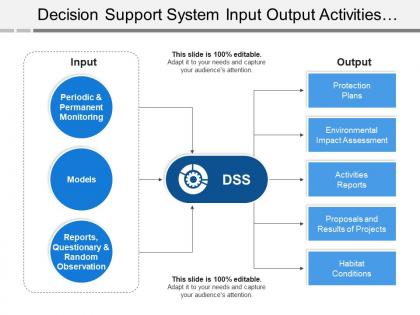
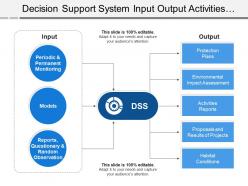
Decision support system input output activities proposals reports




Try Before you Buy Download Free Sample Product
 Impress Your
 Audience
 100%
100% Editable
 Save Hours
 of Time


Zoom along with our Decision Support System Input Output Activities Proposals Reports. Give them the fuel of your thoughts.
People who downloaded this PowerPoint presentation also viewed the following :
Decision support system input output activities proposals reports with all 5 slides:
Be a dependable friend with our Decision Support System Input Output Activities Proposals Reports. Develop their faith in your advice.

FAQs for Decision support system input output
Key components of a Decision Support System include database management systems, model management systems, user interface systems, knowledge management systems, and communication networks. These integrated technologies streamline decision-making by centralizing data access, automating analytical processes, and enabling real-time collaboration, with many organizations finding that strategic DSS implementation ultimately delivers faster problem-solving capabilities and enhanced competitive advantage.
A DSS focuses on supporting specific decision-making processes through interactive analysis and modeling capabilities, while an MIS primarily provides routine operational reports and historical data summaries. Unlike MIS systems that deliver standardized reports, DSS platforms enable managers to manipulate data, run scenarios, and perform what-if analyses, ultimately delivering more strategic insights for complex business decisions.
Data quality serves as the foundation for DSS effectiveness, directly influencing accuracy, reliability, and trustworthiness of analytical outputs and recommendations. Poor data quality can lead to flawed insights and misguided decisions, while high-quality data enables organizations to streamline strategic planning, enhance operational efficiency, and gain competitive advantage through more informed decision-making processes.
Decision Support Systems include model-driven DSS for quantitative analysis, data-driven DSS for large dataset processing, communications-driven DSS for collaborative decision-making, document-driven DSS for unstructured information management, and knowledge-driven DSS for expert system guidance. These systems streamline strategic planning, operational efficiency, and resource allocation across industries like healthcare for treatment protocols, finance for investment analysis, and manufacturing for supply chain optimization, ultimately delivering faster decision-making and competitive advantage.
Machine learning and artificial intelligence enhance DSS functionality by automating data analysis, identifying complex patterns, and providing predictive insights that humans might miss. Through AI algorithms, organizations can process vast datasets in real-time, generate more accurate forecasts, and deliver personalized recommendations, ultimately enabling faster, data-driven decisions with significantly improved strategic outcomes.
Common DSS implementation challenges include data integration complexities, user resistance to new technologies, inadequate training programs, system compatibility issues, and high initial costs. While these obstacles can slow adoption, organizations in healthcare, finance, and manufacturing increasingly find that strategic planning, phased rollouts, and comprehensive change management ultimately deliver improved decision-making capabilities and competitive advantage.
A DSS supports real-time decision-making by continuously processing live data streams, applying predictive analytics, and presenting actionable insights through dynamic dashboards. In complex environments like financial trading, emergency response, or supply chain management, these systems enable organizations to rapidly assess changing conditions, evaluate multiple scenarios simultaneously, and implement strategic responses within minutes rather than hours, ultimately delivering competitive advantage through faster, data-driven decisions.
Effective data visualization techniques within Decision Support Systems include interactive dashboards, heat maps, trend charts, scatter plots, and geographic mapping. These visualization methods enhance decision-making by transforming complex datasets into intuitive visual formats, enabling executives to identify patterns quickly, spot anomalies efficiently, and communicate insights clearly across departments, ultimately delivering faster strategic responses and improved organizational alignment.
User interface design significantly impacts DSS usability by determining information accessibility, visual clarity, navigation efficiency, and user adoption rates across organizations. Well-designed interfaces streamline data interpretation, reduce cognitive load, and enhance decision-making speed, with many financial institutions and healthcare providers finding that intuitive dashboards and customizable views ultimately deliver faster analytical insights and improved user satisfaction.
Healthcare, financial services, manufacturing, retail, and logistics have seen transformative benefits from DSS implementation, with hospitals streamlining patient care decisions, banks accelerating loan approvals, and manufacturers optimizing production schedules. These industries leverage DSS to enhance operational efficiency, reduce costs, and improve decision accuracy, ultimately delivering faster services and competitive advantage in increasingly data-driven markets.
DSS success is measured through decision accuracy improvements, reduced decision-making time, enhanced data utilization rates, user adoption levels, and ROI calculations. Organizations typically track metrics like faster loan approvals in banking, improved inventory management in retail, and better resource allocation in healthcare, with many finding that successful systems deliver 20-40% efficiency gains while significantly reducing operational costs.
DSS can be effectively implemented in small businesses through cloud-based platforms, simplified analytics tools, automated reporting systems, and scalable software solutions that require minimal IT infrastructure. These systems enable small businesses to streamline inventory management, optimize customer targeting, and enhance financial planning, while reducing operational costs and improving decision-making speed, ultimately delivering competitive advantages previously available only to larger organizations.
Ethical DSS considerations include data privacy protection, algorithmic bias prevention, transparency in decision-making processes, accountability for automated recommendations, and ensuring human oversight remains integral. Organizations must balance efficiency gains with fairness, particularly in healthcare and financial services, where biased algorithms could disadvantage certain groups, ultimately requiring robust governance frameworks that maintain trust while delivering competitive advantage.
Cloud-based DSS solutions offer greater scalability, lower upfront costs, and automatic updates compared to traditional on-premise systems, while on-premise solutions provide enhanced data control and customization capabilities. Many financial institutions and healthcare organizations find that cloud solutions enable faster deployment and reduced IT maintenance, though regulated industries often balance these benefits with compliance requirements, ultimately choosing hybrid approaches that deliver operational efficiency while maintaining strategic data governance.
Future trends in Decision Support Systems include advanced AI integration, real-time analytics, cloud-based architectures, enhanced visualization capabilities, and mobile accessibility. These developments streamline decision-making by delivering faster insights, predictive modeling, and automated recommendations, with organizations across healthcare, finance, and manufacturing finding that modern DSS platforms ultimately enhance operational efficiency and competitive advantage.
-
Very well designed and informative templates.
-
The content is very helpful from business point of view.